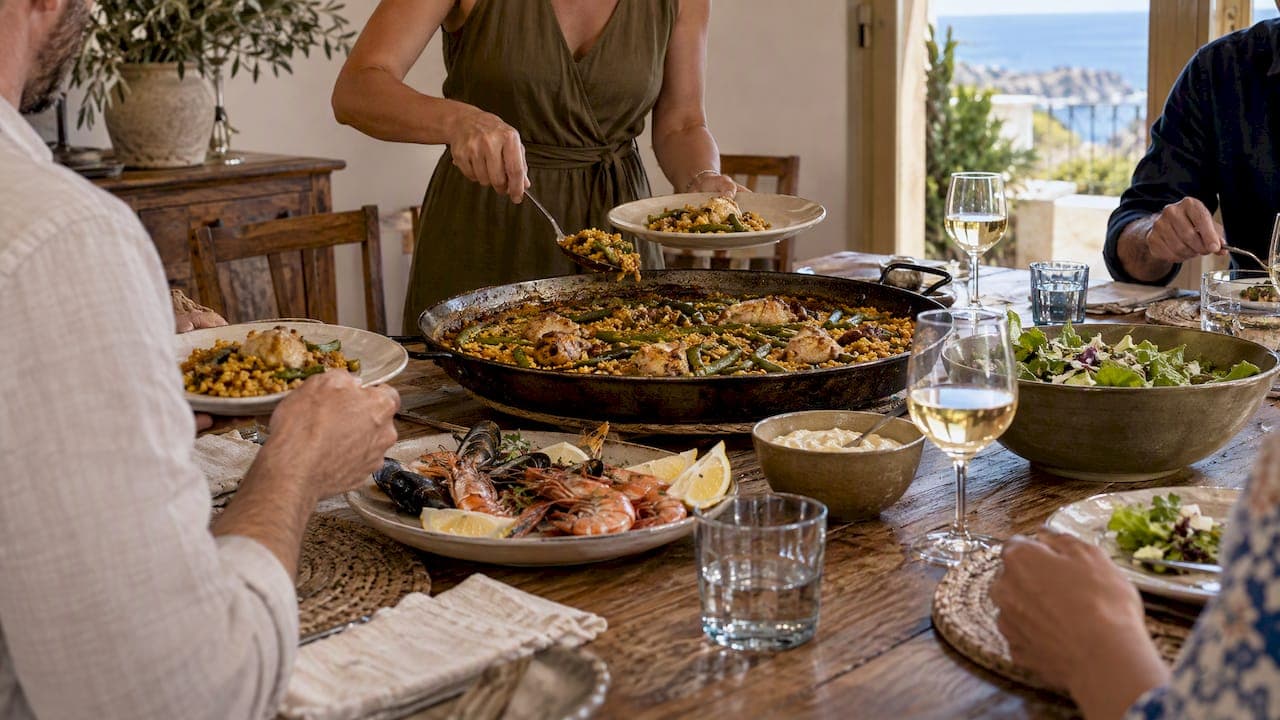
A good menu for picky eaters does not water the food down. It offers familiar flavours, lets each person build their own plate, and keeps one or two dishes on the table that everyone is happy to eat. Below you will find the principles we use, a sample three-course menu with an Andalusian accent, and practical advice for family celebrations and villa dinners in Granada, the Costa Tropical, Málaga and Marbella.
TL;DR
- Serve family-style or deconstructed dishes, so each guest chooses what goes on the plate and nobody is pressured.
- Anchor every course with something familiar, then add one gentle, new element beside it, not inside it.
- Vary textures and keep sauces on the side. Texture, more than flavour, is often what a fussy eater rejects.
- Treat allergies as a separate, non-negotiable matter from preferences, and tell your chef about both early.
- A private chef can cook one menu that flexes around the table, so you are not making separate meals.
Table of Contents
- Why picky eaters need a different kind of menu
- Five principles for planning the menu
- A sample menu for a mixed table
- Familiar dishes, gently elevated
- Serving the meal: family-style rather than plated
- Allergies and intolerances are not preferences
- Planning for a celebration in Andalucía
- Perspective: why we cook for the whole table
- Let us cook it for you
- What to tell your chef before the event
- FAQ
- Sources
Why picky eaters need a different kind of menu
Most pages that rank for this topic are lists of weeknight recipes: pasta bakes, chicken strips, pizza casseroles. They are useful on a Tuesday. They are not much help when you are hosting eight people in a rented villa near Nerja, two of whom are children who eat only pasta and one of whom is an adult who dislikes anything slippery.
A menu for a celebration has to do more. It must feel like an occasion, it must work for several ages at once, and it should not turn into a negotiation at the table. That calls for design rather than a recipe: the structure of the meal matters as much as the dishes in it.
Picky eating is also not limited to children. Many adults have a short list of textures or ingredients they avoid. The same principles apply, with a little more sophistication in the presentation.

Five principles for planning the menu
1. Start from what is already accepted
Ask the parents, or the guest, for the five or six dishes that are reliably eaten. Pasta, plain rice, bread, grilled chicken, potatoes and cheese come up again and again. These become the base of the menu, and a good chef can lift them with better ingredients without changing what they are: fresh pasta, a properly roasted chicken, potatoes cooked in good olive oil.
2. Separate the components
Plates where everything is mixed together are the hardest for a cautious eater. Dishes where protein, vegetables and starch are served apart, with sauces in small jugs, remove most of the risk. Expert-recommended ideas for children include pasta with protein and vegetables served separately, taco bars with separate toppings and quesadillas, all of which hand the choices to the eater.
3. Keep the pressure low
Guidance from Spanish paediatricians is consistent here. The Asociación Española de Pediatría suggests offering new foods repeatedly without pressure, staying neutral when a meal goes badly, avoiding food as reward or punishment and letting children decide how much to eat. The same source says an initial refusal should not be treated as permanent, and that acceptance may take 10 to 15 exposures. A celebration is a single meal, so its job is not to convert anyone. Its job is to put an unfamiliar food on the table calmly, next to something safe.
4. Think in textures
The CDC notes that offering foods in a range of textures, from smooth to chopped or ground, helps children become comfortable with different eating sensations. For a menu, that means including something crisp, something soft and something creamy in each course, so a guest who dislikes one has an obvious alternative.
5. Hide nothing that matters
Blending vegetables into sauces is a common home strategy, and it has a place: grated courgette and carrot can be added to muffins, meatloaf, lasagne and soups to raise their nutritional value. At a celebration with guests who may have allergies, however, every ingredient must be declared. Add vegetables for flavour and body, tell people what is in the dish, and never rely on concealment.
A sample menu for a mixed table
This is the kind of menu we would build for a family birthday or a villa weekend with children and adults of varying tastes. It is an illustration of the approach, not a fixed offer: the real menu is always agreed with you beforehand.
To begin: a sharing board
A wooden board in the middle of the table, with small separate portions:
- Warm bread with olive oil and tomato, served plain or dressed.
- Slices of jamón ibérico and mild cheese, for those who like them.
- Crisp vegetable batons with a yoghurt dip.
- Tortilla española, cut into small squares. It is soft, mild and familiar to most children in Spain.
- Fried croquetas with a creamy béchamel centre, which many cautious eaters accept happily.
Nobody is asked to eat anything. The board simply gives everyone something to reach for, which settles a table quickly.
The main: paella, with the rice kept simple
Paella is an excellent centrepiece for mixed company because it is communal and can be made in sections. A pan of golden rice with chicken and green beans suits most guests. Seafood or rabbit can sit in one half, or be served on the side for those who want it. Lemon wedges, a small bowl of aioli and a green salad go in the centre rather than on each plate.
If you prefer a French route, a roast chicken with buttery potatoes and a jug of jus gives the same freedom: carve it at the table, and let each person decide how much sauce and which vegetables to add.
To finish: build-your-own dessert
A dessert station works as well as a taco bar does at dinner. Offer little pots of vanilla cream, chocolate sauce, fresh Andalusian fruit such as figs, oranges or strawberries depending on the season, and crisp biscuits. Guests assemble their own. It looks generous, it is easy to adapt, and it suits both the child who wants only chocolate and the adult who wants only fruit.

Familiar dishes, gently elevated
The table below shows how a safe favourite can become something worth serving at a celebration, without becoming unrecognisable.
| Familiar favourite | Refined version for a celebration | Why it works |
|---|---|---|
| Plain pasta | Fresh pasta with butter and parmesan, sauces and grilled vegetables on the side | Same base, with the choices left to the eater |
| Chicken nuggets | Golden, lightly crumbed chicken strips with a lemon and herb dip | Keeps the crunch, improves the ingredients |
| Pizza | Thin flatbread with tomato and mozzarella, toppings in bowls | Guests add their own toppings |
| Mashed potato | Silky pommes purée with a jug of gravy or olive oil | Soft, mild and comforting for all ages |
| Burgers | Small burgers with toppings served separately | A deconstructed meal lets people pick and choose |
| Fruit | Fresh fruit platter with a warm chocolate dip | Texture and sweetness in an easy format |
The idea of serving a meal in separate parts has official backing: a Tasmanian health department guide describes deconstructed meals such as burgers, jacket potatoes, wraps and spaghetti with sauce as a way for each family member to choose their own combination.
Serving the meal: family-style rather than plated
A plated tasting menu looks beautiful, but it removes choice. For a table that includes cautious eaters, family-style service usually works better. Dishes arrive in the centre, and guests serve themselves. The same Tasmanian guidance recommends serving something on the table that everyone will eat alongside separate foods people can choose, so the whole family shares one meal with less pressure. That sentence is a good brief for any host.
A few practical habits help:
- Put small serving spoons in every dish, so children can manage for themselves.
- Keep sauces, dressings and spices on the side, never over the top.
- Offer small portions first. Seconds are always possible, but a huge first plate can be intimidating.
- Serve a very simple dish early, while hunger is highest, and bring the more adventurous dishes after that.
- Keep screens away from the table. The AEP's 2024 guidance recommends no screens at all for ages 0 to 6 and notes a link between screen use at meals and less healthy diets.
Allergies and intolerances are not preferences
There is a clear line between a guest who does not like mushrooms and a guest who cannot eat egg. The first is a matter of taste. The second is a medical requirement, and a menu must treat it as one.
The AEP explains that the basic treatment for a food allergy is to remove the food the child cannot tolerate, its derivatives, and any product that may contain even small amounts. In young children, cow's milk and egg are the most frequent causes, while fish, pulses, fruit, nuts and shellfish can also be responsible. Several of these appear in classic celebration dishes: béchamel in croquetas, egg in tortilla, nuts in desserts, shellfish in paella.
So when you plan, do two things separately:
- List the allergies and intolerances, with names and severity, and give them to your chef well before the event.
- List the preferences and dislikes, and treat them as design input.
If allergies are involved, ask the chef how the kitchen avoids cross-contact. We cover this in more detail in our guide to a chef's allergy protocol for private events, and in how to communicate dietary preferences to your chef. Our page on accommodating dietary needs explains what we ask for when you book. If someone at your table avoids gluten or lactose, you will also find ideas in our gluten-free menu examples and lactose-free event menus.
Planning for a celebration in Andalucía
Celebrations here are long, social and generous, which suits a picky eater well. Spanish eating culture already leans towards sharing: tapas, raciones and a central paella are all formats where nobody is committed to a whole plate of one thing.
Birthdays and family gatherings
With children present, begin with the board, move to a communal main and finish with a dessert station. Keep the timing early enough that hungry children are not waiting, and bring a simple dish out first.
Anniversaries and romantic dinners
For two, one fussy palate is easy to accommodate. Agree in advance the two or three things your partner does not enjoy, and the chef builds the courses around them. A tasting format still works: portions are small, so a disliked element costs little. See how we approach this in our sensory anniversary menus.
Weddings and larger events
At larger events, a fixed plated menu often leaves a few guests with nothing they want. Offering two mains, a sharing starter and a simple, clearly labelled alternative keeps everyone comfortable. For smaller weddings, our personalised menu for intimate weddings shows how a menu can be built around the guest list.
Villa weekends
If you are staying in a villa in Marbella, Nerja, Almuñécar or near Granada, the kitchen and the market are close by. Buying produce locally and cooking it simply is often the best answer to a cautious eater: ripe tomatoes, good olive oil and fresh bread need very little help.
Perspective: why we cook for the whole table
We do not think of picky eating as a problem to be solved. We think of it as information about how a person experiences food. As a deaf chef, I have built my cooking around flavour, texture, aroma and presentation, and those are exactly the things a cautious eater is responding to. A guest who refuses a dish is rarely rejecting the idea of dinner. More often it is one texture, one smell or one unexpected change on the plate.
That is why we begin every private menu with a conversation. We ask what is loved, what is avoided and what is simply unfamiliar. We separate allergies from preferences, and we design courses where a guest can choose without being noticed choosing. After more than 13 years in professional kitchens, trained in French gastronomy and cooking Spanish, Mediterranean and international cuisine, my view is simple: a menu succeeds when the most hesitant person at the table relaxes first.
— Joseph Warner
Let us cook it for you
Planning a menu around several tastes is much easier when someone else does the cooking. We design bespoke menus for private villa dining, birthdays, family gatherings and celebrations in Granada and across Andalucía, and we adapt them to your table, including allergies and dietary requirements.
Our menus include Tapas Of Andalusia from €65 per person, the Andalusian Paella Experience from €75 per person and The Sensory Journey from €85 per person. The Celebration Experience starts from €110 per person, and the Villa Chef Experience from €350 per service. A single-evening Private Dining Experience is €250. Tell us who is coming and what they will and will not eat, and we will shape the menu around it.
When you are ready, book your private chef through The Sensory Chef.
What to tell your chef before the event
A short, honest brief saves time and avoids awkward moments. Include:
- Number and ages of guests, so portions and formats suit the table.
- Safe foods: the dishes that are reliably eaten, even if they seem plain.
- Dislikes, with detail where possible (is it the taste, the texture, or the look?).
- Allergies and intolerances, listed separately, with severity.
- Occasion and mood: a lively birthday and a quiet anniversary call for different service.
- Kitchen and equipment at your villa, which affects what can be cooked there.
If children are keen to get involved, cooking together can make unfamiliar ingredients less strange. Our advice for parents on minimum ages and suitable kitchen tasks is a good starting point, and a Mediterranean cooking class can turn a quiet afternoon into part of the holiday.
FAQ
What is a good menu for picky eaters at a party?
Choose a sharing starter, a communal main and a build-your-own dessert. Keep sauces and toppings on the side, and make sure at least one dish on each course is mild and familiar. Guests then choose for themselves, and nobody needs a separate meal.
How do I get a fussy child to try new foods at a celebration?
Do not push. Spanish paediatric guidance suggests offering new foods repeatedly without pressure, staying neutral if they are refused and not using food as a reward. Put the new dish on the table beside a familiar one, and let the child decide how much to eat.
Can a private chef cook for picky eaters and guests with allergies at the same event?
Yes, provided the chef knows in advance. Give a separate list of allergies and of dislikes, and the menu can be designed so that safe dishes are clearly distinct. We work from your brief and confirm the final menu with you before the event.
Should I hide vegetables in the food?
Blending vegetables into sauces or baking them into muffins is a reasonable way to add nutrition at home. At a gathering with guests who may have allergies, always declare the ingredients. Serving vegetables separately, in a form people like, is usually more successful over time.
Does a picky-eater menu have to be bland?
No. Familiar dishes can be made with excellent ingredients: ripe tomatoes, good olive oil, fresh pasta and well-roasted chicken. Flavour stays, but it is introduced gently, and bolder elements are offered on the side.
Sources
- Expert-Recommended Meals for Picky Kids
- How to Please Fussy Eaters, HealthyChildren.org
- Eat better by deconstructing your family meals, Tasmanian Government
- Alergia a alimentos, AEPED
- Alimentación complementaria y alimentación activa, AEPED
- Tips to Help Your Picky Eater, CDC
- Recomendaciones sobre el uso de pantallas, AEP