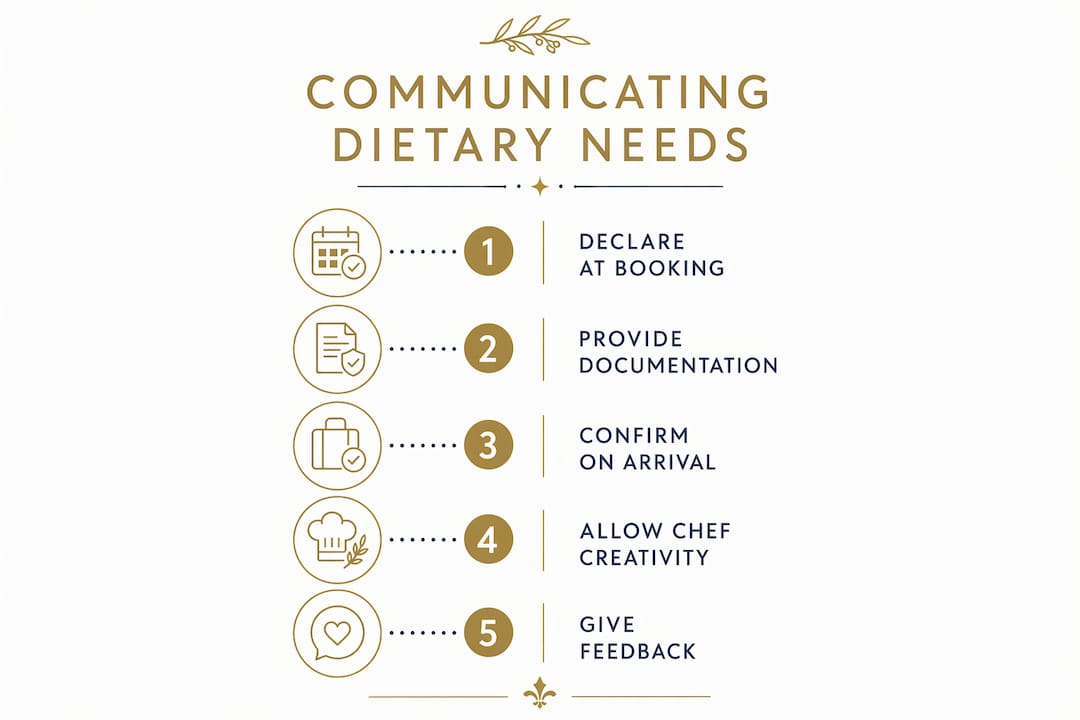
Tell your chef the exact ingredient, the reaction it causes, and whether cross-contact is a risk — do this at the time of booking, not on arrival. That single rule prevents the majority of kitchen errors in private dining. Here is what to send right now:
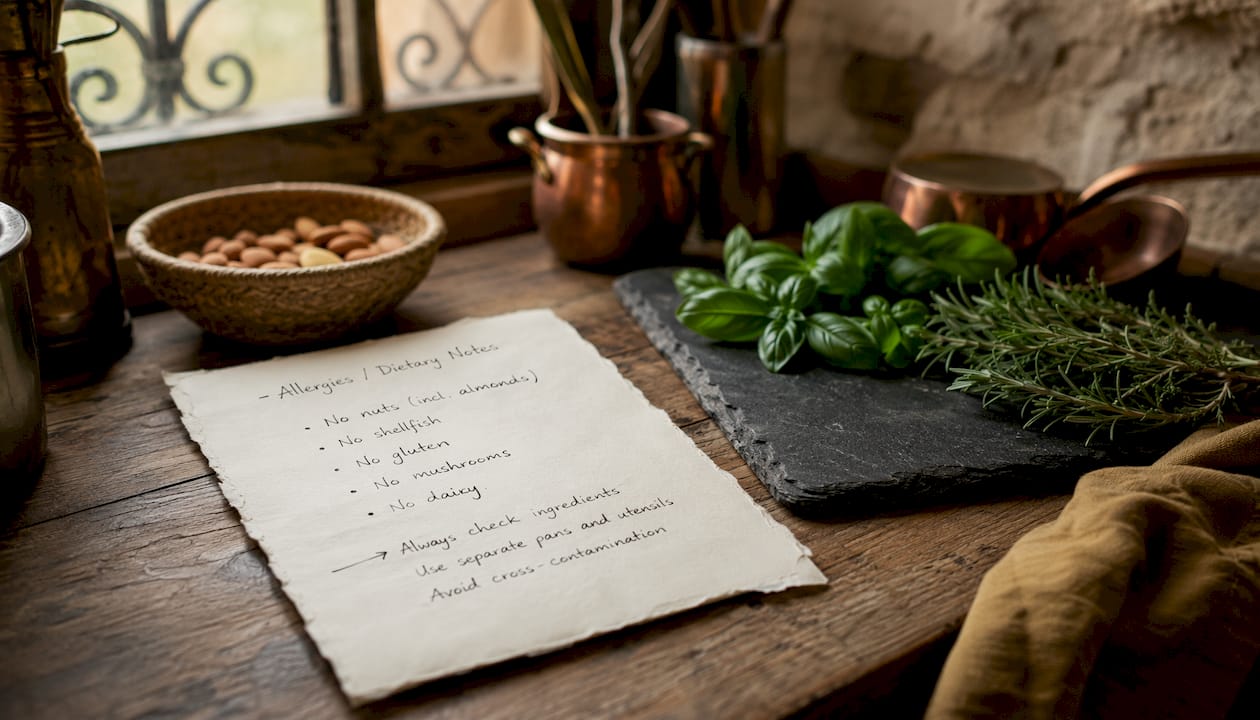
- Name every forbidden ingredient and its common derivatives (e.g., milk, butter, ghee, casein)
- State whether the condition is a diagnosed allergy, intolerance, or personal preference
- Describe the severity: digestive discomfort, anaphylaxis, or coeliac reaction
- Ask explicitly whether the chef can segregate prep areas and utensils
- Reconfirm all of the above briefly on the day of the meal
Ready-to-send message: "I have a clinically confirmed peanut allergy; cross-contact is life-threatening. Please avoid all nut derivatives, including oils and sauces. I carry an EpiPen. Could you confirm your cross-contact procedures before we finalise the menu?"
Joseph Warner of Thesensorychef has built his private dining practice around exactly this kind of clear, early communication. For bespoke bookings in Granada and Andalucía, contact him directly to begin the conversation.
Pro Tip: Write your restrictions in the booking notes field the moment you reserve — do not rely on telling the server on the night.
Table of Contents
- Why allergy, intolerance, and preference are not the same thing
- When should you tell a chef about your dietary needs?
- What to include in your dietary briefing
- How do you ask a chef about cross-contamination?
- How to state preferences without limiting the chef's creativity
- Reconfirming on the day: scripts and labelling
- Managing group events: the per-person restriction matrix
- Green flags and red flags when hiring a private chef
- Pro tips from Joseph Warner and ready-to-use templates
- Key takeaways
- A chef's perspective on dietary needs in private dining
- Thesensorychef: bespoke private dining built around your needs
- Useful sources
- FAQ
Why allergy, intolerance, and preference are not the same thing
Kitchens treat allergies and medical conditions as safety-critical and preferences as compositional constraints. The distinction is not semantic; it determines which protocols a chef applies, which equipment is used, and how much lead time is needed.
- True allergy: an immune response that can cause anaphylaxis. Even trace contact with the allergen can be life-threatening. Requires dedicated utensils, sequenced cooking, and awareness of emergency medication.
- Intolerance: a digestive or metabolic reaction (lactose intolerance, for example) that is uncomfortable but rarely dangerous. Substitutions and careful label-reading are usually sufficient.
- Coeliac disease: an autoimmune condition triggered by gluten. Treated as medically serious; shared toasters, colanders, and floured surfaces are genuine hazards even when the dish itself contains no wheat.
- Preference: an ethical, cultural, or taste-based choice (vegan, pescatarian, low-spice). Guides recipe composition but does not require the same safety controls as a medical condition.
The practical difference is stark. Saying "I'm allergic to nuts" prompts a chef to check ingredients. Saying "I have a diagnosed anaphylactic peanut allergy; cross-contact is life-threatening" changes the entire mise en place: separate boards, fresh gloves, sequenced cooking, and a staff briefing. One sentence, entirely different kitchen response.
Mislabelling a preference as an allergy causes the opposite problem: it triggers unnecessary extreme precautions, reduces kitchen agility, and — over time — erodes the credibility of guests who have genuine medical needs.
When should you tell a chef about your dietary needs?
Always declare restrictions at booking, not on arrival. A private chef sourcing ingredients for a villa dinner in the Alpujarras or along the Costa Tropical cannot pivot to allergen-free alternatives at the last moment.
- At enquiry: include restrictions in your first message or booking form. This allows the chef to assess feasibility before committing to a menu.
- During menu drafting: confirm which dishes are safe, ask about base stocks and cooking fats — invisible ingredients such as anchovy reductions, clarified butter, or shared fryers are common sources of hidden allergens.
- Before ingredient sourcing: complex substitutions (gluten-free pasta, dairy-free cream, specialist allergen-free products) may require ordering from specific suppliers. Allow at least 48–72 hours for private-chef bookings; more for large events.
- Written reconfirmation: send a brief written summary 24 hours before the meal. This gives the chef a reference document during prep.
- On arrival: a short verbal reconfirmation with the chef or host takes 60 seconds and catches any last-minute changes.
On cost: minor substitutions — swapping cream for coconut milk, or using olive oil instead of butter — typically carry no extra charge. Specialist ingredient sourcing, a fully separate prep area, or additional staff time for a complex allergy event may attract a supplementary fee. Ask about this at enquiry, not after the menu is agreed.
Pro Tip: Book quieter services (weekday lunches, off-peak villa dates) when you have complex needs — the kitchen has more time and fewer competing pressures.
What to include in your dietary briefing
Include exact ingredients, derivatives, your diagnosis, severity, symptoms, emergency medication, who is affected, and whether cross-contact is a concern. A written dietary card or brief saves time and reduces mistakes — kitchens value concise, written communication far above a verbal mention at the table.
Briefing checklist:
- Full list of forbidden ingredients and their derivatives (e.g., wheat, barley, rye, malt vinegar for coeliac)
- Type of condition: allergy, intolerance, coeliac, or preference
- Severity and symptoms (anaphylaxis, hives, digestive distress)
- Known triggers beyond the primary ingredient (e.g., sesame in dressings, sulphites in wine)
- Acceptable substitutions you are happy with
- Number of guests affected and whether any restrictions conflict
- Emergency medication (EpiPen, antihistamine) and who carries it
- Contact number for follow-up questions before the event
Sample written brief for a private-chef booking:
Attach any medical documentation if you have it, and note any labelling or medicinal devices (such as an EpiPen) in your message so the chef can brief the full service team.
How do you ask a chef about cross-contamination?
Ask whether the chef can segregate ingredients, use dedicated utensils, change gloves, and clean surfaces between dishes. Cross-contact — when an allergen transfers from one food or surface to another — is the most common cause of reactions in otherwise well-intentioned kitchens.
Practical controls to ask about:
- Separate chopping boards and knives for allergen-free dishes
- Dedicated pans and colanders (critical for coeliac guests)
- Sequencing: allergen-free dishes prepared first, before other ingredients enter the kitchen
- Labelled containers for prepped allergen-free components
- Staff briefing: does every person handling the food know the guest's restriction?
Questions to ask at booking:
- Do you use shared fryers or toasters? (Relevant for gluten-free and nut allergies)
- Are your base stocks made in-house, and what do they contain?
- Can you prepare the allergen-free dish first and cover it before other cooking begins?
- How do you handle cross-contact between courses?
Pro Tip: A private chef offers greater ingredient visibility and direct communication than a restaurant kitchen — but no setting can guarantee zero risk for serious allergies unless it is a dedicated allergen-free facility. Be realistic: ask what controls are possible in the specific kitchen environment, and make your decision based on that honest answer.
How to state preferences without limiting the chef's creativity
Label medical needs clearly, but frame preferences as preferences — what you enjoy, what you would rather avoid, and which alternatives you are happy with. This distinction protects safety while giving the chef room to compose balanced, interesting dishes.
Phrasing that works:
- "I follow a plant-based diet, but fish and shellfish are fine — I'd love something with local seafood if it fits the menu."
- "I'd prefer dishes without coriander, but I'm happy with other fresh herbs."
- "I eat low-spice generally, but a gentle warmth from smoked paprika is lovely."
- "No red meat, but poultry and game are welcome."
Do's and don'ts:
- Do name acceptable substitutes alongside what you avoid — it doubles the chef's creative options
- Do distinguish between "I never eat X" and "I'd rather not have X if possible"
- Don't call a dislike an allergy — mislabelling preferences diverts kitchen resources and reduces menu quality for everyone
- Don't over-restrict by listing every ingredient you have ever disliked; focus on genuine boundaries
Labels such as "vegan" or "vegetarian" are a starting point, not a full specification. A chef will follow up about invisible ingredients — stocks, dressings, hidden dairy in pastry — so be ready for those questions. Answering them openly is what turns a label into a workable menu.
Reconfirming on the day: scripts and labelling
Reconfirm briefly on arrival with a short script, and identify one point person — a host or senior server — for the dining room and chef to liaise with throughout the meal.
Day-of script (guest to host or chef):
"Just a quick reminder: [Name] has a milk allergy — anaphylaxis risk — and carries an EpiPen. Could you confirm the chef has the briefing notes? We are happy to taste a small sample of any dish we are unsure about before it is served."
Labelling practices that help:
- Labelled plates or colour-coded tickets placed at the pass before service
- A printed seating plan with restriction notes for each cover, shared with the chef and server
- Tasting swatches offered by the chef before plating — a practice Thesensorychef uses for tasting experiences to confirm flavour and safety together
Tell the host, the head chef, and the server who brings the first course. Do not assume the information has passed between them automatically — a 30-second check costs nothing and prevents a serious incident.
Managing group events: the per-person restriction matrix
Collect per-person data in a simple matrix before the event so the chef can map distinct menus, plan seating, and allocate prep time. Structured per-guest data reduces error and helps the chef decide how many distinct dishes are realistic.
| Guest name | Restriction type | Severity | Acceptable substitutes | Emergency plan |
|---|---|---|---|---|
| Guest A | Peanut allergy | Anaphylaxis | Any tree-nut-free option | EpiPen carried |
| Guest B | Lactose intolerance | Digestive | Oat milk, coconut cream | None required |
| Guest C | Vegan (preference) | N/A | Fish and shellfish fine | None required |
| Guest D | Coeliac disease | Medical | Certified gluten-free grains | None required |
| Guest E | No restrictions | N/A | N/A | None required |
Share this matrix with the chef at least 48 hours before the event. Copy it into your booking form or send it as a simple spreadsheet attachment.
A private chef can typically manage two distinct menu tracks reliably for small events — for example, an allergen-free track alongside the standard menu. Beyond that, complexity rises quickly. For larger groups with multiple conflicting restrictions, budget for additional prep time, pre-plated solutions, or a second chef.
- Arrange seating so guests with the same restrictions sit together where possible — it simplifies plating and reduces cross-contact risk at the table
- Ask whether the chef needs medical documentation for severe allergies before the event
- Confirm timing windows: allergen-free courses are often plated first and held covered
Green flags and red flags when hiring a private chef
Look for clear experience, written processes, and willingness to discuss controls. Vagueness or refusal to explain procedures is the single most reliable warning sign.
Green flags:
- Documented allergen procedures and willingness to share them in writing
- Allergen training credentials (ServSafe Allergens or equivalent UK food hygiene certification)
- Written briefing forms sent before the event
- Willingness to adapt mise en place, sequence dishes, and use separate equipment
- Clear references from clients with similar dietary needs
Red flags:
- Evasive answers when you ask about cross-contact procedures
- "We can accommodate everything" with no explanation of how
- Insistence that a restriction cannot be managed, with no alternative offered
- No written follow-up after your initial briefing
Verification questions to ask during selection:
- Have you cooked for guests with this specific allergy or condition before?
- How do you check ingredient labels for hidden allergens?
- Can you prepare allergen-free dishes first and keep them covered until service?
- Do you use shared fryers, toasters, or colanders?
- Will you send a written confirmation of the restrictions you have noted?
A chef who answers these questions clearly and without hesitation is one who has thought about the problem before you asked.
Pro tips from Joseph Warner and ready-to-use templates
The single most useful thing a guest can do is tell the chef why a food must be avoided — that one sentence changes everything about how the kitchen plans.
Pro tips from private-dining practice:
- Name the ingredient and the reaction, not just the label: "dairy causes anaphylaxis" is more useful than "dairy-free please"
- Ask about base stocks and cooking fats explicitly — kitchens often use invisible ingredients such as anchovy reductions, clarified butter, or shared fryers that guests would never think to mention
- For recurring bookings, keep a short flavour note after each meal: what worked, what could be adjusted, portion preferences — chefs use this to refine future menus
- If you are planning a nutrition-focused menu (sports recovery, endurance training), share your goals clearly; understanding dietary protein requirements helps the chef balance macros alongside taste
- Offer positive feedback as well as corrections — a chef who knows a dish landed perfectly will repeat the approach
Ready-to-send templates:
Booking enquiry: "We are booking a private dinner for [X] guests on [date]. Two guests have dietary requirements: [Guest A] has a confirmed [allergy/condition] — [severity]. [Guest B] follows a [preference] diet. Please confirm you can accommodate these needs and send a draft menu for review."
Arrival reconfirmation: "Good evening — just confirming the dietary notes sent on [date]. [Guest A] has a [allergy]; please ensure no cross-contact with [ingredient]. Thank you."
Post-meal feedback: "The [dish] was perfect for our guest with [restriction] — the [substitute] worked beautifully. For next time, a slightly smaller portion of [dish] and perhaps a touch more [flavour note] would be lovely."
Pro Tip: Document flavour and portion notes after every private dinner. A feedback loop between guest and chef is what turns a single booking into a trusted, evolving relationship.
Key takeaways
Communicating dietary needs clearly at booking, in writing, with exact ingredients and severity, is the single action that most reliably produces a safe and enjoyable private-dining experience.
| Point | Details |
|---|---|
| Declare at booking | Share all restrictions in your first message — never wait until arrival. |
| Be specific about severity | Name the ingredient, the reaction, and whether cross-contact is a risk. |
| Use a written briefing | A written card or brief reduces mistakes and gives the chef a reference during prep. |
| Group events need a matrix | Collect per-person restriction data in a table and share it at least 48 hours before the event. |
| Thesensorychef | Joseph Warner documents restrictions at booking, confirms on arrival, and builds bespoke menus around your needs across Granada and Andalucía. |
A chef's perspective on dietary needs in private dining
Safety comes first; creativity follows from it. That is the governing principle behind every menu Thesensorychef designs for private dinners across Granada, the Costa Tropical, and the wider Andalucían region.
The most revealing moment in any booking is not the restriction itself — it is the conversation that follows. A guest who writes "I'm vegan" in the notes leaves a kitchen guessing about stocks, dressings, and pastry. A guest who writes "I'm plant-based; fish is fine; I'd love something with local Málaga almonds if possible" opens a creative dialogue. The specificity is not a burden. It is an invitation.
Joseph's sensory approach — developed through years of cooking with heightened attention to texture, aroma, and flavour balance — means that a dietary restriction is rarely a creative obstacle. A guest who cannot eat gluten opens the door to dishes built around local Andalucían legumes, roasted vegetables, and rice-based preparations that carry far more character than a standard wheat-based alternative. A dairy-free requirement leads naturally to the olive oils and citrus reductions that define Mediterranean cooking at its best.
The guests who leave the most satisfied are those who communicated clearly at the start and trusted the process. That trust is earned through transparency on both sides: the guest names the need, the chef names the solution.
Thesensorychef: bespoke private dining built around your needs
When dietary requirements are part of the picture, the difference between a good private-dining experience and a genuinely memorable one comes down to how thoroughly the briefing was done before the first ingredient was sourced.
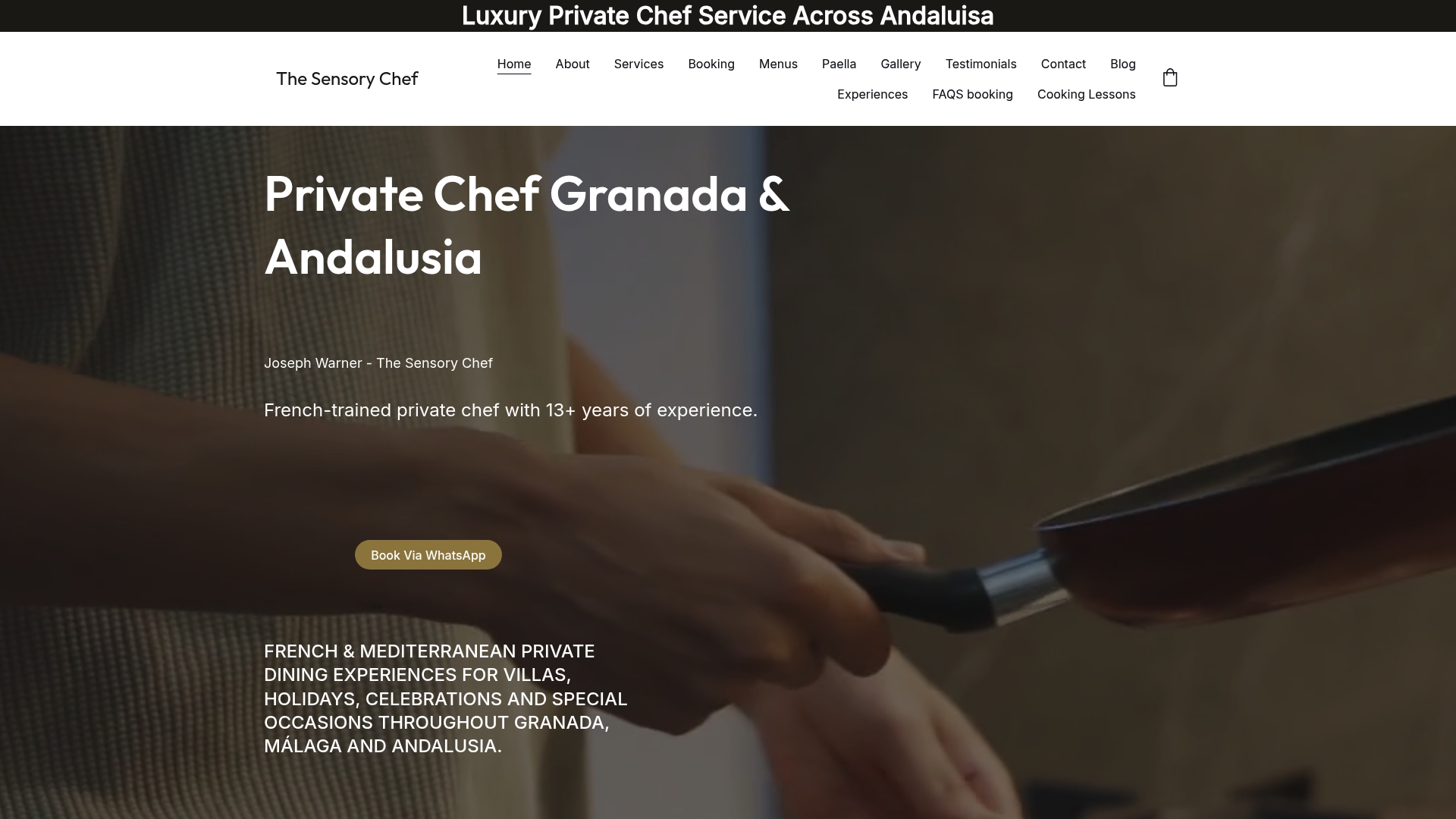
Thesensorychef documents every restriction at the point of booking, confirms the briefing on arrival, and — where appropriate — offers a tasting before the meal is plated. With more than 13 years of professional culinary experience and training in traditional French gastronomy, Joseph Warner brings the same rigour to a dairy-free villa dinner in Almuñécar as to a full tasting menu for a celebration in Granada. Menus are built around your needs, local seasonal ingredients, and the flavour profile you want — not around what is easiest to prepare.
Services cover private villa dining, romantic dinners, family gatherings, anniversaries, and exclusive events across Granada, the Costa Tropical, and Málaga. To discuss your requirements and begin planning a bespoke private-dining experience, get in touch directly. You can also explore the full dietary accommodation process to understand exactly how restrictions are handled from enquiry to table.
Useful sources
- Thesensorychef: accommodate dietary needs in private dining — Thesensorychef's own guide to documenting and managing dietary requirements for private events.
- Thesensorychef: how private chef service works — explains the booking process and logistics for holiday and villa dining.
- Thesensorychef: role of a chef at a private villa — details what to expect from a private chef on the day, including service routines.
- Allergy Amulet: meeting in the middle — practical guidance on what kitchens need from guests with allergies, including the value of written briefings.
- Meal Prep Chef: communicating dietary preferences to a personal chef — covers ingredient visibility and realistic expectations for private-chef contexts.
- Restaurant Manifesto: communicating food allergies — a frank industry perspective on why accurate labelling matters and how to engage service staff effectively.
- Osakaa: speaking directly to the chef — illustrates how direct, precise guest-chef communication produces safer and more personalised dining outcomes.
- Foodie in Paradise: when "I'm a vegan" enters the room — explores how dietary labels function as shorthand and why the follow-up conversation matters.
- PCRM: food preferences and allergens — a clear overview of common allergens and the importance of staff training programmes such as ServSafe.
- Thesensorychef: the role of local ingredients in menus — useful for understanding how local sourcing supports allergen-friendly substitutions.
FAQ
How do you communicate dietary restrictions to a chef?
Share restrictions in writing at the time of booking: name the exact ingredient, the type of condition (allergy, intolerance, or preference), the severity, and whether cross-contact is a concern. A written brief is more reliable than a verbal mention on the day.
What communication does a chef need to accommodate your diet?
A chef needs the forbidden ingredients and their derivatives, the medical or personal reason for the restriction, the severity of any reaction, the number of guests affected, and acceptable substitutes. The more specific the briefing, the more creative and safe the menu can be.
What is the 3-3-3 rule for food?
The 3-3-3 rule is a food-storage guideline, not a dietary communication framework. Definitions vary by source; it is not a recognised standard for briefing chefs on dietary needs.
How do you talk about food preferences without over-restricting the menu?
Label medical needs precisely and frame personal preferences as preferences, naming acceptable alternatives alongside what you avoid. Saying "no red meat, but poultry and game are welcome" gives the chef far more to work with than a flat exclusion.
When is the right time to tell a private chef about dietary needs?
At the initial enquiry, before the menu is finalised. Early communication gives the chef time to source specialist ingredients, plan sequencing, and confirm cross-contact procedures — none of which is possible if restrictions are mentioned on arrival.