
Most cooking schools set the minimum age at 3 to 8 years for accompanied children, with solo attendance typically permitted from around 7 or 8 upward. There is no single legal standard, so age rules vary by provider and by the specific class type. A knife-skills session may require teens of 16, while a sensory tasting workshop happily welcomes a supervised four year old.
TL;DR:
- Children aged 3 to 6 typically participate in sensory tasks without heat or blades, with adult supervision required at all times.
- Solo attendance is usually allowed from age 7 or 8, depending on the provider, with some schools charging for adult supervision or requiring signed consent forms for drop-offs.
- The actual tasks vary widely by age, with preschoolers focusing on tasting and mixing, while teenagers often work independently with more complex techniques like pastry lamination.
- Parent-child classes often allow flexible participation, and private sessions can adapt to the child's skills and comfort level beyond standard age categories.
- Always confirm specific age policies, supervision requirements, allergen policies, and cancellation terms in writing before booking.
Table of Contents
- Edad mínima clases de cocina: the typical age bands explained
- What can children actually do at each age?
- How supervision and solo attendance actually work
- Booking, schedules and what classes typically cost
- Safety, allergies and insurance checks worth making
- The exact questions to ask before you book
- How The Sensory Chef adapts classes across ages
- A note from Joseph Warner
- Book a private, child-friendly class with The Sensory Chef
- Sources
- FAQ
Edad mínima clases de cocina: the typical age bands explained
Cooking schools rarely use one blanket age rule. Instead, they group children into bands that reflect both dexterity and attention span, and each band comes with its own conditions attached.
"Little chefs" classes generally start in early childhood (around preschool age), and these sessions are built around sensory play rather than technique. Expect mixing, decorating, and tasting stations rather than anything near a hob. "Junior chefs" formats usually run from about 7 to 11, the age bracket where most schools first allow supervised knife work and simple stovetop tasks. Teen classes, generally starting in early adolescence, move closer to adult-style instruction, with faster pacing and more complex methods.
- Little chefs (3–6): almost always require a paying adult present.
- Junior chefs (7–11): many providers allow solo attendance from this point, though some hold the line at 8.
- Teens (12+): near-independent participation, sometimes grouped with adult classes for advanced techniques.
- Family classes: no strict age floor, since an adult works alongside the child throughout.
Valencia Club Cocina, for example, lists a minimum age of 4 for accompanied children and allows solo attendance from roughly 7. Other schools, such as KC Culinary, split their programme into "Little Chefs" for ages 5 to 8 (accompaniment required) and "Junior Chefs" for 9 to 14 (no adult needed). The labels look similar across providers, but the fine print rarely matches, which is exactly why checking each listing matters more than trusting the category name alone.
What can children actually do at each age?
Age brackets only tell half the story. What matters more is the task list behind each one, since a "junior" class at one school might involve a gas hob while another keeps children entirely off heat.
- Preschool age (3–6): sensory tasks such as tasting, smelling, mixing, and assembling. No direct contact with heat or blades; an adult usually handles anything hot.
- Primary age (7–11): basic stovetop or oven use under direct supervision, plus training-blade knife practice for simple chopping. Multi-step recipes become manageable here.
- Teens (12+): near-independent oven and knife use, quicker-paced sessions, and techniques such as sauce reduction or pastry lamination. Some knife-skills classes are restricted to 16 and over for safety reasons, as The Learning Kitchen notes on its own booking page.
Look closely at how a class describes its worktop setup. Mentions of "child-height stations" usually signal a younger, lower-risk format, while references to "professional knives" or "live flame" point towards an older, more hands-on group.
Pro Tip: If your child is confident but younger than the stated minimum, ask whether the school offers a private or family-format session. Smaller groups often allow more flexible, closely supervised participation than a standard class timetable permits.
How supervision and solo attendance actually work
Below a school's stated minimum age, usually somewhere between 6 and 8, a paying adult is expected to stay in the room and often at the same worktop. Above that threshold, many providers accept drop-offs once a consent form is signed.
- One adult may supervise several children at once in family-format sessions, but junior-only classes typically run a fixed staff-to-child ratio instead.
- Providers commonly require a signed guardian permission form plus emergency contact details before allowing drop-off, particularly when the accompanying adult is not the parent.
- Some schools charge for the adult's seat in a parent-child pairing, treating it as one paid "team" rather than a free chaperone spot, a pattern Cooks of Crocus Hill sets out clearly in its own class terms.
The practical lesson here: never assume "kids' class" means drop-off is automatic. Confirm it in writing before you book, not on arrival.
Booking, schedules and what classes typically cost
Weekly after-school sessions and full holiday camps run on very different rhythms, and pricing usually follows suit. A weekly slot might last an hour or two after school, while a camp week runs full days across five sessions.
- Weekly term-time classes: shorter, lower per-session cost, often with a one-off registration fee on top.
- Holiday camps: priced by the week, sometimes with a discount for younger children or for booking multiple weeks together.
- Parent-child "team" seats: priced per pair rather than per child, common in family-format bookings.
- Cancellation terms vary, but a frequent pattern allows free cancellation up to 24 to 48 hours before the session, with partial charges applying after that window, as seen on camp pages such as this Tuscan cooking course listing.
Always ask for the exact cancellation policy in writing rather than assuming it matches a competitor's terms.
Safety, allergies and insurance checks worth making
A good provider will answer safety questions readily, without hesitation or vague reassurance. If a school dodges specifics, treat that as a warning sign rather than an oversight.
- Ask whether staff hold current first-aid training and what the incident procedure looks like if a child is burned or cut.
- Request the full ingredient list in advance, along with the school's cross-contamination policy for common allergens such as nuts, gluten, and dairy.
- Confirm the provider holds public liability insurance, and read exactly what the parental consent form covers before signing it.
Pro Tip: A clear written ingredient list is often the single most useful document a provider can hand you before enrolment. It tells you far more about how seriously they take allergies than any verbal reassurance.
The exact questions to ask before you book
Run through this list on the phone or by email before committing to a session:
- What is the exact minimum age for this specific class, not just the general programme?
- Can my child attend alone, or is a paying adult required to stay?
- What is the staff-to-child ratio during the session?
- Can I see a sample menu and how are allergies handled?
- What should my child bring, and are aprons or equipment provided?
- What identification do you require at pick-up, especially if someone other than the parent is collecting?
Request the ingredient list, signed waiver, and cancellation terms in writing before paying a deposit. If your child sits right on the age boundary, ask directly whether the school offers any flexibility, such as a shortened format or a parent sitting nearby without formally joining the class.
How The Sensory Chef adapts classes across ages
Private sessions solve the age-band problem differently: instead of fitting your child into a fixed category, the format adapts to them. A preschooler might spend the hour on tasting stations and simple assembly work, discovering herbs and textures with guided sensory prompts, similar in spirit to approaches used in sensory-led culinary experiences. Primary-age children often enjoy a parent-child pasta or pizza workshop, rolling dough and shaping their own portions.
- Teens get graduated blade training and faster-paced technique work, closer to a genuine kitchen apprenticeship.
- Dietary requirements and allergies are mapped out before the session, with menus adjusted rather than simply substituted.
- Younger siblings can join the same booking with age-appropriate tasks running alongside older children.
Joseph Warner brings more than 13 years of professional culinary experience, trained in French gastronomy, to every private cooking class in Granada.
A note from Joseph Warner
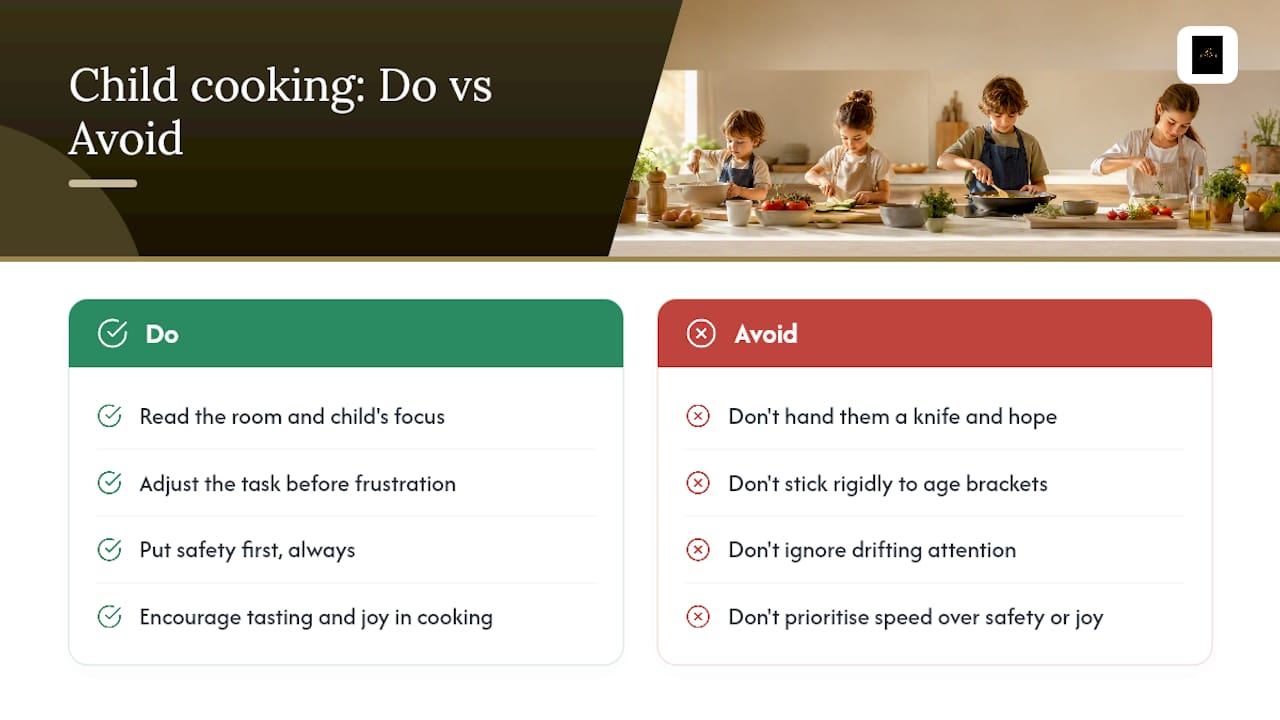
Teaching a child to cook isn't about handing them a knife and hoping for the best. It's about reading the room, noticing when a seven year old's focus has drifted, and adjusting the task before frustration sets in. Safety comes first, always, but the joy matters just as much: watching a child taste something they made themselves, often for the first time, is the whole point.
Private sessions let me tailor pacing and tools to the child in front of me rather than a fixed age bracket. If you're planning a family stay across Andalusia and wondering whether a cooking experience would suit your children, I'd encourage you to get in touch and ask.
— Joseph Warner
Book a private, child-friendly class with The Sensory Chef
Rather than fitting your family into a fixed class category and hoping the age band suits everyone, The Sensory Chef builds the session around your children directly. That means no worrying whether your five year old meets someone else's minimum age policy, because the format flexes to match their skills and attention span from the outset.

Sessions can run as villa-based family workshops, parent-child pairs working side by side, or small-group experiences for slightly older children ready for more independence at the worktop. Menus adjust fully around allergies and dietary needs, with details confirmed in writing before the day. Standard booking terms and cancellation windows are set out clearly on the booking page, so there are no surprises closer to the date. If you'd like to check dates or ask about adapting a session for younger children, visit the Personalised Menu experience page or check the private chef FAQs for details on scheduling and dietary accommodation.
Sources
- Cursos de cocina para niños | Valencia Club Cocina
- FAQs | KC Culinary | Questions & Answers
- FAQ | The Learning Kitchen
- FAQ — Cooks of Crocus Hill
FAQ
At what age is it recommended a child starts learning to cook?
Most schools accept accompanied children from around age 3 to 4 for sensory-based tasks, though hands-on cooking with heat or blades typically waits until 7 or 8.
What cooking courses are available for a 14 year old?
Fourteen year olds usually qualify for teen or junior-plus programmes involving near-independent knife and oven use, and many providers also admit them to adult-style classes since categories like KC Culinary's Junior Chefs band run up to age 14.
What do you need to teach cooking classes?
Providers generally expect instructors to hold food hygiene certification, current first-aid training, and public liability insurance before running sessions involving children, alongside a clear incident and allergy procedure.
How much does a cooking course cost?
Pricing varies widely by format: weekly after-school sessions tend to cost less per visit than full holiday camps, which are usually priced by the week and may include a registration fee.
Can my child attend a cooking class alone, without a parent?
Many providers allow solo attendance from around age 7 to 8, provided a signed guardian consent form and emergency contact details are on file beforehand.