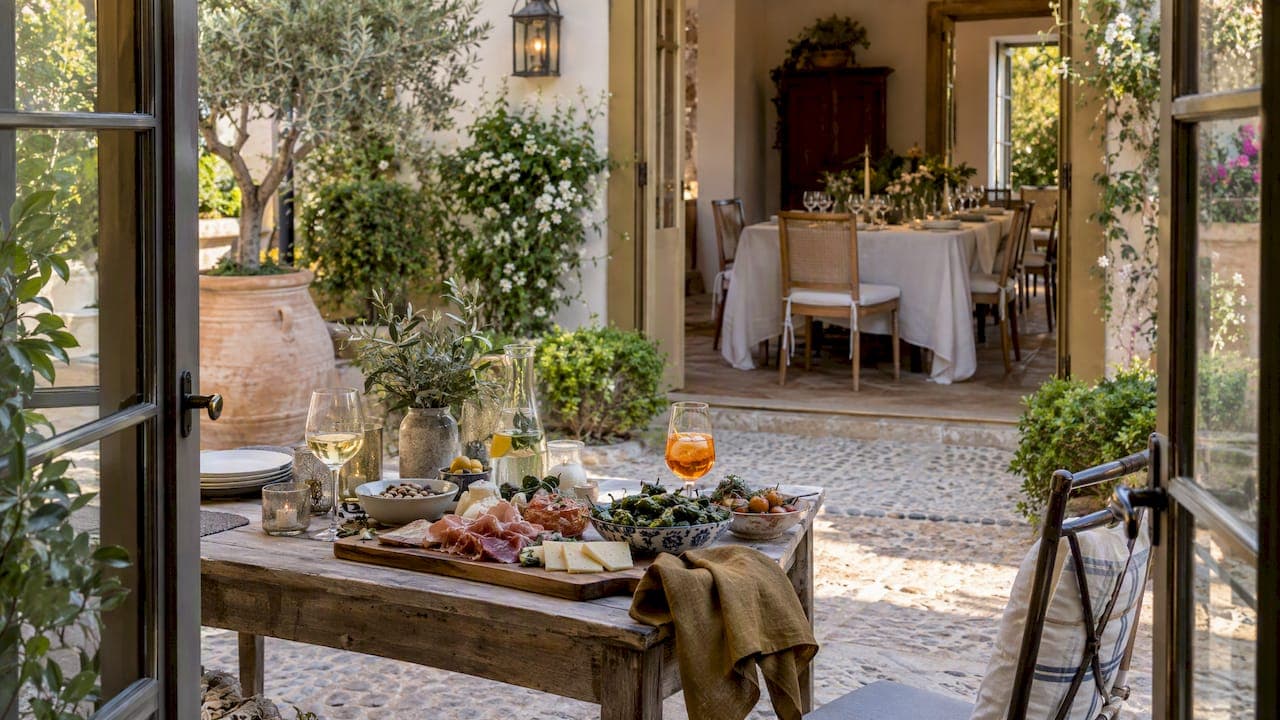
A rehearsal dinner is a smaller, more formal evening for the people involved in your ceremony. A welcome party is a looser gathering that greets everyone who has travelled for the wedding. If you are marrying in Spain, you can host either, both, or a single blended evening, and none of them is compulsory. The right choice depends on your guest list, your budget and how much time you want with the people who matter most.
This guide explains the real differences, how the two events fit together over a wedding weekend, and how a villa dinner with a private chef can suit either one in Granada, the Costa Tropical, Málaga or Marbella.
TL;DR
- A rehearsal dinner is for the wedding party, close family and ceremony participants. A welcome party is open, informal and aimed at out-of-town guests.
- In Spain the pre-wedding evening is usually relaxed: a cocktail, tapas or a family dinner the night before, often finishing by 1am at the latest.
- You can hold both on separate nights, on one night with separate spaces, or merge them into one dinner if the guest list is small.
- Anyone invited to a pre-wedding event should also be invited to the wedding itself.
- A villa meal cooked at the table by a private chef lets you host either event without a restaurant booking.
Table of Contents
- The difference at a glance
- Who is invited to each
- Timing: when each one happens
- Who hosts and pays
- Do you need either?
- How to choose: four questions
- Combining both in one evening
- Perspective: why the food decides the mood
- Menu ideas that suit each evening
- Booking a private chef for your pre-wedding evening
- Practical tips for a villa pre-wedding dinner
- FAQ
- Sources
The difference at a glance
The clearest split is purpose. According to InviteDrop, a rehearsal dinner centres on logistics and gratitude towards those taking part in the ceremony, while a welcome party is an inclusive, informal event meant to break the ice for everyone, especially guests arriving from elsewhere.
| Rehearsal dinner | Welcome party | |
|---|---|---|
| Purpose | Thank the wedding party and run through the ceremony | Greet guests and start the celebrations |
| Guests | Wedding party, immediate family, officiant | Out-of-town guests, or the full guest list |
| Mood | Seated, often with speeches | Mingling, drinks, small plates |
| Typical timing | The night before, after the rehearsal | One or two nights before |
| Size | Smaller | Larger |
| Usual format | Plated dinner or buffet | Cocktail, tapas, barbecue, buffet |
The rehearsal dinner is an American tradition built around a ceremony practice and toasts. In Spain the equivalent has softened. UAUU describes the Spanish pre-wedding party as a relaxed, free-form evening to spend time with close family and intimate friends, with no official status or strict protocol.
Who is invited to each
Rehearsal dinners typically include the wedding party, immediate family, the officiant and other ceremony participants, while welcome parties may take in out-of-town guests or the entire guest list, as Greenvelope explains.
One rule applies to both. The Emily Post Institute says anyone invited to a pre-wedding party should also be invited to the wedding. If your guest list is tight, that rule does most of the work for you.
Drawing the line kindly
If the evening is for the inner circle only, say so plainly. UAUU advises communicating clearly when a pre-wedding party is limited, to avoid hurt feelings. A short line on the invitation, or a personal message to those not invited, is enough.
When two events run, send two invitations with clear labels. Greenvelope names this best practice, and it spares guests from wondering which dinner they are expected at.
Timing: when each one happens
A welcome party is often held one or two days before the ceremony, according to Vogue. A rehearsal dinner sits closer to the wedding, normally the night before, after the ceremony run-through. Over The Moon places a destination welcome party one or two nights before the wedding and the rehearsal dinner the night before.
In Spain, planners quoted by Bulevar Sur describe the preboda as generally held the night before the wedding, often as an informal cocktail or tapas gathering that finishes by 1am. UAUU suggests ending between 11:30pm and 1:00am so guests can rest.
Spanish dinner hours matter here. Guests who are used to eating at 6:30pm may be hungry long before a 9pm table, so build in a first round of small bites at around 8pm.

A simple weekend plan
For a three-night wedding weekend:
- Two nights before: welcome party with the full guest list, drinks and tapas.
- The night before: rehearsal dinner for the wedding party and close family, seated and unhurried.
- Wedding day: the ceremony and celebration, with a family breakfast or lunch if you wish.
Vogue notes that if everyone attends both events, couples often put the welcome party first and the rehearsal dinner second. If the rehearsal dinner is the smaller one, some reverse the order.
Who hosts and pays
Traditions differ. Over The Moon says the welcome party is hosted by the couple or their parents, while the rehearsal dinner has traditionally fallen to the groom's parents, though it may be co-hosted by both families or hosted by the couple.
Spain is less prescriptive. Planners cited by Bulevar Sur generally describe the couple as paying for the preboda, while another notes that couples sometimes state the menu price on the invitation when guests are expected to pay. Agree this early and put it in writing within the family, then state it clearly on the invitation so nobody is surprised at the table.
Do you need either?
No. A wedding in Spain is legally valid once it is solemnised, and it must be registered in the Civil Registry to be fully recognised, as the Spanish government's General Access Point sets out. The pre-wedding evenings are social choices, not legal steps.
They are worth considering for one practical reason: on the wedding day itself, the schedule is too crowded for long conversations. Bulevar Sur frames the preboda as the moment when the couple can properly speak with visiting guests before the day begins.
How to choose: four questions
How many guests are travelling? If most of your list is flying in, a welcome party gives them a first evening together. If most are local, a rehearsal dinner may be all you need.
How large is the wedding party? A big wedding party and large families push you towards a seated rehearsal dinner, with the welcome party kept lighter.
What is the budget? A welcome party can be modest: canapés, a few shared dishes, drinks. A seated dinner for 25 costs more per head. Decide which evening you want to be generous on.
How much energy do you have? Two evenings before a wedding can be tiring. If you suspect so, merge them.

Combining both in one evening
This is increasingly common, and it can work well. Vogue, citing planner Marcy Blum, says both can happen on the same day provided they do not overlap: use different spaces or a private room for the dinner, and have a family member greet welcome-party guests while the dinner is still going. LetsGetRehearsed describes a smaller formal dinner first, followed by a transition into a larger welcome party.
In a villa this is straightforward. The terrace becomes the welcome space, with drinks and small plates, while a long table indoors or by the pool hosts the closer group. The kitchen sits between the two.
Perspective: why the food decides the mood
We have cooked for many villa gatherings, and the pattern is consistent. The evening before a wedding is rarely about the menu itself. It is about whether the host can sit down. When a couple spends the night checking the oven and refilling plates, the welcome has not really happened.
A private chef changes that. At The Sensory Chef, we cook in the villa kitchen, bring the ingredients, serve and leave the space tidy, so the couple and their parents can be guests at their own dinner. Our approach is built around flavour, texture, aroma and presentation, and as a deaf chef I pay close attention to how a dish looks and feels as it reaches the table.
For a welcome party, we favour food that moves: tapas, canapés, a paella finished in front of guests. For a rehearsal dinner, we favour a seated menu with a pace that leaves room for speeches. Both can come from the same kitchen on the same weekend, and both can be built around allergies and dietary needs. Tell us early, and we plan the menu around them rather than adjusting it at the last minute.
— Joseph Warner
Menu ideas that suit each evening
For the welcome party
Think shareable and unhurried. Hot and cold tapas, jamón, local cheeses, seasonal vegetables and a paella to finish work well in the warmer months. Our guides to tapas for groups at home and cocktail menu planning for Spain explain how much to prepare per guest, which is where most hosts over- or under-order.
For the rehearsal dinner
A seated three or four-course menu, with French technique and Mediterranean produce, gives the night a sense of occasion without stiffness. Choose dishes that can be plated in waves so speeches fall between courses, not over a cooling plate.
For mixed dietary needs
A wedding party often contains vegetarians, coeliacs and guests with allergies. Settle this before the menu is fixed. Our page on accommodating dietary needs explains how we handle it, and our gluten-free menu examples show what is possible.
Booking a private chef for your pre-wedding evening
Our published menus give a sense of cost. Per-person menus on our menus page include Tapas Of Andalusia from €65, the Andalusian Paella Experience from €75 and the Celebration Experience from €110. Our Private Dining Experience is listed at €250, and our services page lists further options. Each menu is adapted to your group, so tell us your numbers, venue and dietary needs and we will advise on what suits a welcome party, a rehearsal dinner or both.

We cook in villas across Granada, the Costa Tropical, Málaga and Marbella. To check availability for your wedding weekend, book your experience with The Sensory Chef as early as you can, since weekends in the main season fill first.
Practical tips for a villa pre-wedding dinner
- Check the kitchen. Tell your chef about oven size, hobs and fridge space before the day.
- Plan the staffing. Service for a seated group needs more hands than a cocktail. Our note on waiter numbers for private dinners in Spain is a useful guide.
- Mind the heat. Outdoor dinners in summer are best started in the evening, with shade and water ready.
- Keep speeches short. Place them between courses so food and conversation both stay warm.
- Leave a buffer. Allow time for guests arriving late from airports in Málaga or Granada.
FAQ
Is a welcome party the same as a rehearsal dinner?
No. A rehearsal dinner is a smaller event for the wedding party, close family and ceremony participants, usually held after the ceremony run-through. A welcome party is more informal and aimed at guests who have travelled, often the whole guest list.
Do wedding guests attend the rehearsal dinner?
Only some. Traditionally it includes the wedding party, immediate family and the officiant. Anyone you do invite should also be invited to the wedding itself.
Can I hold both on the same night?
Yes, if they do not overlap. Use separate spaces, such as a private room or a different terrace, and have a family member greet arriving guests while the dinner continues.
When should the pre-wedding evening end in Spain?
A sensible finish is between 11:30pm and 1:00am, which lets guests rest before the wedding day.
Who pays for each event?
There is no strict rule. Welcome parties are usually hosted by the couple or their parents. Rehearsal dinners traditionally fell to the groom's parents, but couples and both families now often share the cost.
Sources
- Wedding Welcome Party Etiquette and Planning Advice, Vogue
- Rehearsal dinner vs welcome party, InviteDrop
- What is a Pre-Wedding Party and How to Organise One, UAUU
- Rehearsal Dinner Etiquette, Greenvelope
- Etiquette Today: Pre-Wedding Parties Guest Lists, Emily Post Institute
- What Order Should Your Pre- and Post-Wedding Events Go In, Over The Moon
- ¿Qué es una preboda y cómo organizarla?, Bulevar Sur
- Marriage, Punto de Acceso General
- Wedding Rehearsal Dinner or Welcome Party, LetsGetRehearsed