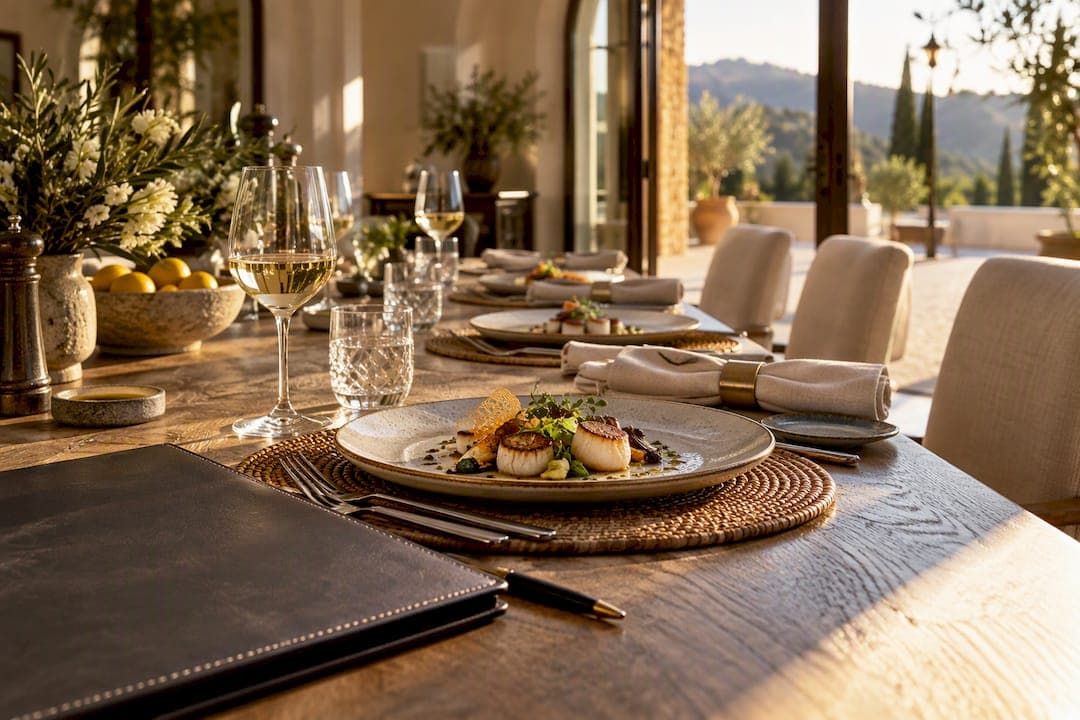
A private chef normally covers menu design, ingredient sourcing, on-site cooking, plating and service, plus a basic tidy of the kitchen once dinner is done. That is the standard shape of the service, whether you are booking a family dinner in Granada or a wedding celebration on the Costa Tropical. What sits outside that core, waiting staff, wine pairing, extended clean-up or hired glassware, tends to be priced separately, and villa house rules can narrow or widen the scope before a single pan touches the hob.
TL;DR:
- Most private chef quotes include menu consultation, ingredient sourcing, on-site cooking, plating, and basic clean-up, with extras like waiting staff or wine pairing charged separately.
- Final pricing should be broken down into ingredients, labor, travel, equipment hire, and applicable taxes, avoiding hidden costs like parking or corkage fees.
- Villa properties may restrict external providers and have specific kitchen, power, and parking requirements that must be confirmed before booking.
- Allergen management requires written confirmation of dietary details and separate preparation areas, following EU regulations to prevent cross-contact.
- Booking should be done well in advance—two to three months for weddings—and all details, including guest count, menu, and cancellation policies, must be confirmed in writing.
Table of Contents
- Standard inclusions most private chefs provide
- Optional extras that change the price
- What cost lines should I check in a quote?
- Venue and logistics checks for villas and private venues
- How is allergen and dietary safety handled?
- When should I book and what should be in writing?
- Checklist of questions to ask before you book
- What we recommend as the minimum standard
- Ready to book your private chef experience?
- Sources
- FAQ
Standard inclusions most private chefs provide
Most quotes for a private chef in Spain build around five fixed stages, and knowing them helps you spot when a proposal is thinner than it looks.
The process usually opens with a menu consultation, either by phone, email or in person, where the chef asks about the occasion, guest numbers, allergies and flavour preferences. Some chefs offer a small tasting beforehand for weddings or milestone celebrations; for a standard villa dinner, this stage is usually a conversation rather than a sit-down sample.
Ingredient sourcing comes next, and this is where terms vary the most between providers. Spanish guides on hiring a private chef note that typical services include menu design, planning, on-site cooking and adaptation for allergies and intolerances, usually finishing with a basic tidy-up. Some chefs shop for you and fold the ingredient cost into the quoted price; others ask you to buy from a shared list, which can lower the fee but adds a supermarket run to your day.
On the day itself, the chef arrives with a prep schedule already worked out: mise en place at home or on-site, cooking timed to your dinner slot, and plating that matches the occasion, from rustic sharing boards for a Tapas Selection to individually plated courses for a formal celebration menu.
Clean-up is the detail most likely to cause confusion. Vendor pages describing typical inclusions state that ingredient supply, tableware and basic kitchen clean-up are frequently included, while beverages and more extensive tidying can be optional extras. "Clean-up" in most contracts means wiping surfaces and washing cooking equipment, not scrubbing every guest's plate or restoring the kitchen to a spotless finish; if that matters to you, ask for it explicitly.
In short, a standard private chef booking includes:
- A menu consultation covering occasion, guest count and dietary needs
- Ingredient sourcing, either chef-bought or via an agreed shopping list
- On-site cooking with a planned prep and service timeline
- Plating and presentation suited to the event
- Basic kitchen clean-up: surfaces and cooking equipment, not a full deep clean
Optional extras that change the price
Beyond the core service, most private chef bookings offer a menu of add-ons, and each one shifts either the headline price or the logistics of the evening.
Waiting staff and a sommelier are the most requested extras for larger groups or formal dinners, since a solo chef cannot cook and serve eight courses simultaneously. Wine pairing, whether the chef sources bottles or simply guides your own selection, usually carries its own fee. Beverage service more broadly, including corkage if you bring your own wine, is one of the costs vendors most often keep separate, alongside any tableware or equipment the venue's kitchen does not already stock.
Common add-ons include:
- Extra waiting staff or a dedicated sommelier for wine pairing
- Beverage supply, service and corkage where you supply your own wine
- Tableware, glassware or specialist equipment hire
- Extended or full clean-up, cake cutting, or late-night clearing after the last guests leave
- Experience extras: live cooking demonstrations, tasting flights or a short paella masterclass
None of these are unusual to ask for. They simply need to be priced and confirmed before the night, not assumed.
What cost lines should I check in a quote?
A quote per person tells you little on its own. What matters is what sits behind that figure, and the strongest signal of a trustworthy proposal is not the lowest number but the clearest one.
Expect a fair quote to break down, or at least be able to explain on request: ingredient cost, labour (the chef's time and any staff), travel to the villa, menaje (tableware and equipment hire), IVA, and any extras you have requested. Guest numbers, menu complexity and service timing (a lunch versus a five-course dinner running past midnight) all move the per-person figure, sometimes considerably. Local pricing guidance for Andalusia shows how these variables shift the final figure from one booking to the next, which is worth reading before comparing two proposals side by side, as covered in this guide to private chef costs in Marbella.
Watch for costs that arrive as surprises rather than line items: parking or toll charges for the chef's vehicle, a mark-up on supermarket shopping done on your behalf, corkage fees you were not told about, and late fees if the evening overruns the agreed finish time.
Before accepting a proposal, ask for:
- A full breakdown of ingredients, labour, travel and menaje
- Confirmation of whether IVA is included in the quoted figure
- The exact guest number the price is based on, and the cost per additional guest
- Clarity on what counts as an "extra" versus what's already included
- A note on cancellation or amendment terms tied to the price
Pro Tip: Ask every chef you're comparing to quote using the same guest number and menu style. A ten euro difference per head means little if one quote includes wine service and the other does not.
Venue and logistics checks for villas and private venues
Villa dining brings a second layer of planning that a restaurant booking never requires, and it is worth working through before you confirm a date.
Start with the property rules. Many villas restrict external suppliers, cap guest numbers for events, or enforce noise curfews that affect how late service can run; vendor FAQs consistently recommend confirming villa rules on external providers, guest limits, kitchen access and parking before booking, since these details decide whether a menu is even feasible.
Kitchen access matters just as much as permission. A chef needs to know oven type, hob configuration, gas or induction, and whether the property has enough worktop space and fridge capacity for a multi-course menu. Power supply is not a trivial detail either, particularly in older or more remote Andalusian properties, where a second portable induction hob as a backup can rescue a menu if a fuse trips mid-service.
Before booking, confirm:
- Whether the villa allows external chefs and caterers, and any guest-number limits
- Kitchen equipment, oven and hob type, and available worktop space
- Power and gas supply, plus a backup plan for remote properties
- Parking and delivery access for the chef's vehicle and ingredients
- Timing windows for setup, service and departure, and any staff facilities on-site
If you are hosting in a rental villa near Nerja or along the Costa Tropical, our guide on private chef benefits for holiday villas walks through these checks in more detail.
How is allergen and dietary safety handled?
Spain follows EU food information rules, and any chef working professionally in a private home is expected to know them, not treat allergen management as an afterthought.
Precautionary allergen labelling should only be used once preventive hygiene controls have been applied and a documented technical assessment shows the risk genuinely cannot be avoided, not as a default disclaimer to cover every possibility.
That principle comes from AESAN's 2026 procedure on allergen cross-contact management, Spain's food safety authority, and it applies just as much to a villa dinner as to a restaurant kitchen. Alongside it, EU Regulation (EU) 1169/2011 requires accurate allergen information for non-prepacked food, and Regulation (EC) 852/2004 sets the hygiene standards professional caterers must follow wherever they cook, including a client's kitchen.
In practice, this means a properly run private chef service will ask for allergen details in writing before the day, keep separate preparation areas or equipment for allergen-sensitive dishes, and document any substitutions made to the agreed menu. A "may contain" caveat is only justified when those steps have already been taken and a genuine risk remains, not used loosely to avoid liability.

Advance written confirmation of allergens, backed by a documented ingredient list, is one of the simplest ways to protect both host and chef, a point reinforced by guidance on communicating dietary preferences clearly before the event. Broader food-quality standards, including how hygiene and sourcing are assessed, are covered well in this overview of food quality standards.
When should I book and what should be in writing?
Timing matters more for celebrations than for a casual dinner. A simple villa dinner for six can often be arranged within a week or two, but a wedding or an intimate multi-course celebration needs longer, both to secure the date and to finalise a bespoke menu.
As a rough guide:
- Book small dinners and family gatherings one to two weeks ahead where possible
- Book celebration menus, anniversaries or larger parties three to six weeks ahead
- Book intimate weddings or full-day villa events two to three months ahead, allowing time for a tasting and menu revisions
Whatever the occasion, get the essentials in writing: the final guest range, the agreed menu, all allergen notes, the cancellation policy, and the deposit amount and due date. Spanish private chef bookings are typically confirmed with a deposit and the balance settled by bank transfer or card on or before the day, though terms vary by provider, so ask directly. Sharing detailed allergy and equipment information during this planning stage, well before the day itself, avoids last-minute substitutions that can undercut a carefully designed menu.
Checklist of questions to ask before you book
A short call or email before committing can save you from a mismatched booking. Ask the chef to confirm:
- Exactly what the quoted price includes: shopping, plating, clearing and washing up
- How many staff will be on-site and who handles serving
- What allergen procedures are in place, and get this confirmed in writing
- Arrival and finish times, any travel costs, and whether the chef carries public liability insurance
If a chef cannot answer these clearly, that hesitation tells you as much as the answer itself would.
What we recommend as the minimum standard
Having cooked across villas from Granada to Málaga and Marbella for more than 13 years, trained in French gastronomy and adapted through Mediterranean, Spanish and international menus, I treat four things as non-negotiable: a proper menu consultation, a written allergen plan, agreed staff levels before the day, and a clearly defined clean-up scope. Anything less leaves gaps that surface at the worst possible moment, mid-service, with guests waiting.
— Joseph Warner
Ready to book your private chef experience?
Prices for private chef services are typically presented clearly from the outset, helping clients understand what a booking includes before committing, rather than receiving a vague per-person estimate that grows once staff, sourcing or clean-up are added later. Whether you want a Paella Feast for a relaxed villa lunch, a full Celebration Menu for an anniversary, or a hands-on Mediterranean Cooking Class for a group of friends, each experience is built around your guest count, your kitchen, and your dietary needs from the first conversation.
Menus draw on more than 13 years of French-trained gastronomy adapted to Spanish and Mediterranean ingredients, with every allergy and intolerance planned for in writing before the day. Browse the full range of private chef services in Granada, or look through sample menus for private dining if you want inspiration before deciding. To move forward, get in touch with your guest number, preferred date, venue and any dietary requirements, and request a quote through the private dining experience booking page.
Sources
For allergen procedures, see AESAN's precautionary labelling guidance. For typical service inclusions, see La Rancina's private chef guide and our booking page.
- Procedimiento para la gestión del contacto cruzado de alérgenos y el empleo del etiquetado precautorio de alérgenos (AESAN, 2026)
- Contratar un chef privado en Mallorca: qué tener en cuenta (La Rancina)
- Chef Privado: Disfruta De Nuestro Catering Con Chef Privado (TheChefClub)
- Chef privado en Guadalajara: preguntas frecuentes antes de contratar uno (Flavor And Technology)
FAQ
What does a private chef include as standard?
A private chef normally includes menu design, ingredient sourcing, on-site cooking, plating and service, and a basic kitchen tidy-up afterwards. Extras like waiting staff, wine pairing or extended clean-up are usually quoted separately, so it pays to ask what's covered before comparing prices.
What is a private chef exactly?
A private chef is a professional cook hired to design and prepare a menu on-site, at a villa, home or private venue, rather than in a restaurant setting. The service typically covers consultation, sourcing, cooking, plating and a basic clean-up, tailored to the client's occasion and dietary needs.
How much does a private chef charge per month?
Ongoing monthly private chef arrangements are uncommon for holiday and event bookings in Spain, where most clients hire per occasion rather than on retainer. For a one-off villa dinner, celebration or wedding, pricing is quoted per event or per person rather than as a monthly rate.
How much does a professional private chef charge?
Professional private chef fees vary with menu style, guest count and whether extras like sommelier service or extended staffing are included, so quotes differ from one booking to the next. Current prices for individual experiences, from tasting menus to celebration dinners, are listed on The Sensory Chef's services page.