Most luxury villa catering failures come from three avoidable sources: vague staffing contracts, menus that ignore the venue's real capabilities, and logistics nobody has formally agreed to own. The fixes are straightforward once you know where to look.
The common catering mistakes at luxury villas — and the one-line fix for each:
- Vague 'fully staffed' language — require named personnel and a minimum staff-to-guest ratio in writing before you sign.
- Venue-unaware menu — ask the chef to confirm every dish can be finished and plated in the villa kitchen, not a professional one.
- No grocery cap or delivery window — agree a written daily per-person grocery limit and confirm who shops, when, and with receipts.
- Allergen details sent too late — submit all dietary requirements at least one week ahead; four to six weeks for remote locations or specialist ingredients.
- Equipment assumed, not confirmed — request a written appliance inventory (oven type, hob count, refrigeration capacity) before menu sign-off.
- No service window in the contract — specify exact chef arrival time, service hours, and clear-up window in the contract.
- No contingency clause — include a named escalation contact and a written remedy for staff no-shows or supplier failures.
- No named coordinator — assign one person (villa manager or lead chef) who owns the schedule and all communication.
Table of Contents
- Why villa catering is different from a restaurant or hotel
- What staffing contracts must actually say
- How to design a menu that works in a villa
- Supplier and delivery mistakes to avoid
- Food safety, allergens and what UK guests should ask for
- Equipment, power and the on-site timeline
- Contingency planning: the scenarios and the fixes
- How to brief a private chef: a short template
- How Thesensorychef prevents these mistakes in Andalusia
- How villa management and catering staff should communicate
- When service style does not match guest expectations
- Security and privacy during villa catering events
- Key takeaways
- What actually goes wrong — and why it keeps happening
- A specialist who handles all of this for you
- Useful sources and further reading
- FAQ
Why villa catering is different from a restaurant or hotel
A villa is not a commercial kitchen with a dining room attached. The operational differences are structural: a residential hob, limited refrigeration, no pass, no porter, and a supply chain that depends on local markets and delivery windows that vary across Andalucía.
In Andalusia specifically, summer heat affects everything from cold-chain integrity to outdoor plating. Terrace wind can destroy a foam garnish in seconds. A supplier based in Granada may not reach a remote cortijo before noon. These are not edge cases; they are the operating conditions.
A menu designed for a professional kitchen with a brigade of six will not translate cleanly to a villa kitchen with one chef and a two-ring induction hob. The menu must be designed for the venue, not reverse-engineered to fit it after arrival.
What staffing contracts must actually say
Most delivery failures begin with the phrase "fully staffed." Audits indicate that 23% of villa contracts marketed as fully staffed suffer from a gap between the promised roster and the team that actually arrives. That figure reflects a contract failure, not merely a marketing one.
For larger groups, a minimum staff-to-guest ratio is widely accepted as important for formal plated service. Below that, pacing slips and drinks go untouched.
| Issue | Why it matters | Contract clause to include |
|---|---|---|
| Chef replaced without notice | Quality drops; compensation rarely covers the gap | Named chef, 72-hour substitution notice, 10% daily rate reduction for any substitution over 24 hours |
| Roster shared across properties | Your villa may be covered by a reserve bench | Named-staff clause with hire dates; right to refuse occupancy below contracted minimum |
| Service hours undefined | Chef leaves before clear-up; guests left with dishes | Exact arrival time, service window, and clear-up end time in writing |
| No escalation contact | Nobody to call when something goes wrong | Named coordinator with a direct mobile number in the contract |
Contract checklist — require all of the following in writing:
- Named staff roster with roles and hire dates
- Minimum staff-to-guest ratio stated explicitly
- Exact service window (arrival, service start, clear-up end)
- Substitution rights limited to medical or emergency, with written notice
- Named escalation contact and response time
- Remedy for shortfall (pro-rata refund or rate reduction)
Sample clause 1 — named roster: "The operator shall provide the staff named in Schedule A for the full contracted stay. Substitutions require 72 hours' written notice where practicable. Any substitution exceeding 24 hours entitles the guest to a 10% daily rate reduction on the staff line item."
Sample clause 2 — service window: "The chef shall arrive no later than [time], commence service at [time], and complete clear-up by [time]. Departure before clear-up completion requires written agreement from the guest."
Pro Tip: Ask the operator to produce the named-staff roster with hire dates within 14 days of booking. An operator whose bench is real will produce it without hesitation.
How to design a menu that works in a villa
A venue-aware menu is the primary determinant of whether a tasting experience survives the evening. Dishes that rely on last-minute assembly, precise temperature control, or a full brigade simply do not translate to a residential setting.
Rules for a villa-ready menu:
- Favour dishes that can be finished in stages rather than assembled at the last second.
- Avoid excessive foam, gel, or glaze elements on outdoor terraces — heat and wind destroy them.
- Build parallel vegetarian and allergen-friendly routes from the start, not as afterthoughts.
- Limit courses that require simultaneous plating for large groups without a pass.
- Choose proteins and sauces that hold texture and temperature during a short transit from kitchen to table.
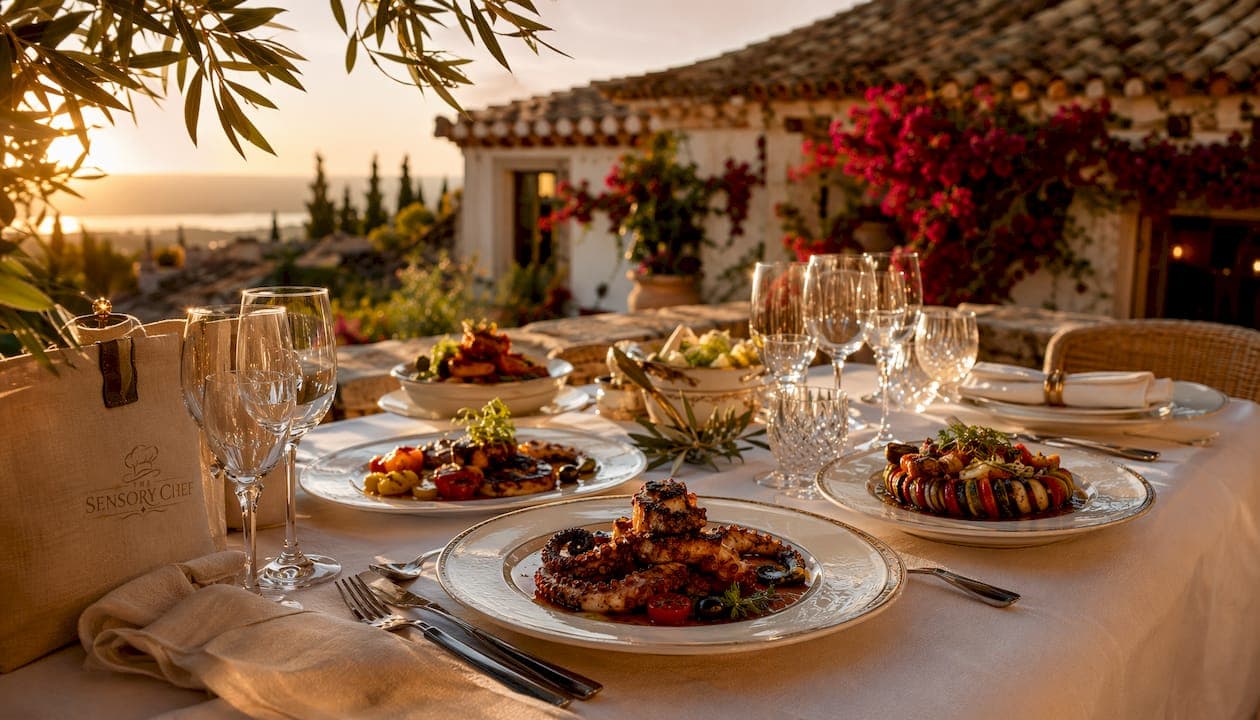
For a terrace sunset dinner, lean on cold starters (gazpacho, cured fish, chilled vegetable plates) that are plated in advance and unaffected by wind. For a family-style lunch, shared platters of roasted vegetables, paella, and grilled meats reduce last-minute pressure and suit the relaxed rhythm of an Andalusian afternoon. For a formal anniversary dinner, a four-course plated menu works well when components are staged in advance and only finished to order.
Pro Tip: Ask your chef to identify which components can be prepared up to two hours in advance and held without quality loss. That list tells you whether the menu is genuinely villa-ready.
Supplier and delivery mistakes to avoid
Provisioning failures almost always come from unclear responsibilities. Nobody confirmed who shops, when deliveries arrive, or what happens when a key ingredient is unavailable in the local market.
Supplier checklist — confirm in writing before arrival:
- Who is responsible for grocery shopping (chef, villa manager, or concierge)?
- Is there a written grocery cap (daily per-person limit)?
- Will receipts be provided for all provisioning?
- What are the delivery windows, and do they suit the menu timing?
- What are the local substitutes for specialist ingredients, and who approves changes?
- For remote areas of Andalucía, what is the contingency sourcing plan?
On storage: confirm fridge and freezer capacity in litres with the villa manager before finalising the menu. A group of ten generating a week of food can see grocery costs exceed US$5,000 before labour is added, so a written cap and a receipts requirement are practical controls, not formalities. Provisioning markups of 10–20% are common; agree on the billing model (chef-in-villa rate, daily fee plus groceries, or per-meal) before arrival to avoid reconciliation disputes. For guidance on booking party rentals and vendor coordination, the same principle applies: written agreements prevent surprises.
Food safety, allergens and what UK guests should ask for
Clear written allergy protocols submitted in advance are non-negotiable. A verbal mention at the table is not a protocol.
Allergen and dietary checklist:
- Declare all severe allergies in writing at least one week before arrival; four to six weeks for remote locations or specialist ingredients.
- Ask the chef to label all mise en place for allergen-containing components.
- Request separate utensils and dedicated prep times for high-risk allergens (nuts, shellfish, gluten).
- Ask for written confirmation of HACCP-aligned hygiene practice or equivalent documentation.
- Confirm the chef's food-hygiene certification level before final payment.
Spanish food-safety law places primary responsibility on the food handler, but as a UK guest you are entitled to ask for written hygiene documentation and a clear allergen-handling protocol. For practical guidance on communicating dietary needs to a private chef, a structured written brief is the most reliable method.
Statistic note: Dietary and allergy details submitted sufficiently in advance allow a chef to source appropriate ingredients and adjust mise en place without compromising the menu for other guests.
Equipment, power and the on-site timeline
Confirm the villa's key appliances before final menu sign-off. A short pre-stay kitchen audit — photos, appliance list, and a brief checklist — prevents the majority of on-site equipment surprises.
Equipment checklist:
- Oven type and number of cavities
- Hob type (gas, induction, ceramic) and number of rings
- Extraction capacity
- Fridge and freezer volume
- Plating bench or cold surface for assembly
- Crockery, glassware, and cutlery inventory (count and condition)
| Stage | Formal dinner (6–8 guests) | Family-style lunch (8 guests) |
|---|---|---|
| Chef arrival | 3 hours before service | 2 hours before service |
| Mise en place | 2 hours | — |
| Service start | On time per contract | — |
| Clear-up end | — after last course | 1 hour after meal |
If an appliance fails, the immediate options are a menu pivot to dishes requiring fewer heat sources, or equipment rental from a local supplier. For Andalusia, event planning resources covering rental logistics can help identify local vendors quickly.
Contingency planning: the scenarios and the fixes
The easiest failures to manage are those already addressed in the contract and the day schedule.
- Staff no-show — the contract should name a backup contact and require the operator to source a qualified substitute within four hours; a pro-rata refund applies if they cannot.
- Late grocery delivery — the chef should carry a short list of non-perishable components that allow the first course to proceed while the delivery is awaited.
- Sudden weather on the terrace — confirm with the villa manager before the event whether an indoor alternative exists; include this in the day schedule.
- Equipment breakdown — agree in advance which courses can be adapted to a single heat source; keep the rental supplier's number to hand.
Sample contingency clause: "In the event that a named staff member is unavailable on the day of service, the operator shall provide a qualified substitute of equivalent seniority within four hours of notification, or apply a pro-rata refund of the staff line item for the affected service period."
Escalation contacts to confirm before arrival:
- Lead chef's direct mobile
- Villa manager's direct mobile
- Backup supplier or grocery delivery contact
- Local equipment rental contact
How to brief a private chef: a short template
A structured brief submitted before booking resolves most misunderstandings before they become problems.
Chef brief template:
- Event date(s) and duration
- Number of guests and age range
- Dietary requirements and severe allergies (named, in writing)
- Preferred cuisine style and any dishes to avoid
- Service style (formal plated, family-style, buffet)
- Venue details: kitchen appliances, outdoor or indoor, access and parking
- Who handles provisioning, and is there a grocery cap?
- Chef arrival time, service window, and clear-up expectations
- Budget range per person (excluding groceries if separate)
Questions to ask when vetting a chef:
- Can you provide a named staff roster and hire dates?
- Do you hold a current food-hygiene certificate? At what level?
- Have you worked in a villa kitchen in Andalusia before?
- What is your contingency plan if a key ingredient is unavailable locally?
- Can you provide references from a comparable villa event?
- What is your insurance cover for catering events?
For family trips, book four to eight weeks ahead; for Christmas or New Year events, six to eight months is the realistic minimum. Request a sample menu or tasting session before final payment where possible.
How Thesensorychef prevents these mistakes in Andalusia
Thesensorychef addresses the three highest-risk failure points directly: named rosters, venue-aware menus, and clear provisioning agreements. Joseph Warner, a French-trained private chef with more than 13 years of experience, works across Granada, Málaga, Marbella, and the Costa Tropical with a service model built around the specific constraints of Andalusian villa dining.
Concrete service features:
- Pre-visit kitchen audit (photo checklist and appliance confirmation before menu sign-off)
- Named staff roster provided in writing with the booking confirmation
- Written service window covering arrival, service, and clear-up
- Grocery cap options and receipts provided for all provisioning
- HACCP-aligned hygiene practice with food-hygiene certification
- Sample menus adapted to Andalusian conditions (heat, terrace wind, local supply)
- Allergen-handling protocols submitted in writing before arrival
Pro Tip: Ask any chef you are considering to send you their kitchen audit checklist before you confirm. If they do not have one, that tells you something important about how they approach villa work.
For a full picture of what professional private villa chef service covers, the scope of responsibilities is broader than most guests expect.
How villa management and catering staff should communicate
A villa where nobody owns the full operation is where disappointment reliably begins. The most successful villa dining arrangements designate a single coordinator — either the villa manager or the lead chef — who owns the schedule, the communication, and the escalation path.
Before arrival, agree a communication protocol in writing: who contacts whom, by which channel, and within what timeframe. On the day, the chef and villa manager should share a single written schedule covering access times, delivery windows, service start, and clear-up. Any change to that schedule should be confirmed in writing, not verbally, to avoid the "I thought you said..." disputes that derail otherwise well-planned evenings.
When service style does not match guest expectations
A mismatch between service style and guest expectation is one of the quieter failures in villa dining — rarely catastrophic, but reliably disappointing. A formal plated service imposed on a relaxed family holiday feels stiff; a casual buffet at an anniversary dinner feels careless.
Agree the service style explicitly in the brief: formal plated, family-style sharing, or a hybrid. Confirm whether the chef will introduce each course, remain visible throughout, or work quietly in the background. For larger groups, clarify whether a dedicated server is included or whether the chef handles both kitchen and front-of-house. These details shape the entire atmosphere of the evening, and they cost nothing to agree in advance.
Security and privacy during villa catering events
Luxury villa guests often have legitimate privacy expectations that a catering team needs to respect. Agree the access areas in the contract: which rooms the chef and any additional staff may enter, where equipment is stored, and whether any areas of the villa are off-limits during service.
For high-profile guests or events with a confidentiality requirement, include a short non-disclosure clause in the catering contract. Confirm that the chef and any additional staff will not photograph the property, guests, or food for social media without explicit written consent. These are standard professional expectations; a chef who resists them is worth noting.
Key takeaways
The single most protective step you can take before booking villa catering is to require a named staff roster, a written service window, and a grocery cap in the contract — everything else follows from those three commitments.
| Point | Details |
|---|---|
| Named roster is non-negotiable | Require named staff with hire dates; 23% of contracts fail to deliver the marketed team. |
| Staff-to-guest ratio | State a minimum 1:6 ratio for formal plated service in the contract. |
| Allergen brief timing | Submit dietary requirements at least one week ahead; four to six weeks for remote areas or specialist ingredients. |
| Grocery cap and receipts | Agree a written daily per-person limit and require receipts to prevent budget drift. |
| Thesensorychef | Provides named rosters, pre-visit kitchen audits, and HACCP-aligned hygiene practice across Andalusia. |
What actually goes wrong — and why it keeps happening
The failures described in this article are not rare. They follow a pattern: a guest assumes the villa operator has handled the details, the operator assumes the chef has, and the chef arrives to find a kitchen that cannot support the menu they planned.
The root cause is almost always an absence of written agreements at each handover point. A named roster clause costs nothing to add. A grocery cap takes one email to agree. A kitchen audit checklist takes twenty minutes to complete. The reason these steps are skipped is not complexity; it is the assumption that a premium price guarantees a professional process. It does not, automatically.
What does change the outcome is specificity: named people, written times, agreed budgets, and a single coordinator who owns the day. That is the framework Thesensorychef uses for every booking in Andalusia, and it is the framework this article has given you to apply to any booking you make.
A specialist who handles all of this for you
Thesensorychef offers a fully managed private dining experience across Granada, Málaga, Marbella, and the Costa Tropical — with a pre-visit kitchen audit, named staff roster, written service window, grocery cap options, and HACCP-aligned hygiene practice included as standard. Joseph Warner brings more than 13 years of professional culinary experience, trained in French gastronomy and deeply familiar with the local markets, seasonal produce, and villa conditions of Andalusia.
To request a sample menu or discuss your event, visit the private dining booking page and send a brief message with your dates, guest numbers, and any dietary requirements. A response with a tailored proposal follows within 48 hours.
Useful sources and further reading
These references back the checklists and figures in this article.
- Villa Staffing Shortage Receipts — Villas for Kings: audit data on the 23% staffing delivery gap and named-staff clause templates.
- Private Chef Dining in Luxury Villas Guide — JoVacations: booking windows, grocery budgeting, and billing model comparisons.
- Fine Dining at Home: A Guide for Villas and Yachts — Le Private Chef: venue-aware menu design principles.
- How to Book a Private Chef for a Villa — YAL'OOU: staff-to-guest ratios and pre-stay kitchen audit guidance.
- Experience a Villa with Private Chef — Explore Effortlessly: coordinator role and communication protocols.
- How Private Villa Dining Is Organised — Thesensorychef: menu design, staffing and logistics for Andalusian villa dining.
- Accommodate Dietary Needs: Private Dining Made Easy — Thesensorychef: allergen handling and dietary communication for private events.
- Event Planning Checklist for Stress-Free Celebrations — Terriffics Entertainment: vendor coordination and contingency planning for catering events.
FAQ
What is the most common catering mistake at luxury villas?
Accepting vague "fully staffed" language without requiring a named roster. Industry audits show 23% of fully-staffed villa contracts fail to deliver the promised team.
How far in advance should I submit dietary requirements?
At least one week before arrival for standard locations; four to six weeks if the villa is remote or specialist ingredients are needed.
What staff-to-guest ratio should a formal villa dinner have?
A minimum of 1 server per 6 guests is the accepted standard for formal plated service to maintain pacing and attentive service throughout the meal.
How does Thesensorychef handle provisioning for villa events?
Thesensorychef agrees a written grocery cap and provides receipts for all provisioning, with menus adapted to local Andalusian markets and seasonal availability.
When should I book a private chef for a villa in Andalusia?
Four to eight weeks ahead for family trips and standard events; six to eight months ahead for Christmas, New Year, or large formal occasions.