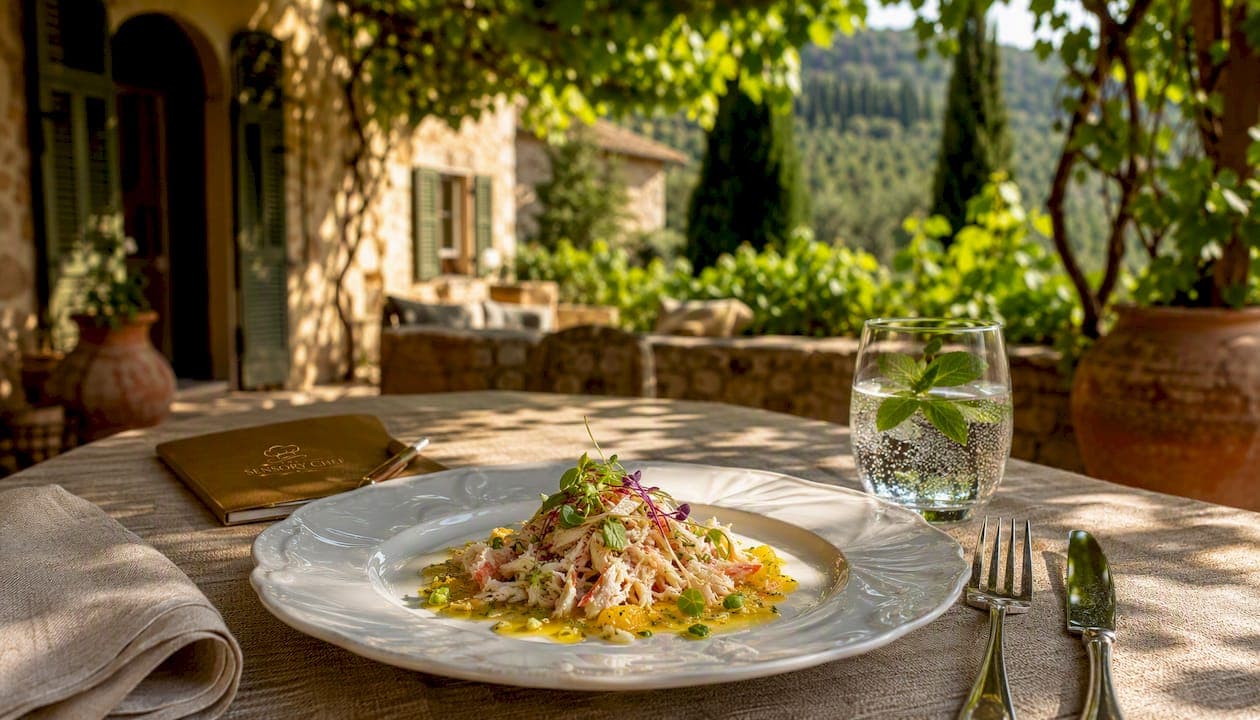
Culinary artistry is the intentional elevation of cooking into a multi-sensory experience, where ingredient selection, professional technique, creative composition and the dining context work together to produce something that transcends a meal. It is what separates a plate of food from a moment a guest remembers. According to EHL Insights, this practice engages all five senses simultaneously, taste, smell, sight, texture and sound, through deliberate creative and technical choices. Institutions such as EHL and École Ducasse frame it as the meeting point of food science and artistic intent. Thesensorychef, founded by French-trained chef Joseph Warner, applies exactly this philosophy to private villa dining across Granada and Andalusia.
TL;DR
- Culinary artistry rests on four pillars: ingredient selection, professional technique, creative plating and the service experience.
- It appears most vividly in fine dining, tasting menus, private villa dinners and culinary workshops.
- The difference between cooking and culinary artistry lies in intent: every choice, from aroma to plate geometry, is deliberate.
- Experiencing it first-hand, through a private tasting menu or a paella service at your villa, is the clearest way to understand what it means in practice.
Table of Contents
- What is culinary artistry, and how does it differ from ordinary cooking?
- The four core elements that turn cooking into artistry
- What tools and techniques do culinary artists actually use?
- How a sensory-first approach shapes culinary artistry
- How do you practise and develop culinary artistry over time?
- What are the professional pathways into culinary arts?
- Is culinary artistry a fine art, a craft, or both?
- Short examples that show culinary artistry in practice
- Why does culinary artistry matter beyond the plate?
- Key takeaways
- A chef's perspective on what culinary artistry really demands
- Experience culinary artistry at your villa or private event
- Useful sources and further reading
- FAQ
What is culinary artistry, and how does it differ from ordinary cooking?
Ordinary cooking satisfies hunger. Culinary artistry, as a discipline, does something more considered: it treats the meal as a composed experience, where every element from the first aroma to the final texture is chosen with purpose. EHL Insights defines culinary arts as the skills and disciplines related to preparing, cooking, presenting and serving food, with the explicit aim of creating meals that are both aesthetically beautiful and delicious.
The distinction comes down to intent and orchestration. A home cook following a recipe produces food. A culinary artist uses that same recipe as a starting point, then asks what the dish should feel like, what memory it should evoke, and whether the colour of the garnish contradicts or completes the aroma rising from the bowl.
Who practises culinary artistry?
- Private chefs — , who bring the same discipline into a villa kitchen, adapting to a guest's tastes, dietary needs and the intimacy of a smaller table.
Where you encounter it
In each setting, the culinary arts tradition extends beyond the plate to what Wikipedia describes as "table arts": the dining environment, service choreography and the way courses are sequenced to build and release tension across a meal.
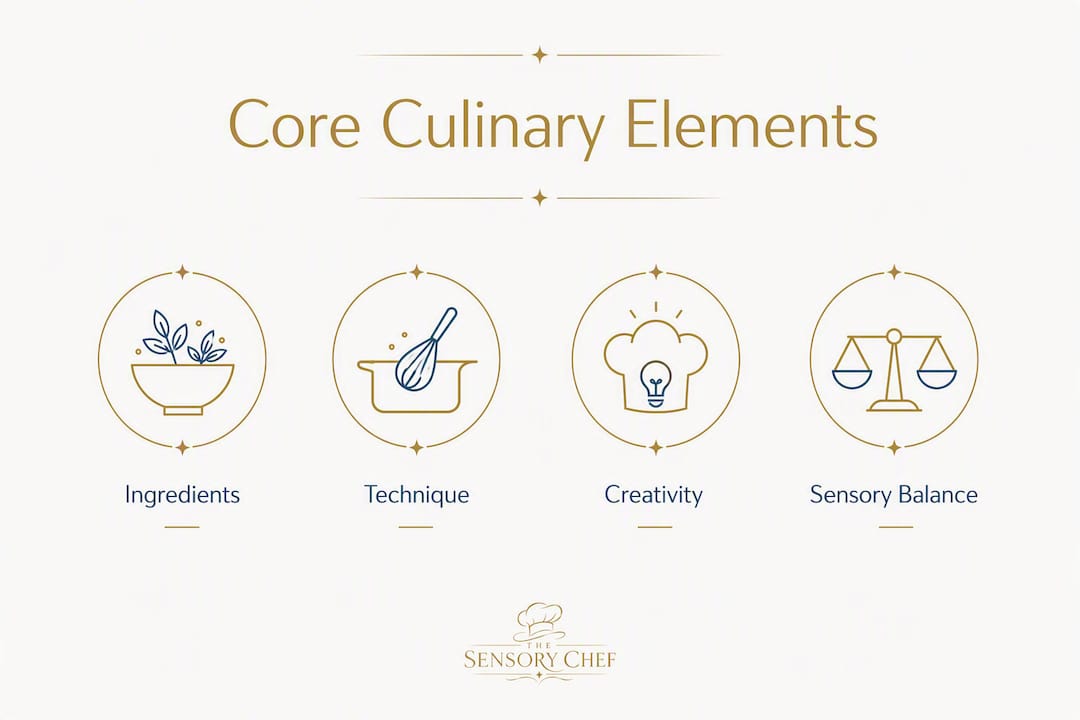
The four core elements that turn cooking into artistry
Understanding culinary artistry means understanding its working parts. These four elements appear in every serious culinary tradition, from classical French gastronomy to contemporary Mediterranean cooking.
-
Creativity and conceptual intent. A culinary artist begins with an idea, not just a recipe. That idea might be a season, a memory, a local ingredient at its peak, or a deliberate contrast between expectation and surprise. Edible Western NY captures this well: a culinary artist distinguishes themselves from a cook by taking creative risks with familiar ingredients to offer something genuinely new, and the diner's reaction is part of the payoff. Creativity without discipline produces novelty; creativity with technique produces artistry.
-
Professional technique. Knife skills, heat control, emulsification, reduction, fermentation, pastry work: these are the grammar of culinary artistry. Technique is what makes an idea reproducible and safe to serve. École Ducasse emphasises that professional training combines food science with creative practice, giving chefs the reliable tools to experiment and produce consistent results. A perfectly executed beurre blanc or a precisely timed sous-vide fillet is not incidental to artistry; it is its foundation.
-
Sensory balance and composition. Taste alone does not define the work. As EHL Insights notes, true mastery means harmonising sensory factors: if aroma or visual appeal is missing, the experience is incomplete. A dish that smells extraordinary but looks careless sends a contradictory message. Colour, height, negative space on the plate, the sound of a crisp element breaking under a fork — all of these are compositional decisions.
-
Service and dining context. The plate arrives in a context: a table setting, a pace of service, a conversation between chef and guest. Practitioners treat menu design and service as part of the art itself, orchestrating the dining environment to harmonise with the food. In private-dining settings, this means the chef's timing, the sequencing of courses and even the temperature of the room become part of the composition.
"Culinary creativity involves appealing to senses and emotions, combining aesthetic experience with performance; some culinary outputs cross from craft into artwork when a high threshold of skill and novelty is met." A recipe for culinary creativity — ScienceDirect
Pro Tip: Restraint is as important as ambition. The most memorable dishes often do one thing exceptionally well rather than five things adequately. Before adding an element to a plate, ask whether it earns its place through flavour, texture or visual purpose — not all three are required, but at least one must be answered clearly.
What tools and techniques do culinary artists actually use?
Technique and equipment are the practical vocabulary of culinary artistry. Knowing which tools matter, and why, helps you appreciate what a skilled chef brings to your table.
Core cooking techniques and their artistic purpose
- Sous-vide: precise temperature control that produces textures impossible to achieve by conventional heat; a chicken breast cooked at 63°C for 90 minutes has a silkiness that pan-roasting cannot replicate.
- Reduction: concentrating a stock or sauce by simmering removes water and intensifies flavour, producing depth in a few spoonfuls that would take a litre of liquid to achieve otherwise.
- Emulsification: combining fat and water into a stable, glossy sauce (a hollandaise, a vinaigrette, a romesco) requires understanding the chemistry of lecithin and temperature simultaneously.
- Maillard reaction: the browning of proteins and sugars under dry heat creates hundreds of flavour compounds; controlling it is the difference between a seared scallop with a golden crust and one that is merely cooked.
- Fermentation and curing: salt, acid and time transform raw ingredients into something with layered complexity; anchovies, aged cheese and sourdough all rely on this principle.
- Plating and garnish work: the final compositional act, where colour, height, sauce placement and garnish create the visual first impression.
Essential tools for private dinners and tasting menus
- Chef's knives (Japanese or French): precision cutting is the foundation of consistent texture and presentation; a sharp knife is a safety tool as much as an artistic one.
- Plating tweezers: allow placement of micro-herbs, edible flowers and small garnishes with accuracy that fingers cannot achieve.
- Thermal probe: removes guesswork from meat, fish and pastry cookery; a resting temperature of 55°C for a medium-rare fillet is a repeatable standard, not an estimate.
- Small blowtorch: caramelises sugar, finishes a crème brûlée, chars a citrus half for aroma; in a villa kitchen it replaces a salamander grill.
- Offset spatula and squeeze bottles: give the chef control over sauce dots, smears and layered plating that define contemporary presentation.
For practical plating guidance, the food presentation tips published by Thesensorychef cover the specific techniques Joseph uses in private-dining settings.
Mise en place as an artistic enabler
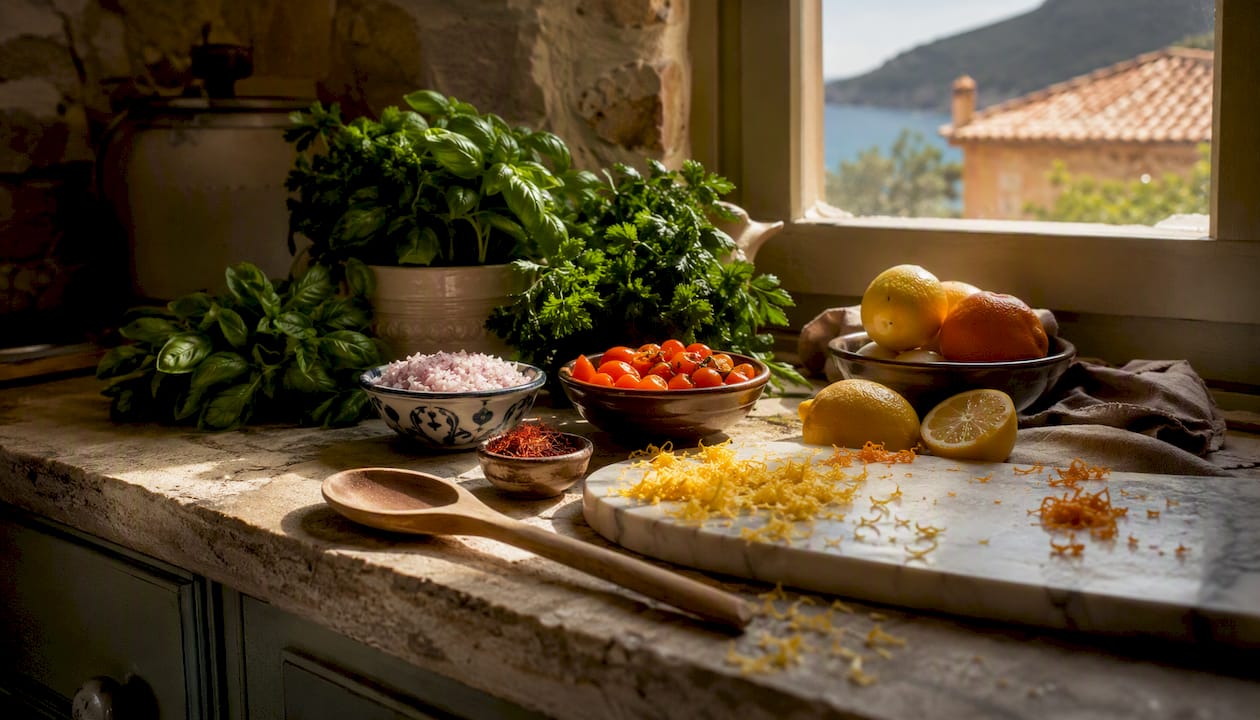
Mise en place, the French practice of preparing and organising every ingredient and tool before service begins, is not merely a professional habit. It is what allows a chef to think creatively during service rather than reactively. In a villa kitchen, where the workspace may be unfamiliar and the guest timeline fixed, thorough mise en place is the difference between a composed, unhurried service and a chaotic one. Timing and service choreography, plating at the pass, synchronised courses, temperature control, are as important to artistry as the recipe itself.
A brief note on safety in private settings: a blowtorch requires ventilation; sous-vide equipment draws significant power; and a villa kitchen's hob configuration may differ from a professional range. A skilled private chef assesses the space in advance and adapts the menu accordingly, never compromising safety for a technique that the environment cannot safely support.
How a sensory-first approach shapes culinary artistry
Joseph Warner, founder of Thesensorychef and a French-trained chef with more than 13 years of professional experience, developed his approach to culinary artistry through a particularly acute lens: as a deaf chef, he relies on taste, aroma, texture, temperature and visual contrast rather than the ambient sounds of a kitchen. That constraint became a methodology.
Joseph's sensory checklist for private villa dinners
- Taste: balance of salt, acid, fat and sweetness confirmed at every stage of cooking, not just at plating.
- Aroma: does the dish smell as good as it looks? Warm herbs, toasted spices and citrus zest are added at the last moment to preserve volatility.
- Texture: at least two contrasting textures per course; a silky purée needs a crisp element to give the palate something to work against.
- Temperature: hot and cold elements on the same plate (a warm seared fish over a cold citrus gel, for example) create a sensory contrast that keeps the diner engaged.
- Visual contrast: colour, negative space and height are considered as a composition, not an afterthought.
For a private paella service on the Costa Tropical, Joseph sources saffron, smoked paprika and fresh local shellfish, then builds the socarrat, the caramelised rice crust at the base of the pan, by listening with his hands: feeling the vibration of the pan and watching the edges of the rice for the precise moment of golden crust formation. The result is a dish that engages sight, smell, texture and taste in a single, unhurried moment at the table. You can read more about this approach in the guide to creating a sensory dining experience in Granada.
Three exercises to sharpen your own sensory awareness
- Blind tasting: cover your eyes and taste three versions of the same ingredient prepared differently (raw, roasted, puréed). Note what changes in flavour, texture and aroma, and write a single sentence describing each. This trains you to articulate sensory experience rather than simply react to it.
- Aroma mapping: before cooking, smell each ingredient separately, then in combination. Identify which aromas amplify each other and which compete. Saffron and lemon, for instance, reinforce each other; saffron and strong vinegar fight.
- Plating sketches: before you plate a dish, draw it on paper. Decide where the sauce goes, where the protein sits, and where the garnish creates visual movement. Chefs who sketch before they plate make fewer compositional mistakes and waste less food.
How do you practise and develop culinary artistry over time?
Culinary artistry is not a fixed destination. It is a practice, and like any practice it responds to deliberate repetition, honest feedback and a willingness to start again.
A practical learning path
- Master the fundamentals first. Knife skills, stock-making, sauce work and heat control are the non-negotiable foundation. Without them, creative ideas cannot be executed reliably. Spend time on classical French mother sauces, on breaking down a whole fish, on understanding how salt changes a dish at different stages of cooking.
- Study composition and menu design. Once technique is stable, learn how courses relate to each other: how a light, acidic first course prepares the palate for a richer main, how a pre-dessert resets expectations. Read menus from fine-dining restaurants as you would read a short story, looking for narrative arc.
- Practise taste mapping and ingredient journalling. Keep a notebook. Record what you tasted, what worked, what surprised you, and what you would change. Over months, patterns emerge: you will notice which flavour combinations you return to and which you avoid, and that self-knowledge is the beginning of a personal culinary voice.
- Seek constructive feedback. Peer tastings, where a small group eats together and discusses each dish honestly, are more useful than compliments. Chef mentorship, whether through a formal apprenticeship or an informal arrangement, accelerates development because it provides a standard to measure against. Recording service notes after each dinner, what was praised, what was left on the plate, what the timing felt like, builds a body of evidence over time.
- Add service and storytelling last. The final layer of culinary artistry is the ability to explain a dish: its provenance, its technique, the reason a particular ingredient was chosen. This is what transforms a meal into a culinary experience.
Recommended resources
- The French Laundry Cookbook by Thomas Keller: a rigorous study of technique and composition from one of the most influential kitchens of the past three decades.
- On Food and Cooking by Harold McGee: the standard reference for food science, covering the chemistry behind every major cooking technique.
- EHL culinary arts programmes: formal academic framing of culinary arts as a discipline, useful for understanding the professional vocabulary.
- Thesensorychef's private cooking workshops in Granada: hands-on sessions where participants work directly with Joseph on plating, sensory tasting and menu composition.
What are the professional pathways into culinary arts?
Culinary artistry is learned, not innate. The routes into professional practice vary considerably in length, cost and intensity, but they share a common structure: technical foundations first, creative development second.
Study routes
- Formal culinary school (two to four years): institutions such as EHL and École Ducasse offer structured programmes covering technique, food science, pastry, menu design and hospitality management. Graduates enter the profession with a recognised qualification and a broad technical vocabulary.
- Apprenticeships: working in a professional kitchen under a head chef, typically for two to three years. The learning is faster and more practical than school, but narrower in scope; you learn what that kitchen does exceptionally well.
- Short courses and workshops: intensive programmes of one day to several weeks, focused on a specific skill (pastry, plating, fermentation). Useful for working professionals adding a specialism.
- On-the-job progression: starting as a kitchen porter or commis and working up through the brigade. Slower, but the most common path in the industry.
The career ladder and its relationship to artistry
| Role | Relationship to culinary artistry |
|---|---|
| Commis chef | Executes basic prep; learns precision and mise en place. |
| Chef de partie | Owns a section (fish, pastry, grill); develops technical mastery in one area. |
| Sous-chef | Coordinates the brigade; begins shaping menus and managing quality. |
| Head chef | Full creative and operational responsibility; the menu is their artistic statement. |
| Food designer / stylist | Extends culinary artistry into visual media, events and brand work. |
| Private chef | Works directly with clients; combines artistry with personalised service and adaptability. |
For someone aiming to practise culinary artistry professionally, a realistic timeline is five to eight years from first kitchen job to a position with genuine creative autonomy. Culinary schools such as École Ducasse note that formal study in food science and technique gives chefs the reliable tools to experiment safely, turning kitchens into laboratories for artistic work. The Chef Apprentice School of the Arts observes that culinary artists in training contexts experiment publicly and refine techniques through direct diner feedback, an iterative process that mirrors how artists in other disciplines develop.
Is culinary artistry a fine art, a craft, or both?
This question has a longer history than it might seem. Philosophers have debated whether cooking can be art since at least the eighteenth century, and the debate has not been resolved cleanly. The more useful framing, for a practitioner, is to treat culinary artistry as a spectrum.
Arguments for craft
- Cooking is reproducible: a skilled chef can produce the same dish to the same standard night after night, which is closer to craft than to the singular, unrepeatable object of fine art.
- It is functional: food nourishes, and its primary purpose is consumption, not contemplation.
- Mastery is measured by consistency, not by novelty.
Arguments for art
- A tasting menu, designed as a narrative sequence with a beginning, middle and end, functions as a performance. The diner is an audience, and the chef is the author.
- ScienceDirect research on culinary creativity concludes that some culinary outputs cross from craft into artwork when a high threshold of skill and novelty is met.
- Food can carry cultural memory, political statement and personal biography in ways that purely functional objects do not.
The most honest answer is that culinary artistry sits at the intersection of both. Craft provides the reliable foundation; artistic intent gives it meaning. A banquet for two hundred guests demands craft: consistency, speed and precision at scale. A six-course tasting menu for eight guests at a private villa demands art: a composed narrative, sensory orchestration and the courage to serve something the guest has never encountered before.
Pro Tip: When evaluating a dish you have cooked, ask two separate questions: "Is this technically correct?" and "Does this say something?" The first is craft. The second is art. Both need a yes before the dish is finished.
Short examples that show culinary artistry in practice
Abstract principles become clear when you see them in a specific dish. These three examples illustrate how the four pillars work together in real settings.
A six-course tasting menu
The opening course is a single scallop, seared to a deep gold on one side, served on a pool of cauliflower velouté with a few drops of brown butter and a pinch of sea salt. The technique is precise: a dry, very hot pan, the scallop placed once and not moved for ninety seconds. The composition is deliberate: the cream of the velouté, the gold of the sear, the dark dots of butter. The sensory aim is to deliver richness and sweetness in the first bite, signalling to the guest that the meal will be generous without being heavy.
Each subsequent course shifts the register: an acidic citrus sorbet after a rich fish course, a lamb dish with bitter radicchio to cut the fat, a pre-dessert of yoghurt and honey that resets the palate before the final sweet course. The menu is a composed arc, not a sequence of unrelated dishes.
Technique highlights: dry-pan searing, velouté reduction, sorbet churning, sauce emulsification. Sensory aim: build and release richness across six courses, ending lighter than you began.
A private villa paella service
Paella is a dish that rewards patience and punishes distraction. For a private dinner on the Costa Tropical, Joseph sources bomba rice, fresh local prawns, clams, saffron from La Mancha and smoked paprika from Murcia. The sofrito, the base of tomato, onion and garlic cooked slowly in olive oil, takes twenty minutes before the rice is added. The stock is added warm, not cold, to maintain the temperature of the pan. The socarrat forms in the final three minutes: the heat is raised, the rice is left untouched, and the crust develops at the base of the pan.
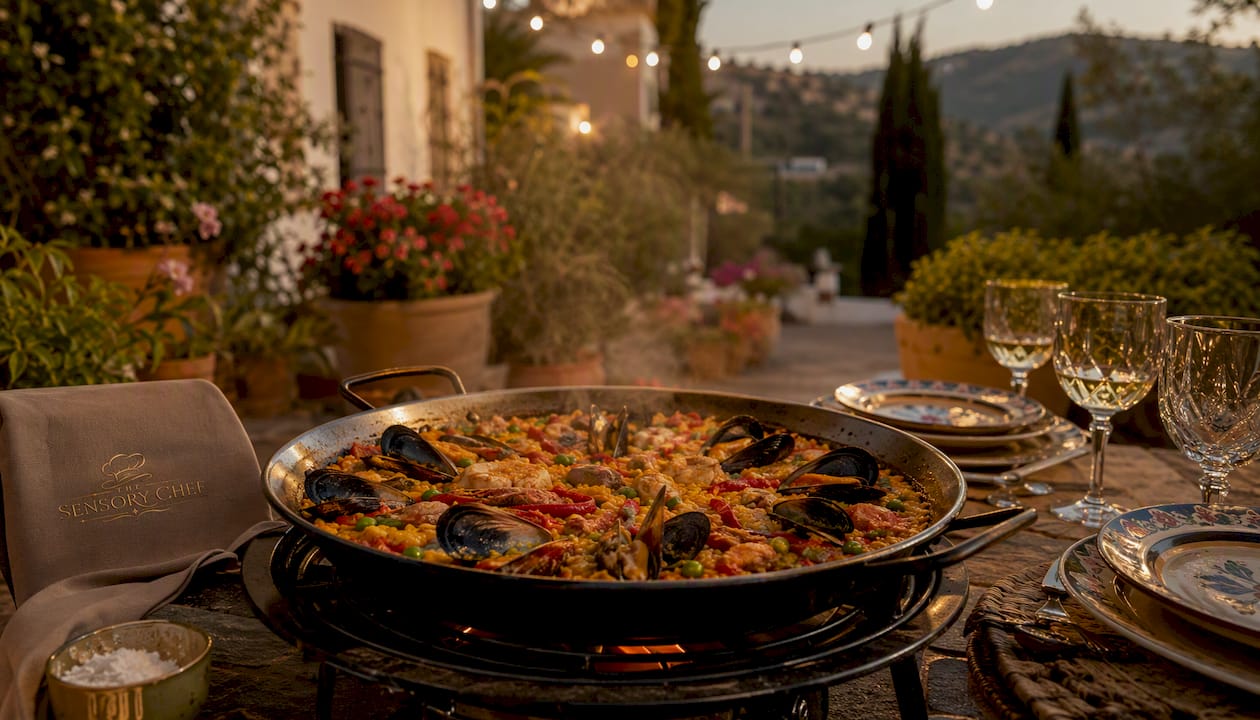
The result engages every sense: the colour of the saffron, the aroma of the paprika, the sound of the crust forming, the contrast between the tender rice and the crisp base. You can see examples of international cuisine for private dining that follow the same principle of sourcing and technique working together.
Technique highlights: sofrito building, stock temperature management, socarrat formation. Sensory aim: aroma-led, with a textural payoff at the base of the pan.
A plated seasonal dessert
A late-summer dessert: roasted white peach, a quenelle of crème fraîche, a tuile of caramelised almond, a few drops of aged balsamic. The peach is halved, brushed with honey and roasted at 200°C until the edges caramelise. The crème fraîche is lightly whipped with vanilla and a pinch of salt. The tuile is made from a thin batter spread on a silicone mat and baked until golden.
On the plate: the peach sits off-centre, the crème fraîche quenelle rests against it, the tuile leans at an angle for height, and the balsamic is placed in three small drops. The composition uses the rule of odd numbers and negative space. The sensory aim is warmth, acidity and crunch in a single forkful.
Technique highlights: caramelisation, quenelle shaping, tuile work, sauce placement. Sensory aim: warm fruit, cool cream, crunch, acidity — four sensations in one bite.
Why does culinary artistry matter beyond the plate?
Culinary artistry is not a luxury reserved for Michelin-starred restaurants. Its effects are felt wherever food is prepared with genuine care, and those effects extend well beyond the diner's immediate pleasure.
For diners
- A meal composed with artistry creates a memory, not just a meal. Guests recall the dish, the setting and the feeling long after the evening ends.
- Sensory engagement, taste, aroma, texture and visual beauty experienced together, produces a quality of attention that routine eating does not.
- A well-designed tasting menu can introduce a guest to an ingredient, a technique or a cultural tradition they would not have sought out independently.
For hosts and event organisers
- A private chef who practises culinary artistry differentiates an event from a catered function. The food becomes a talking point, a gift to guests rather than a logistical necessity.
- Bespoke menus that account for dietary requirements and personal preferences signal care and attention in a way that a standard menu cannot. Thesensorychef's approach to accommodating dietary needs is built on this principle.
For culture and hospitality
- Culinary artistry preserves regional food traditions by treating local ingredients and techniques as worth the effort of mastery. A properly made socarrat or a classical bouillabaisse is a cultural document as much as a dish.
- It also creates space for innovation: new combinations, new techniques and new narratives that keep a cuisine alive and relevant.
Experiential dining, where the meal is designed as an event rather than a transaction, has become one of the most sought-after forms of hospitality. The gastronomic experience that a skilled private chef creates in a villa setting offers something a restaurant cannot: complete personalisation, the intimacy of a private table and the sensory coherence of a menu designed specifically for you and your guests.
A thoughtfully chosen wine pairing amplifies this further. Vinoperte's guide to experiential wine selection explores how matching wine to a sensory menu extends the artistry from the plate to the glass, reinforcing aroma and texture across every course.
Key takeaways
Culinary artistry is the deliberate orchestration of ingredient selection, professional technique, sensory composition and service into a multi-sensory experience that transforms a meal into a lasting memory.
| Point | Details |
|---|---|
| Four pillars define artistry | Ingredient selection, professional technique, creative composition and service context work together — none is optional. |
| Craft and art are both present | Consistency and reproducibility (craft) support the creative, narrative intent (art) that makes a meal memorable. |
| Sensory balance is the test | A dish that tastes well but lacks aroma, visual appeal or textural contrast is incomplete by the standards of culinary artistry. |
| Development takes deliberate practice | Taste mapping, plating sketches, peer feedback and chef mentorship are the practical tools for building a culinary voice over time. |
| Thesensorychef brings it to your table | Joseph Warner's private tasting menus and villa dining experiences in Granada and Andalusia are designed around these principles, with menus tailored to your occasion and guests. |
A chef's perspective on what culinary artistry really demands
The phrase "culinary artistry" can sound like marketing language until you stand in a kitchen at 7pm with eight guests arriving in forty minutes and a sauce that has broken. At that moment, artistry is not about inspiration. It is about the ten thousand hours of technique that let you fix the sauce, adjust the seasoning, re-plate the course and still deliver something beautiful on time.
What I have come to believe, after more than thirteen years in professional kitchens and private dining rooms across France, Spain and the Mediterranean, is that the creative part of cooking is the smallest part. The larger part is discipline: the mise en place done hours before service, the stock made from yesterday's bones, the decision to source saffron from La Mancha rather than a cheaper alternative because the flavour difference is real and the guest will notice it even if they cannot name it.
The sensory approach I developed, partly through necessity as a deaf chef, taught me that a dish communicates through every channel simultaneously. Guests do not consciously separate the aroma from the taste from the visual composition, but they feel the difference when one of those channels is absent. That is the practical meaning of culinary artistry: not a single brilliant idea, but the sustained attention to every sensory detail from the first shopping list to the last plate cleared from the table.
If you want to experience what that attention produces, a private dinner is the most direct way to understand it. The Sensory Chef signature experience is designed precisely for that.
Experience culinary artistry at your villa or private event
Thesensorychef offers something that a restaurant cannot: a private chef who brings the full discipline of culinary artistry directly to your table, whether that is a villa terrace in Granada, a seaside setting on the Costa Tropical or a private event in Málaga or Andalusia.
Joseph Warner designs every menu around your guests, your occasion and the season. The food is personal, technically precise and composed to engage every sense from the first course to the last.
Services available for private bookings:
- Bespoke tasting menus (4–7 courses, paired or unpaired)
- Private villa paella and Mediterranean feasts
- Romantic dinners and anniversary celebrations
- Birthday and family gathering menus
- Dietary requirements and allergy-adapted menus
To book a private dining experience or discuss a bespoke menu, visit the private dining experience page or enquire directly through the site. Availability across Granada, Almuñécar, the Costa Tropical, Málaga and Andalusia.
Useful sources and further reading
A curated selection of the sources used in this article, for readers who want to explore culinary artistry in greater depth.
- What is Culinary Arts? — EHL Insights: clear academic framing of culinary arts as a discipline, covering the four core pillars and sensory engagement. A reliable starting point for anyone new to the subject.
- Culinary arts — Wikipedia: broad encyclopedic overview of culinary arts history, tools, techniques and professional roles; useful for context and terminology.
- A recipe for culinary creativity — ScienceDirect: academic research defining the characteristics of creative chefs and the conditions under which culinary work crosses from craft into art.
- Culinary arts — École Ducasse: professional training perspective on how food science and technique underpin creative culinary practice; relevant for anyone considering formal study.
- What is a culinary experience: a complete guide — Thesensorychef: Joseph Warner's own guide to what a culinary experience involves, grounding the abstract principles of artistry in private-dining practice.
FAQ
What is the meaning of culinary artistry?
Culinary artistry is the intentional practice of preparing and presenting food as a multi-sensory experience, combining ingredient selection, professional technique, creative composition and service to produce something that goes beyond satisfying hunger. EHL Insights frames it as the deliberate orchestration of taste, aroma, texture, sight and sound into a unified dining experience.
What is culinary art in simple terms?
Culinary art is cooking practised with creative intent and professional skill, where every decision about an ingredient, a technique or a plate's appearance is made deliberately. The goal is a dish that engages the senses and creates a lasting impression, not merely a meal that fills a plate.
What does culinary creativity mean?
Culinary creativity means taking risks with familiar ingredients and techniques to produce something genuinely new, then refining that idea through tasting and feedback until it works reliably. Research published in ScienceDirect identifies it as the defining characteristic that separates culinary craft from culinary art.
What do culinary artists do in a professional setting?
Culinary artists design menus, select and source ingredients, execute complex techniques and compose plates with visual and sensory intention. In private-dining contexts, such as the bespoke villa dinners offered by Thesensorychef, they also adapt every element of the experience to the specific guests, occasion and setting.
How can you experience culinary artistry in Andalusia?
The most direct way is through a private chef service that brings a composed, multi-course menu to your villa or event. Thesensorychef's signature experience is designed around exactly these principles, with menus tailored to your guests and the season across Granada, the Costa Tropical and Málaga.