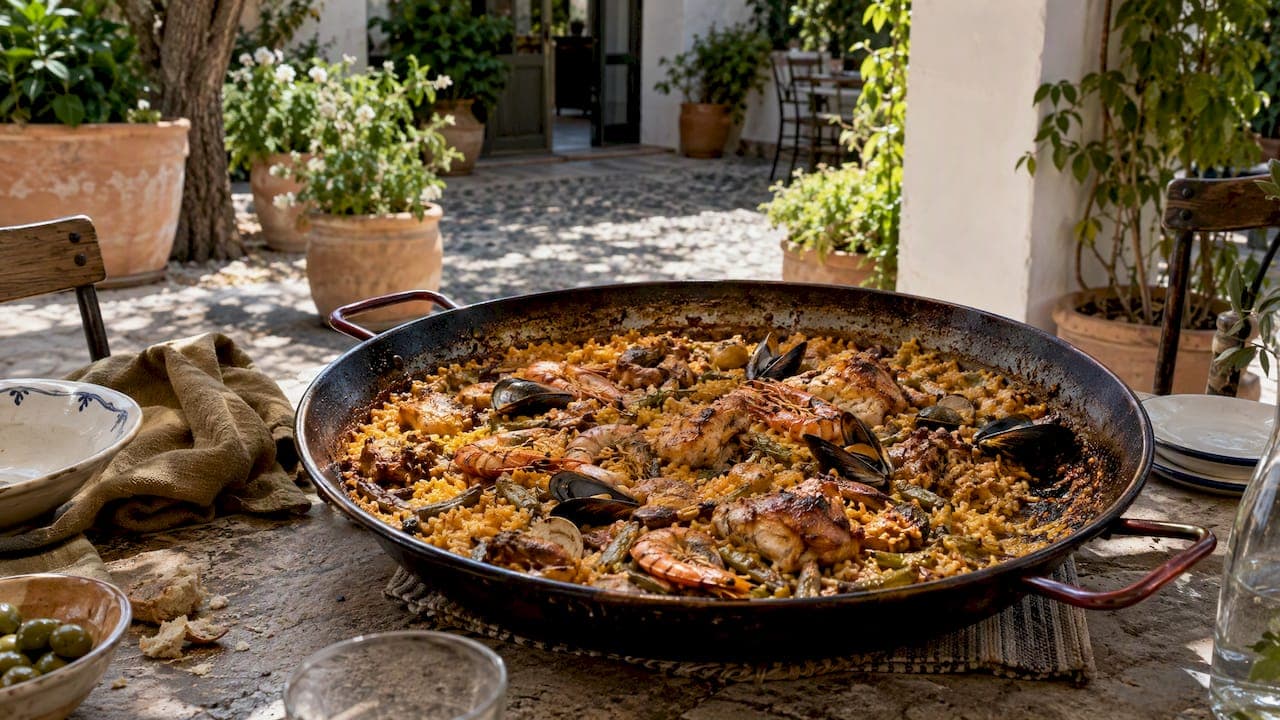
A paella at your villa works best when five things are settled early: how many guests you have, where the fire will stand, who is cooking, what else is on the table, and what your guests cannot eat. Get those right and the rice becomes the centrepiece of the day. Get them wrong and you spend the party at the burner instead of beside the pool.
This guide is written for villa guests, hosts and families planning a celebration in Granada, the Costa Tropical, Málaga and the Costa del Sol. It covers the practical decisions, the rules worth knowing and what a private chef changes.
TL;DR
- Decide guest numbers first: the pan, the burner and the cooking time all follow from that figure.
- Cook outdoors on a level, sheltered, ventilated spot, away from dry vegetation, and check local fire restrictions in the summer months.
- Food safety matters more in the heat: keep cold items cold and cook animal products through.
- Tell your chef about allergies and dietary needs at booking, not on the day.
- Our paella experiences start from €75 per person, and we cook live at your villa.
Table of Contents
- Start with the guest list, not the recipe
- Choosing the style of paella
- Where to cook: space, fire and wind
- Food safety when you cook outdoors in the heat
- Cook it yourself or hire a chef?
- A realistic timeline for the day
- What else goes on the table
- Allergies and dietary needs
- Our perspective: why we cook paella the way we do
- Booking a private chef for your villa paella
- How far ahead to book
- Practical checklist for the day
- FAQ
- Sources
Start with the guest list, not the recipe
Every decision downstream depends on headcount. Paella is cooked in a single wide, shallow pan, and the rice layer must stay thin for the base to caramelise properly. Cram too many portions into one pan and the result is soggy in the middle and scorched at the edge.
As a working guide, a standard 60 cm paella pan comfortably serves 20 to 25 guests, and for 50 or more professionals run several burners in parallel so that every pan finishes at the same time. For a family of eight, a much smaller pan is ideal. For a wedding weekend of 40, expect two pans and a chef who manages them side by side.
A few questions to settle before you speak to anyone:
- How many adults and how many children? Children often eat smaller portions, but they also tend to arrive hungry.
- Is the paella the whole meal or one course among several?
- Will everyone eat at once? Paella is best served within minutes of leaving the heat, so a staggered buffet works against it.
- Are there guests who do not eat meat, shellfish or gluten?
The last point decides the type of paella. A single pan cannot be all things to all guests. Many hosts choose one main pan, such as chicken and vegetable or seafood, plus a smaller, separate vegetable pan. That is simple for a chef to arrange when it is planned in advance and awkward when it is improvised.
Choosing the style of paella
The word paella covers several dishes, and your guests may have firm opinions.
| Style | What to expect | Good for |
|---|---|---|
| Chicken and vegetable | Familiar, savoury, rich in flavour from the base stock | Mixed groups, families with children |
| Seafood | Prawns, mussels and fish, lighter and more fragrant | Coastal villas, summer lunches |
| Mixed (mixta) | Meat and seafood together | Large groups wanting variety |
| Vegetable | Seasonal vegetables, no animal products | Vegetarian guests, lighter menus |
On the coast near Almuñécar, Salobreña and Nerja, the sea is a short drive away and seafood is a natural choice. Inland around Granada, a hearty meat and vegetable rice suits cooler evenings. If you are unsure, ask the chef what is best at the local market that week. Good rice follows good ingredients, and the best version is rarely the one fixed months in advance.
Where to cook: space, fire and wind
A paella is cooked over an open flame, usually gas, sometimes wood. That shapes where it can happen in your villa.
Pick a flat, open, ventilated spot. A terrace corner or a patch of paving near the outdoor kitchen works well. Some caterers say all they need is a level, ventilated space and that they do not use your kitchen at all. That is worth asking about, because it keeps the mess, the smoke and the grease out of your rental.
Mind the wind. On hilltop villas in the Alpujarras or on exposed Costa Tropical terraces, a steady breeze can cool one side of a pan and ruin the cooking. A sheltered corner matters more than a view.
Keep distance from anything that burns. Awnings, dry pine needles, thick hedges and wooden pergolas all deserve a second look.
Fire restrictions in summer
Andalusia has a high-risk wildfire season. In 2026 the Junta de Andalucía banned lighting fires for food preparation, barbecues included, in recreational areas, camping sites and forest land from 1 June to 15 October. The same report notes that restrictions on vehicles and burning also apply to farmland and urban land within 400 metres of a forest area.
A villa garden is not a recreational area, but many villas sit close to scrubland, pine and olive slopes. Dates can change from year to year, so check the current rules with your town hall (ayuntamiento) or your villa manager before you plan an open-flame lunch in summer. A gas burner on a paved terrace is a very different risk from a wood fire beside dry brush, and a professional chef will tell you so plainly.
Food safety when you cook outdoors in the heat
A hot terrace in July is not a hospital kitchen, and good hosts take that seriously. Spain's food safety agency, AESAN, gives summer guidance that is worth knowing even if you are not the one cooking:
- Anyone handling food must keep their hands clean and wash them whenever needed, including after using the toilet.
- Products of animal origin need to reach an internal temperature of at least 70°C, and dishes made with fresh eggs, such as certain sauces, need to reach 75°C and be eaten immediately, according to the research we reviewed from the same AESAN campaign. For a paella, that means chicken, rabbit and seafood must be properly cooked through, not just coloured on the surface.
- For cold starters such as aioli-style sauces or desserts, use pasteurised egg products where possible and keep everything chilled until the moment of serving.
If you hire a professional, it is reasonable to ask how they work. AESAN's guidance on retail food rules treats direct supply of prepared food in premises used mainly as private homes as a specific case within Real Decreto 1021/2022. Sensible questions to ask any chef or caterer include whether they carry public liability insurance and whether they follow a documented hygiene system such as HACCP. A good professional will answer without hesitation.
Cook it yourself or hire a chef?
Both are valid choices. The right one depends on what you want from the day.
Cook it yourself if the group is small, you enjoy the process and you are happy to be at the pan for 40 minutes or so. Our paella checklist for home cooks walks through the method for a first attempt, and a guide to reproducing a chef's paella at home shows how long the preparation really takes.
Learn with a chef if you would like to cook but with someone guiding the heat, timing and stock. This is a popular choice for hen parties, birthdays and family reunions, because the cooking becomes part of the entertainment. See our paella workshops in Granada villas for how it works.
Hire a private chef to cook live if you want to host rather than work. The chef arrives with ingredients and equipment, cooks in front of your guests and clears up afterwards. Live cooking lets the chef manage the heat precisely in changing outdoor conditions, which is what produces the socarrat, the caramelised crust at the bottom of the pan that paella lovers look for.

A realistic timeline for the day
Paella is not fast food. Here is a pattern that works for a lunch for around 20 guests, adapted to your own group.
- Two to three hours before eating: the chef arrives, sets up the burner and begins the stock and sofrito, the slow base of onion, tomato and pepper.
- One hour before: drinks and a light aperitivo for guests. This is the moment for tapas, olives, Iberian ham and chilled white wine or vermut.
- Thirty to forty minutes before serving: the rice goes into the pan. Guests drift over to watch and photographs begin.
- Final minutes: the pan rests briefly off the heat, the flavours settle, and everybody sits.
- After the meal: dessert, coffee and, if you wish, a short chat with the chef about the dish.
Build that gap into your plan. The most common mistake we see in villa events is expecting the paella to appear at a fixed minute while guests are still in the pool. Rice does not wait for anyone, so guests should be at the table when it is ready.
What else goes on the table
A paella rarely stands alone. A good Andalusian meal around it might include:
- A cold starter: gazpacho or salmorejo in summer, both made from tomato and bread and ideal in the heat.
- Tapas to begin: croquetas, tortilla, marinated olives, local cheeses. Our Tapas Of Andalusia menu starts from €65 per person.
- A salad: simple, dressed at the last moment.
- A dessert: something fresh and light, such as seasonal fruit, a lemon tart or a custard-based sweet from the chef.
- Drinks: a local white or rosé, plus water and soft drinks for children.
In Granada province, the long tradition of serving a free tapa with a drink is a lovely cue for the aperitivo phase. Even in your own villa, a few small plates while the rice cooks recreates it.
Allergies and dietary needs
Tell your chef about allergies when you book. Shellfish, nuts, gluten, eggs and dairy all appear in traditional Spanish cooking, sometimes in places you would not expect, such as stock or sauces. Paella is naturally gluten-free in its basic form, but stocks, side dishes, desserts and bread are not always.
For a group, ask each guest, or your group organiser, for three details: the allergy or intolerance, how severe it is, and whether trace amounts or shared utensils matter. A chef who knows this in advance can use separate pans and utensils and plan the order of service. We take this seriously, and you can read more about accommodating dietary needs in private dining.

Our perspective: why we cook paella the way we do
We see paella as the dish where everything is visible. You hear the sizzle of the sofrito, smell the saffron and paprika as the stock goes in, watch the rice change, and finally taste the crust at the edge of the pan. It is a sensory dish, and that is the heart of how we cook.
We are a French-trained team led by a chef with more than 13 years in professional kitchens, and the sensory approach comes from Joseph's own experience as a deaf chef. He relies on sight, touch, aroma and taste, and it shapes how we run a villa service: we watch the colour of the rice, feel the texture of the grain and read the aroma instead of leaning on a timer. We would encourage hosts to invite guests to gather around the pan, because the cooking itself is part of the occasion.
Our advice, after cooking in private villas across Granada and Andalusia: keep the menu focused. One superb pan, a few well-chosen starters and a simple dessert beat a sprawling spread every time. And decide on dietary requirements before the day, not during it.
— Joseph Warner
Booking a private chef for your villa paella
If you would like to hand the cooking to a professional, we offer several routes, depending on how you want to spend the day.
| Experience | Price |
|---|---|
| Andalusian Paella Experience | From €75 per person |
| Paella Feast | €130 |
| Paella Cooking Experience (hands-on) | €85 |
| Villa Chef Experience | From €350 per service |
The per-person menus are on our menus page, and the fixed-price options, including the Paella Feast and the hands-on Paella Cooking Experience, are on our services page. If your plans are bigger, perhaps a wedding weekend or an anniversary, our private villa dining guide explains how we plan from first message to final plate.
We work in Granada, Nerja, Almuñécar, Salobreña, Motril, La Herradura, Málaga, Marbella and along the Costa del Sol. If you are staying on the coast, you may also like our note on why a private chef suits a Nerja holiday villa, or our page on villa catering in Salobreña.
To check your date and discuss a menu, book your experience with The Sensory Chef.
How far ahead to book
Summer weekends, wedding dates and bank holidays in Spain fill quickly, and a chef needs time to source what is best at the market. As a rule, contact us as soon as your villa dates are confirmed. Our guide to booking a private chef in advance sets out chef-led timelines, and it is more useful to ask early and adjust than to ask late and compromise.
When you write, include:
- Your villa location and dates
- Approximate number of guests, adults and children
- Any allergies, intolerances or dietary preferences
- The occasion: birthday, anniversary, hen party, family reunion or wedding celebration
- Whether you want to watch, join in or simply sit down and eat
Practical checklist for the day
- Confirm the cooking spot and clear it of furniture and cushions.
- Check that the terrace has shade for the chef and your guests.
- Make sure there is a tap or water source and a cool place for ingredients.
- Have enough tables and chairs, and set the table before the rice goes in.
- Keep pets and small children away from the burner.
- Ask your villa manager about any noise, fire or outdoor cooking rules in the rental agreement.
- Keep a bottle of water and a phone close by. In a wildfire emergency, the number to call in Spain is 112.
FAQ
How much paella do I need per person?
There is no single rule, because appetite, starters and the rest of the menu all change the answer. Tell your chef the number of adults and children and what else you are serving, and they will size the pan accordingly. A 60 cm pan is generally enough for 20 to 25 guests, so larger groups need more than one pan.
Can a private chef cook paella in a rented villa?
Yes, in most cases. Check your rental agreement or ask the villa manager about outdoor cooking and open flames, particularly in summer when fire risk in Andalusia is high. We can tell you what we need on site, usually a level, ventilated outdoor space and access to water, and we will advise on a safe setup.
Can you make a paella for guests with allergies?
Often yes, if we know in advance. Let us know the allergy, how serious it is and who is affected, and we can plan ingredients, utensils and order of service. For severe allergies, we would also suggest guests carry their own medication, as with any meal away from home.
How much does a villa paella with a chef cost?
Our Andalusian Paella Experience starts from €75 per person, and our Paella Feast is €130. The final figure depends on your menu and your guest numbers, so contact us through our booking page for a clear quote.
Sources
- Paella for weddings and events: chef on-site, Artistealo
- Preventing food poisoning in summer, AESAN
- Questions and answers on Real Decreto 1021/2022, AESAN
- Junta de Andalucía fire restrictions, 1 June to 15 October, El Mira