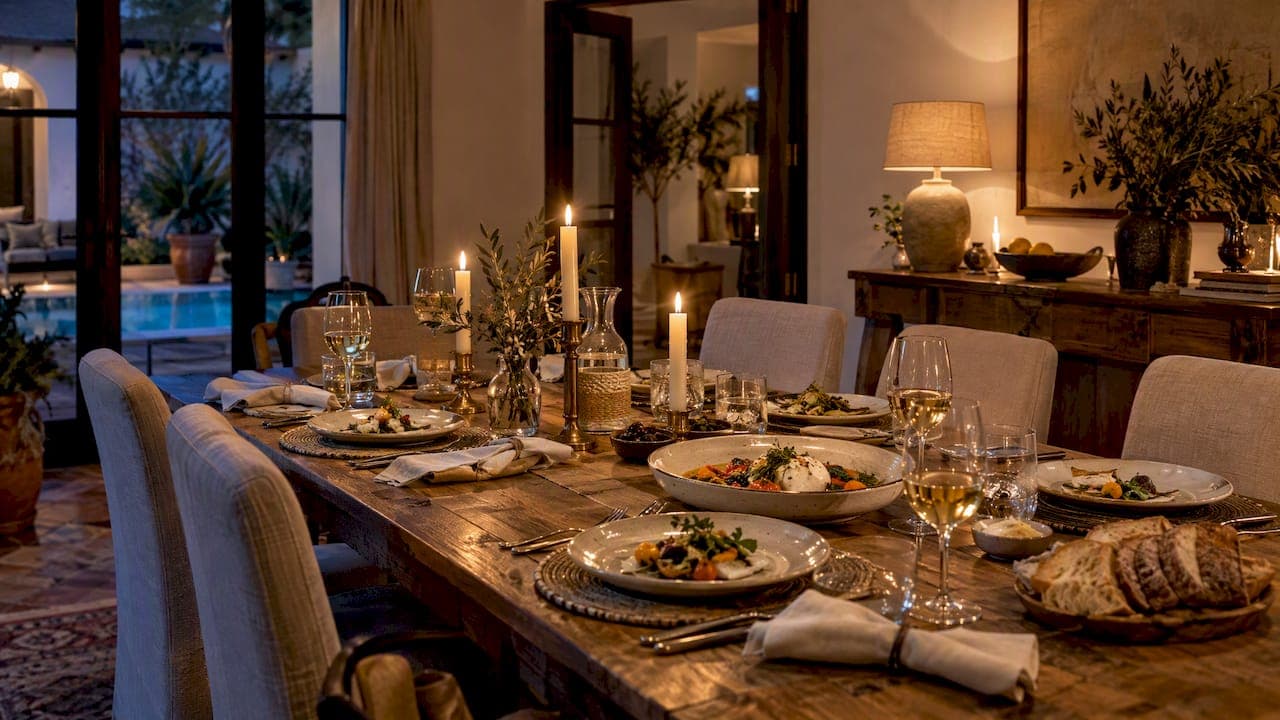
Layered warm lighting with a candle as the focal point, a low tablescape, comfortable seating and quiet instrumental music make a private dinner at home feel intimate. That is the whole recipe for good ambientación for a private dinner at home. Check your space is safe for open flames first. If you would rather have a chef lead the evening, you can book us at The Sensory Chef.
TL;DR:
- A study found that warm 2700 K light and lower brightness can feel more private; dim gradually, since large color shifts reduce preference.
- Choose LED candles in small rooms, around children, or near soft furnishings; never leave real flames unattended or close to curtains and napkins.
- For four guests, a round table keeps everyone in one conversation; at a rectangular table, seat guests close together at one end instead.
- Ask about allergies, dietary needs, and mobility when inviting guests, then label dishes discreetly and leave clear paths for wheelchairs or walking frames.
- Keep instrumental music low enough that lyrics are not clear; louder background sound makes guests raise their voices and can gradually drown conversation.
Table of Contents
- How do you light a room so it feels like a cocoon?
- What makes a tablescape that helps conversation?
- How should you arrange the seating?
- How do you use candles safely and still make them dramatic?
- What music works for a private dinner?
- What should you serve in low light?
- What is the quick setup checklist before guests arrive?
- How do you keep the room comfortable in temperature and air?
- How can you reduce outside noise?
- How do textures and fabrics support a sensory dinner?
- How do you make the dinner comfortable for every guest?
- Chef perspective: sensory-led tips from Joseph Warner
- How can The Sensory Chef bring the private dinner to your home or villa?
- FAQ
- Sources
How do you light a room so it feels like a cocoon?
Think in three layers. Ambient light is the soft general glow that replaces the harsh overhead. Accent light picks out a sideboard, a plant or a wall. Focal light, usually candles, draws the eye to the table. Professional hosts rely on this layering, and it is what stops a dining room feeling like a kitchen after dark.
Research points the same way. A study of LED colour temperature and illuminance in a restaurant found that lower illuminance and warmer tones increase the sense of privacy and pleasure in social dining, with 2700 K and reduced lux tending to feel most intimate.
Dimming brings a trade-off. Experimental work on dim-to-warm lighting suggests a modest shift towards warmer light as you dim can be liked, but large shifts reduce preference, and manual dimming is often favoured over automatic modes.
Practical swaps to try:
- Switch off the overhead and use two or three table lamps at different heights.
- Add wall sconces or a floor lamp in a corner to wash the walls.
- Fit a simple LED dimmer to your main lamp and set it by eye.
- Angle shades so no bare bulb sits at eye level, which avoids glare.
Pro Tip: Set the lights while the room is empty, then sit in a guest's chair. If you can see any bare bulb from there, move it.
What makes a tablescape that helps conversation?
Keep it low, textured and reflective. Table-setting guidance favours modest centrepieces and unscented candles, so eye lines stay open across the table and nothing competes with the food. Heavily scented florals are the usual culprit: a bowl of lilies can flatten a delicate dish.
Pick one of three motifs:
- Minimal modern: a long, low glass vase with a single stem, white plates, linen napkins in stone or oatmeal, and a row of slim candles.
- Rustic and natural: a wooden board as a runner, olive branches or herbs in small jars, ceramic plates and stoneware glasses, with chunky candles at varied heights.
- Vintage candlelit: thrifted brass or silver candlesticks, mismatched china, cloth napkins and a few polished metal trays to bounce light back.
Mixing natural materials such as wood, ceramic and seagrass, as IKEA's table-setting ideas suggest, adds warmth without clutter. Keep plates simple, and let one texture lead rather than five.
How should you arrange the seating?
For four guests, a round table is hard to beat. Practitioner guidance notes that it keeps everyone in a single conversation instead of splitting into pairs. On a rectangular table, seat guests close together at one end rather than spread along its length, and use the corner seats for the most talkative pairs.
Comfort decides how long people stay at the table:
- Add slim seat cushions to hard chairs.
- Slip a small cushion behind the lower back where chairs are upright.
- Choose chairs with a slight backrest angle over rigid, perfectly vertical ones.
- Leave clear walkways and room to push a chair back.
- Never place candles where a guest must reach past an open flame.
How do you use candles safely and still make them dramatic?
Safety first, then drama. Use stable holders on a flat, uncluttered surface. Keep flames well clear of napkins, curtains and dried flowers, and never leave candles burning unattended.
For effect, candlelit dinner guidance recommends stable holders, mixed candle heights and hurricanes or lanterns. Add a mirror or polished metal tray behind a cluster and the light multiplies.
- Mix tall tapers, pillars and tealights in a loose group.
- Use hurricanes outdoors on a terrace, where breezes tug at bare flames.
- Choose LED wax candles for small rooms, children, or spaces heavy with soft furnishings.
Pro Tip: Light the candles in the order you will blow them out, furthest from the door first, and snuff them from the table edge inward.
What music works for a private dinner?
Choose instrumental or low-lyric styles: soft jazz, bossa nova or gentle lo-fi instrumentals. Lyrics pull attention away from the person across the table.
The volume rule is simple. Music should sound like a background murmur. If guests can clearly make out the words, turn it down. Hosting experts point to the Lombard effect: when background sound rises, people raise their voices, and the room gets louder without anyone noticing. We cover levels in more detail in our guide to private dinner music.
- Build a playlist in advance, long enough that it never loops.
- Start gentle for arrivals, stay low through the mains, and lift slightly for dessert.
- Place a small speaker away from the table, not beside anyone's ear.
What should you serve in low light?
Dim rooms reward food that is easy to see, easy to cut and easy to share. Pre-sliced roasts, silky soups and finger-friendly small plates keep conversation moving, because nobody is wrestling with a knife by candlelight.
- Choose plates that contrast with the food: pale plates for dark sauces, darker ones for pale dishes.
- Serve bite-sized portions and pre-plated starters so you are not carving in the dark.
- Space courses so the table can breathe; rushed courses break the mood faster than any harsh bulb.
When we design a menu, we match it to the room, the light and your guests, including dietary requirements and allergies. Our personalised menus are built exactly this way.
What is the quick setup checklist before guests arrive?
Start preparing before the doorbell:
- Set lamps and dimmers, then test the sound with your playlist.
- Clear the table, then dress it: cloths, plates, glasses, napkins.
- Place the centrepiece and candle holders, keeping sightlines low.
- Finish and plate cold dishes; hold hot ones.
- Walk the room for hazards: trailing cables, curtains near flames.
- Light the candles last, in a sensible order.
In a small or cluttered space, swap real candles for LED ones and set a mirrored tray under the focal group. Finish with a safety check, then sit in a guest's chair to rehearse light and sound. For a longer walk-through, our luxury dining at home guide goes step by step.
How do you keep the room comfortable in temperature and air?
A beautiful table fails if guests are too warm. Cooking, candles and bodies all add heat, so cool the room a little before people arrive; it will rise during the evening. A little cooler than you think is right.
Ventilate before dinner. Open windows while you finish the table, then close them if there is traffic noise or a chill. Cooking smells linger, so run the extractor while you prepare and shut the kitchen door once plating is done.
Think about airflow near the flames. A draught from a fan or open door makes candles flicker, drips wax and can blow a flame towards napkins. Keep candles away from vents, and place tapers in sheltered spots or hurricanes.
On warm Andalusian evenings, a terrace or patio can be the best room in the house: cool the space with shade through the afternoon, keep water jugs on the table, and bring a light shawl or throw for anyone who feels the temperature drop after dark. Offer chilled water throughout, and a warm drink such as herbal tea after dessert. Small touches like these tell guests you have thought about their comfort, and comfortable guests linger.
How can you reduce outside noise?
You cannot soundproof a rented villa, but you can soften the room. Hard surfaces such as tile, glass and bare walls bounce noise around. Soft ones absorb it: rugs, heavy curtains, upholstered chairs and cushions all take the edge off.
Close windows and shutters facing the street or a neighbour's terrace before guests arrive. Draw curtains across glazed doors; thick fabric helps with echo as well as light. If a door rattles, fix it with a folded cloth or a draught excluder at the base.
Choose the quietest room, away from the road, the kitchen extractor and the washing machine. Run the dishwasher before dinner or well after. Put phones on silent, and tell guests the evening is unhurried.
Where noise is unavoidable, a low, steady layer of background music softens intrusions without drowning conversation. Keep it within the volume rule above so you do not create a new problem. Seat guests with their backs to the noisiest wall so the sound travels behind them rather than across the table. A tablecloth beneath plates also quietens cutlery and glasses, which adds to the hush.
How do textures and fabrics support a sensory dinner?
Texture is what makes a table feel considered. Dining-room design guidance recommends layering textures and mixing in thrifted or vintage pieces for character, and it stresses that lighting fixtures strongly influence a room's mood.
Think in contrasts. Pair crisp linen napkins with a rough ceramic plate, or a smooth glass with a woven placemat. A heavy cloth in a warm neutral deadens clatter and makes the table feel soft. Velvet or wool cushions on chairs and a throw over a bench invite people to settle.

Keep colours warm and quiet: cream, terracotta, olive, deep green or burnished brass echo candlelight rather than fight it. Avoid glossy, reflective tablecloths that bounce light into guests' eyes.
As a sensory chef, we think about how fabric feels under the hand as much as how it looks. A napkin with weight, a glass with a good rim and a plate that is pleasant to hold all change how food tastes to the person eating it. Choose one or two tactile moments and let them lead, rather than layering everything.
How do you make the dinner comfortable for every guest?
Accessibility starts with light and seating. Older guests and people with low vision often need more light on the plate and less glare in the eye. Place a small lamp or focal candle where it falls on the food, and avoid bare bulbs in anyone's line of sight. Keep a few brighter lamps ready for reading menus or taking medication.
Offer a choice of chairs, with and without arms; armrests help people stand. Keep walkways clear, tuck cables away, and leave a wide gap for a wheelchair or walking frame. Place the guest who needs most room at the end of the table or near the door.
Ask guests about dietary needs, allergies and mobility when you invite them, not on the night. Label dishes discreetly if anyone has an allergy, and keep seasoning mild so each person can adjust at the table.
Think about sensory comfort too. Some guests are sensitive to strong scents, flicker or loud music, and a quiet word beforehand lets you adjust. Our approach to accessible sensory dining comes from the same principle: the evening works when everyone feels at ease.

Chef perspective: sensory-led tips from Joseph Warner
Most hosts over-style and under-plan. After more than 13 years as a French-trained private chef, I have learned that guests remember how the evening felt: the pace, the warmth, the way one course gave way to the next. Pair texture with aroma: something crisp beside something soft, something fragrant with something plain. Plate for low light, so each dish reads clearly in the glow of a candle. And space your courses so conversation can breathe. If you would rather enjoy your own party, enquire about a private-dining booking and let us deliver the whole evening.
— Joseph Warner
How can The Sensory Chef bring the private dinner to your home or villa?
If you would rather spend the evening with your guests than in the kitchen, we can run the whole dinner for you, at your home or villa in Granada, the Costa Tropical, Málaga and across Andalucía. A booking can cover:
- A bespoke menu designed around your occasion and your guests.
- Sourcing of fresh, local ingredients.
- Cooking and service on site, so the kitchen stays our job.
- Accommodation of dietary requirements and allergies.

Current prices for our Private Dining Experience are on our services page. Tell us the date, the number of guests and the mood you want, and we will help you plan it. Send us an enquiry through our booking page.
FAQ
What ideas are there for a themed dinner at home?
Choose a theme that matches the food and let lighting and tableware echo it: a Mediterranean tapas night, a French bistro evening or a paella feast. Keep the theme to colour, one centrepiece and a playlist rather than costumes or heavy props.
What can I do for an elegant but easy dinner?
Serve food that can be prepared ahead, such as a soup, a roast you slice in advance and a dessert that sets in the fridge. Keep the table simple with candles, linen and one low arrangement, and light the room softly.
What are good ideas for a romantic dinner at home?
Use warm, dim light, a few candles and soft instrumental music, and seat the two of you at a corner of the table instead of across a wide gap. Pick a menu of small courses so you are not rushed, and put phones away.
What can I do for a dinner for two at home?
Use a small table or the corner of a larger one so you sit close, with low candles and a low arrangement. Choose two or three courses, prepare as much as possible in advance, and keep the music low enough to talk over.
Sources
- Effects of LED Color Temperature and Illuminance on Customers' Emotional States and Spatial Impressions in a Restaurant
- Full article: Dim-to-Warm Lighting: An Experimental Analysis of Preference and Perceived Naturalness
- El arte de recibir: 8 claves de experto para cenas íntimas inolvidables
- 15 Stunning Table Décor Ideas to Elevate Any Meal
- 70 Dining Room Decor Ideas to Inspire a Stylish Makeover