The kitchen brigade system, known in professional kitchens as the brigade de cuisine, is a hierarchical staffing structure that assigns every cook a defined role so a kitchen can deliver consistent, timed service at scale. Developed in the late 19th century by Georges-Auguste Escoffier, the system transformed chaotic Victorian kitchens into disciplined operations modelled on military command. Institutions such as Le Cordon Bleu have taught and preserved it ever since, and its principles remain the backbone of professional kitchens worldwide.
At its core, the brigade delivers four things:
-
Efficiency and timing: every station works in parallel so courses arrive together
-
Quality control: each role carries clear accountability for its output
-
Reporting lines: authority flows from the head chef down, removing ambiguity during service
-
Staff development: junior cooks learn from senior station chefs, creating a natural progression path
Table of Contents
Where did the kitchen brigade system come from?
The story begins before Escoffier. Marie-Antoine Carême, the great early 19th-century chef, had already begun organising French kitchens into specialist sections. Escoffier took that foundation and, drawing directly from his experience with military organisation during the Franco-Prussian War, codified it into the brigade de cuisine during his tenure at the Savoy and Ritz hotels in the 1890s.
The military influence is visible in the language: ranks, stations, a clear chain of command, and the expectation that orders are followed without debate during service. Escoffier’s genius was applying that discipline to the rise of à la carte dining, where guests order individually rather than from a fixed menu. Synchronising dozens of different dishes across multiple stations, so every item for a table arrives at the same moment, required exactly the kind of structured coordination the brigade provided.
Le Cordon Bleu describes the result as a “well-oiled machine” in which every member knows their role. The school has taught the model to generations of chefs, cementing it as the global standard for professional kitchen organisation.
Core brigade roles and their responsibilities at a glance
The Wikipedia kitchen brigade entry and High Speed Training’s kitchen hierarchy guide both provide comprehensive role lists. The table below distils the core positions with their primary duties and notes on where roles are commonly merged in smaller kitchens.
| Role | Primary responsibility | Common in small kitchens? |
|---|---|---|
| Executive Chef / Chef de Cuisine | Menu creation, team management, final quality sign-off | Always present (often the owner) |
| Sous Chef | Day-to-day service management, covers all stations | Often merged with Chef de Cuisine |
| Saucier | Sauces, sautéed dishes, meat garnishes | Merged with Rôtisseur |
| Poissonnier | Fish and seafood cookery | Merged with Saucier |
| Rôtisseur | Roasting, grilling, frying | Merged with Saucier |
| Entremetier | Vegetables, soups, egg dishes | Merged with Garde-Manger |
| Garde-Manger | Cold larder, charcuterie, salads | Usually retained separately |
| Pâtissier | Pastry, desserts, bread (covers Boulanger and Glacier) | Retained or outsourced |
| Tournant | Floater covering any station as needed | Invaluable in small teams |
| Aboyeur / Expeditor | Calls orders, manages the pass | Chef doubles as expeditor |
| Commis | Station assistant, learning under Chef de Partie | Often the only junior role |
| Plongeur | Dishwashing, kitchen porter duties | Always present |
Pro Tip: In a kitchen of four or fewer, the Tournant role is your most versatile hire. A cook who can move fluidly between the sauce, larder and pastry stations without losing pace is worth more than a specialist who cannot adapt.
How modern UK kitchens adapt the brigade
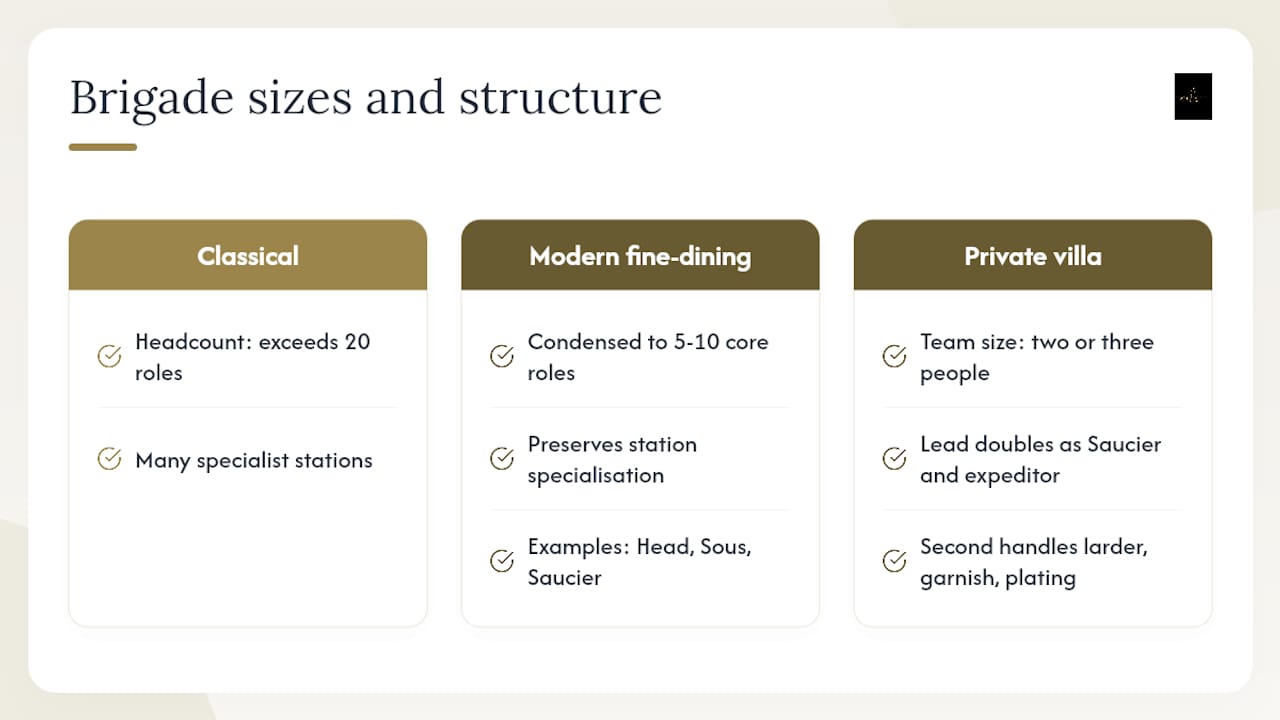
Almost no modern kitchen runs the full classical brigade, which can exceed 20 distinct roles. Le Cordon Bleu confirms that high-end kitchens today condense duties into 5–10 core roles while preserving station specialisation and accountability. Supply chains have removed the need for in-house butchers and fishmongers; pre-prepped produce, reduced menus, and tighter labour budgets have done the rest.
A typical UK fine-dining kitchen might run with roles such as Head Chef, Sous Chef, Saucier (covering fish and grill), Garde-Manger, Pâtissier, and a couple of Commis. A boutique hotel might add a Tournant and a dedicated Pastry Commis. The brigade’s spirit, clear ownership of each station and a single voice at the pass, remains intact even when the headcount drops.
For private villa dining in Andalucía, the condensation goes further still. A team of two or three covers every station, with the lead chef acting as both Saucier and expeditor, and a second cook handling larder, garnish and plating support.
Pro Tip: Whatever you cut, keep two things: a defined expeditor (even if that is you) and written mise en place lists for every station. These two habits prevent the most common service failures in small teams.
Key takeaways
The kitchen brigade system remains the most effective organisational model for professional kitchens because it assigns clear ownership to every station, synchronises timing across courses, and creates a built-in training pathway from Commis to Chef de Partie.
| Point | Details |
|---|---|
| Origin | Georges-Auguste Escoffier codified the brigade in the late 19th century, drawing on military discipline. |
| Core structure | The pyramid runs from Executive Chef through Sous Chef and Chefs de Partie to Commis and support roles. |
| Modern condensation | Most professional kitchens today use 5–10 core roles rather than the full classical brigade of 20+. |
| Key benefits | Consistent quality, precise timing, clear communication, and a natural staff development pathway. |
| Small-team application | Preserve station ownership and a defined expeditor role even when one person covers multiple stations. |
Ready to experience what a well-orchestrated private kitchen can produce? Explore The Sensory Chef’s private dining experience and book a bespoke dinner in Granada or across Andalucía.
How communication and workflow actually run during service
The Aboyeur is the brigade’s nervous system. In a classical kitchen, this role belongs to a dedicated expeditor who stands at the pass, receives printed or digital tickets, and calls each order aloud to the relevant stations. Every station chef acknowledges with a verbal “Oui, Chef” before beginning. This call-and-confirm loop is what prevents duplicate dishes, missed courses, and timing errors.
Mise en place is the silent half of that communication. Every component prepared before service, portioned, labelled and stored at the correct temperature, is a decision already made. During service, the cook executes rather than improvises. The less a chef has to think during a busy pass, the fewer mistakes reach the guest.
Modern kitchens often supplement verbal calling with digital ticketing systems displayed on screens above each station. The verbal call remains, but the screen provides a visual backup that reduces mishearing in a noisy kitchen. In private dining, a handwritten course card pinned above the pass serves the same purpose.
Challenges and criticisms of the brigade in modern kitchens
The brigade’s rigidity is its greatest strength and its most common criticism. A strict hierarchy can suppress creativity: junior cooks who develop strong ideas may find little space to express them within a system that values execution over invention. Some of the most influential kitchens of the past two decades have deliberately flattened the structure, giving Commis and Chefs de Partie more voice in menu development.
The system also carries a cultural legacy that the industry is actively examining. The military model normalised a high-pressure, often punishing kitchen culture. Long hours, verbal aggression and a “sink or swim” attitude towards junior staff were, for decades, treated as features rather than flaws. Many UK kitchens are now working to retain the brigade’s operational clarity while replacing its harsher cultural habits with structured mentorship and clearer wellbeing expectations.
Cost is a practical constraint. Running a full brigade in a mid-market UK restaurant is economically difficult given current labour costs and staffing shortages. The condensed brigade is not just a stylistic choice; for many operators, it is a financial necessity.
How roles interact during a live service: three examples
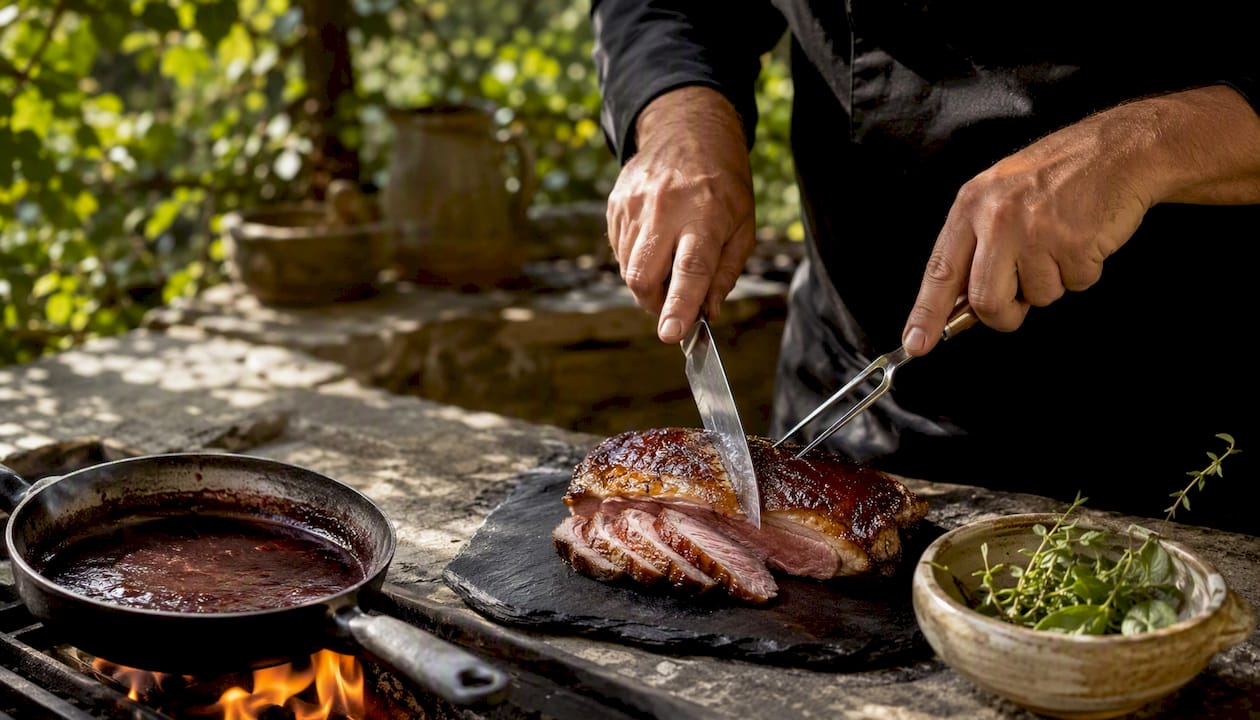
Saucier and Rôtisseur: A guest orders a roasted duck breast with a red wine reduction. The Rôtisseur begins the duck to order; the Saucier finishes the reduction and holds it warm. The Aboyeur calls the pass when both components are 90 seconds from ready, and the two cooks plate together. Neither can succeed without the other’s timing.
Garde-Manger and Commis: A cold starter of cured salmon with a citrus dressing requires the Garde-Manger to portion and dress the fish while the Commis adds micro-herbs and places the plates on the pass in the correct order for the table. The Commis learns plating discipline by watching and repeating.
Pâtissier and Aboyeur: Desserts are the most time-sensitive course because many components, soufflés, ice cream quenelles, warm chocolate fondants, cannot wait. The Pâtissier and Aboyeur must communicate the moment a main course leaves the pass so dessert preparation begins at exactly the right moment. A 30-second miscommunication here collapses the timing of the entire meal.
Traditional brigade vs modern UK kitchen staffing: a comparison
The classical brigade Escoffier designed for the Savoy assumed a large, permanent team with deep specialist knowledge in every section. The modern UK kitchen operates under different constraints: shorter menus, flexible staffing, and a labour market that makes 20-person brigades rare outside the largest hotel operations.
| Dimension | Classical brigade | Modern UK kitchen |
|---|---|---|
| Team size | 20+ roles | 5–10 core roles |
| Specialist roles | Butcher, fishmonger, boulanger in-house | Outsourced to suppliers |
| Menu scope | Extensive à la carte with daily specials | Shorter, tightly edited menus |
| Communication | Verbal calling, strict hierarchy | Digital tickets plus verbal confirmation |
| Junior development | Formal apprenticeship within the brigade | Mix of in-house training and external courses |
| Cultural expectations | Military discipline, high pressure | Shifting towards structured mentorship |
The principles, station ownership, a single voice at the pass, and mise en place discipline, transfer directly from one model to the other. What changes is the headcount and the degree of specialisation each station demands.
A chef’s perspective on the brigade and private dining
The brigade is not a relic. It is a decision-making framework that removes ambiguity precisely when ambiguity is most dangerous: during a live service, when six tables are at different courses and every plate has to be right. Working as a private chef across Granada and Andalucía, Joseph Warner applies its core logic to every event, whether a six-course tasting menu for twelve guests at a villa on the Costa Tropical or a relaxed paella lunch for a family gathering in the Albaicín.
The adaptation is practical rather than ceremonial. With a small team, the titles dissolve, but the principles hold: one person owns the pass, every component is prepped before guests arrive, and the menu is designed so that no two courses demand the same station at the same moment. That discipline is what allows a two-person team to deliver the same sensory precision, in flavour, texture, aroma and presentation, that a larger brigade achieves with more hands.
If you are planning a private dinner, a celebration, or a bespoke tasting menu in Andalucía, explore The Sensory Chef’s signature experience and discover how these principles translate into something genuinely memorable at your table.

Further reading
-
Escoffier.edu: the original source for brigade role definitions, hierarchy explanations and station specialisations; best for understanding the classical structure in depth.
-
Le Cordon Bleu — kitchen brigade overview: concise definition, historical attribution and commentary on which roles persist in modern kitchens; ideal for a quick, authoritative summary.
-
High Speed Training — kitchen hierarchy guide: practical role charts used in UK hospitality training; best for seeing which positions are commonly combined and which are retained.
-
Lightspeed — kitchen brigade roles and benefits: covers communication, stress reduction and the training pathway from Commis to Chef de Partie; useful for managers and trainees.
-
Fine Dining Lovers — Escoffier’s brigade explained: professional chef commentary on how the brigade synchronises à la carte service; good for understanding the operational rationale.
-
Wikipedia — kitchen brigade: comprehensive lists of historical positions with English and French naming; useful for terminology and the full classical role inventory.
FAQ
Who created the kitchen brigade system?
Georges-Auguste Escoffier developed the brigade de cuisine in the late 19th century, drawing on military organisational principles to bring order to the large professional kitchens of London and Paris.
Is the kitchen brigade system still used today?
Yes. Fine-dining and hotel kitchens continue to use it, though most condense the classical structure of 20-plus roles into a leaner model of 5–10 core roles while preserving station specialisation and the expeditor role at the pass.
What are the main benefits of a kitchen brigade?
The brigade delivers consistent quality, precise timing across courses, clear communication through a single expeditor voice, and a built-in training pathway that takes a Commis through to Chef de Partie level.
What skills does working in a kitchen brigade require?
Every role demands mise en place discipline and clear communication under pressure. Station-specific skills include knife work and reduction technique for the Saucier, cold-larder hygiene for the Garde-Manger, and forward planning for the Pâtissier, whose work cannot be rushed to order.