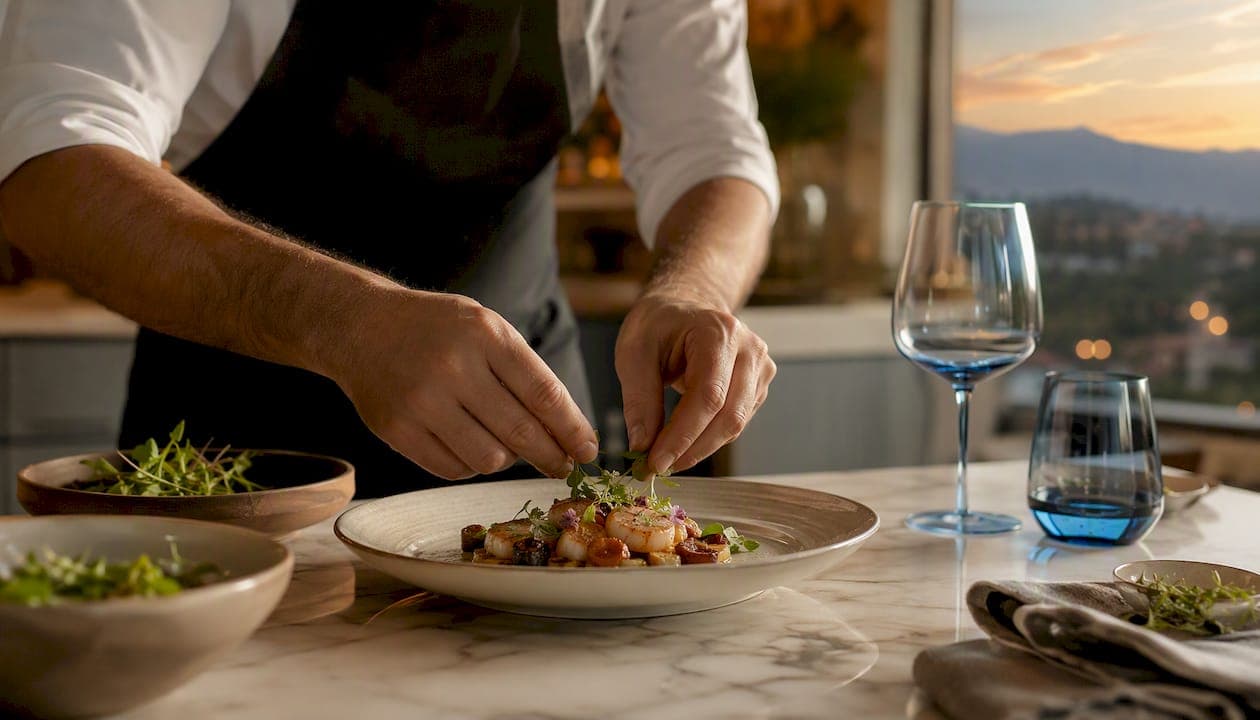
An intimate dining experience is a private, small-group meal designed around connection rather than capacity, typically for two to twelve guests, where a personalised menu, attentive service and a carefully considered atmosphere work together to make every person at the table feel genuinely seen. Fine dining combines culinary mastery, attentive service and elegant ambiance to create immersive, memorable meals, but intimate dining goes a step further by shrinking the room and sharpening the focus on the people in it.
The fastest way to recognise one:
- Guest count: usually 2–12 people, rarely more
- Setting: a private villa, a dedicated private dining room, a chef's table, or a small restaurant with exclusive use
- Pacing: courses arrive at the table's rhythm, not the kitchen's schedule
- Menu: bespoke or semi-bespoke, adapted to dietary needs and personal preferences
- Service: discreet, anticipatory, and often chef-led
Key takeaways
An intimate dining experience is defined by privacy, personalised menus, and attentive pacing for small groups of 2–12 guests.
| Point | Details |
|---|---|
| Core definition | A private, small-group meal for 2–12 guests built around personalised menus and attentive, unhurried service. |
| Atmosphere essentials | Warm lighting, low ambient sound, considered table dressing and discreet service create the conditions for genuine intimacy. |
| Format options | In-villa dining, private dining rooms, chef's tables and private omakase each suit different occasions and guest counts. |
| Planning lead time | Contact a private chef 6–8 weeks before the event; share dietary requirements 3–4 weeks out. |
| Brief your chef fully | The more detail you share about guests, the occasion and preferences, the more precisely the evening can be shaped. |
Table of Contents
- What makes an intimate dining experience feel truly private?
- Where does intimate dining take place?
- What menus and service styles suit intimate dining?
- What occasions suit an intimate dinner, and how many guests?
- How do you plan an intimate private dinner?
- How does a chef build intimacy at the table?
- Sample menus and theme ideas for small groups
- What should you wear, and how does etiquette work?
- What a chef notices that most guides miss
- Sources
- FAQ
What makes an intimate dining experience feel truly private?
The sensory design of a room does most of the work before a single dish arrives. Acoustic levels, table spacing and lighting are measurable choices that materially affect conversation quality and perceived intimacy. A table set in a large, echoing room with bright overhead lighting will feel exposed regardless of how good the food is.
The key atmospheric elements and why each matters:
- Lighting: warm, low-level light (candles or dimmable pendants) narrows the guest's visual field to the table and the people across from them, reducing distraction and encouraging presence
- Acoustics: soft furnishings, low ceilings and small rooms absorb ambient noise; background music at conversation level (roughly 60–65 dB) supports rather than competes with speech
- Table geometry: a round or square table for two to six keeps everyone equidistant; rectangular tables longer than six seats begin to fracture into sub-conversations
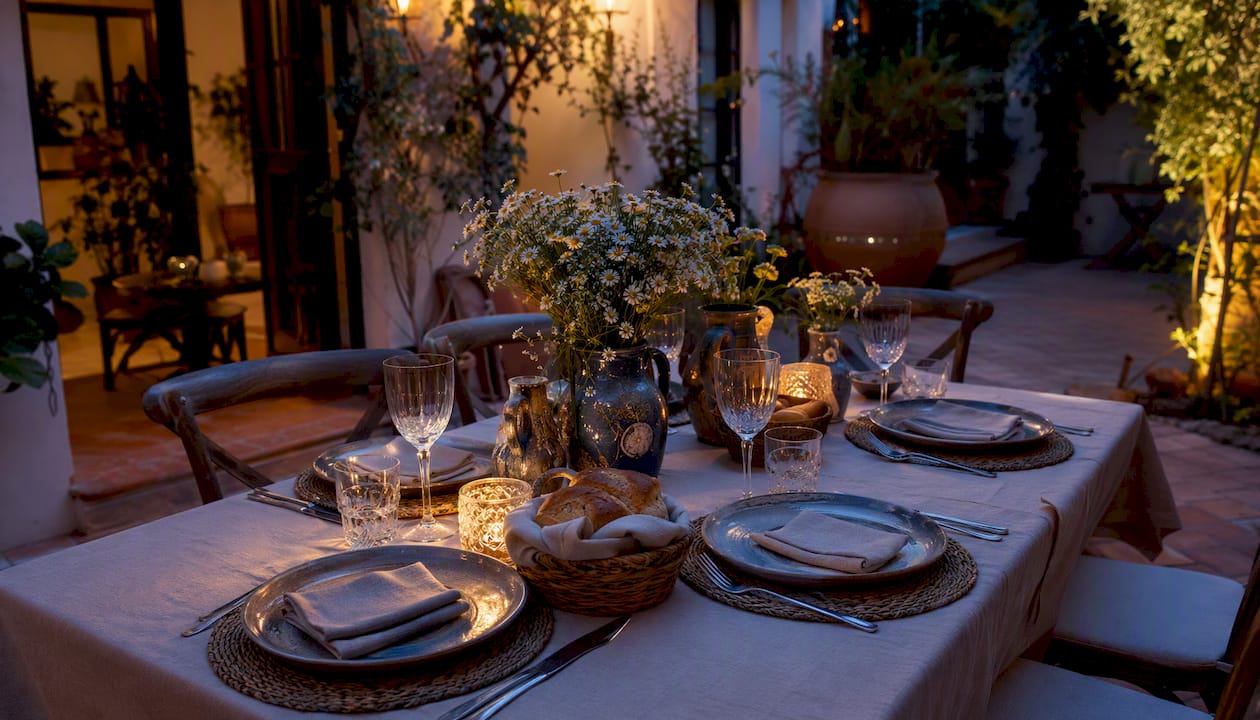
- Table dressing: linen, quality glassware and considered centrepieces signal care without crowding the surface; a cluttered table interrupts the sensory experience
- Service tone: discreet, unhurried service that reads the room rather than interrupting it is the single most underrated element
Experiential dining research confirms that multi-sensory cues, including sight, sound, scent and flavour, create emotional connection and lasting memory. A chef who understands this designs the room and the menu together.
Pro Tip: Shift the first course back by ten minutes from the stated arrival time. Guests who have had a drink, settled into the space and begun talking are far more receptive to food than guests who feel rushed to the table. That single timing adjustment changes the entire tone of the evening.
Where does intimate dining take place?
The format shapes the experience as much as the food. Private-room and chef's table formats allow a chef to deliver a bespoke menu, time courses to the table's rhythm and engage directly with guests in a way that larger catering cannot replicate.
Common formats:
- In-villa or private home dining: a private chef cooks in your own kitchen or villa kitchen; maximum privacy, zero travel, and the setting is already personal
- Private dining room: a dedicated room within a restaurant or venue, booked exclusively for your group; combines professional kitchen infrastructure with seclusion
- Chef's table: a small counter or table positioned at or near the open kitchen; guests watch preparation and interact with the chef throughout the meal
- Private omakase or counter: private omakase formats restore the one-chef-one-table relationship, producing a higher level of attention and presence; typically two to eight guests
- Small restaurant with exclusive use: a neighbourhood restaurant booked entirely for your group; retains the restaurant atmosphere while removing other diners
The choice between a private room and a chef's counter comes down to what you want the evening to feel like. A private room offers theatre and separation; a chef's counter offers transparency and conversation. Neither is superior — they suit different occasions and different guests.
For villa guests in Andalucía, in-villa dining removes every logistical friction: no taxi, no dress-code anxiety, no other tables. The private dining experience comes to you, which is often the most intimate format of all.
What menus and service styles suit intimate dining?
Menu format is the architecture of the evening. A well-sequenced menu builds anticipation, controls pacing and gives the chef room to adapt in real time.
Common menu shapes for private dinners:
- Multi-course tasting menu: five to eight courses in small portions; the chef controls the narrative from amuse-bouche to petit four
- Prix fixe: three or four courses with two or three choices per course; structured but flexible
- Shared plates: Mediterranean or family-style service where dishes arrive at the centre of the table; warmer and more conversational than plated courses
- Fully bespoke menu: built around the guests' preferences, dietary requirements and the season's best ingredients; the most personal option
A tasting menu is not just a sequence of dishes. It is a conversation between the chef and the table — each course responding to what came before and preparing the palate for what follows.
Service at an intimate dinner is calibrated differently from restaurant service. A sommelier or the chef themselves may present each dish with a short note on provenance or technique. Cutlery changes between courses, wine is poured attentively but not intrusively, and the pace is set by the guests' conversation rather than a fixed timeline. Wine pairing guidance adds another sensory layer, matching each course to a complementary glass and giving guests a thread to follow through the meal.
What occasions suit an intimate dinner, and how many guests?
An intimate dinner prioritises connection and conversation among a small group in a private or cosy setting. The occasion shapes the ideal guest count more than any other factor.
Typical occasions and the guest numbers they suit:
- Romantic dinner or anniversary: 2 guests; maximum privacy, full chef attention, the most personal format
- Small celebration (birthday, proposal, reunion): 3–6 guests; still intimate enough for a single conversation around the table
- Family gathering or milestone event: 7–12 guests; requires more logistical planning but retains the private, personalised character
- Small business dinner or client entertainment: 4–8 guests; a private room or villa setting signals care and discretion
The guest-count bands matter because they determine service logistics. Two guests can receive a fully bespoke, course-by-course experience with the chef present throughout. Eight guests require more structured plating and timing. Twelve guests begin to need additional service staff to maintain the same quality of attention.
Luxury dining is shifting from spectacle towards intimacy, discretion and personalisation, with smaller dining rooms and bespoke menus preferred. A private dinner for four in a Granadan villa courtyard is, by that measure, more current than a table for twelve in a grand restaurant.
How do you plan an intimate private dinner?
Good planning is invisible on the night. The checklist below covers the key decisions and their ideal lead times.
Planning timeline:
- Six to eight weeks before: confirm the date, guest count, venue or villa access, and contact a private chef to discuss the concept and menu direction
- Three to four weeks before: finalise the menu, share dietary requirements and allergies, confirm the kitchen equipment available (for villa bookings)
- One to two weeks before: agree the table layout, start time, service style and any décor or floristry; confirm wine choices or ask the chef to recommend pairings
- Two to three days before: send guests any dress guidance or arrival notes; confirm logistics (parking, access, timings) with the chef
- Day of the event: clear the kitchen and dining space by early afternoon; trust the chef from that point
Brief your chef as thoroughly as you would brief a tailor. The more they know about your guests, the occasion and your preferences, the more precisely they can shape the evening.
| Task | When to complete |
|---|---|
| Book private chef and confirm date | 6–8 weeks before |
| Share dietary requirements and allergies | 3–4 weeks before |
| Finalise menu and wine pairing | 2–3 weeks before |
| Confirm table layout, music and décor | 1–2 weeks before |
| Send guest arrival notes and dress guidance | 2–3 days before |
| Clear kitchen and dining space | Morning of the event |
Budget shapes vary considerably depending on the number of courses, ingredient quality, travel distance and whether additional service staff are required. A private chef for a villa dinner in Andalucía typically charges per person or per event; the clearest way to get an accurate figure is to describe the occasion and guest count directly when you enquire.
How does a chef build intimacy at the table?
Joseph Warner has spent more than 13 years building private dining experiences across Granada and Andalucía, trained in traditional French gastronomy and working across Mediterranean, Spanish and international cuisines. His approach to intimate dining centres on three practical disciplines.
- Menu sequencing: each course is chosen for what it does to the palate before the next one arrives; a light, acidic starter opens appetite; a rich middle course satisfies; a clean, aromatic dessert closes the memory
- Real-time adaptation: at a private table, a chef can read the room, slow a course if conversation is flowing, or adjust a portion if a guest is flagging; this is the core advantage of the chef's table format over larger catering
- Sensory focus: as a deaf chef, Joseph Warner developed a heightened attention to flavour, texture, aroma and presentation, which informs every dish he designs for private guests
His personalised menu approach begins with a conversation about the guests, the occasion and the season, not with a fixed menu handed over for approval.
Sample menus and theme ideas for small groups
These sketches are starting points. Every menu is adapted to the guests, the season and the available local produce.
- Romantic tasting menu (2 guests): chilled gazpacho with Andalusian olive oil; seared scallop with saffron cream and pea shoots; slow-roasted lamb with rosemary jus and grilled courgette; lemon posset with candied citrus and shortbread
- Mediterranean shared plates (4–6 guests): warm flatbread with hummus and roasted peppers; grilled octopus with paprika and lemon; slow-cooked chickpea and spinach stew; whole sea bream baked with herbs and tomatoes; almond and orange cake to finish
- Intimate paella night (6–8 guests): a single, theatre-style paella Valenciana or seafood paella cooked at the table, preceded by jamón and manchego, followed by crema catalana; paired with a chilled Albariño or Verdejo
- Seasonal vegetable-led menu (any group size): roasted beetroot with goat's cheese and walnuts; wild mushroom and truffle risotto; charred cauliflower steak with romesco and capers; dark chocolate mousse with sea salt
Dietary requirements are not constraints — they are part of the brief. A gluten-free, plant-based or allergen-aware menu can be as considered and as pleasurable as any other, provided the chef knows in advance.
For broader inspiration, international cuisine examples show how menus can be shaped around a theme, a region or a guest's personal food history.
What should you wear, and how does etiquette work?
Dress and conduct at a private dinner are simpler than most guests expect.
Dress guidance by occasion:
- Villa or in-home dinner (casual occasion): smart-casual; clean, well-fitted clothes in neutral or warm tones; no need for formal dress
- Special celebration or anniversary dinner: smart-casual to semi-formal; a dress or tailored trousers for guests, a blazer or shirt for partners; avoid anything that would feel uncomfortable over a long, relaxed meal
- Private dining room or chef's table: follow the venue's stated dress code; when in doubt, smart-casual is almost always appropriate
Simple etiquette for small tables:
- Silence or pocket your phone for the duration of the meal; a private dinner is a rare space free from interruption
- Follow the chef's or host's lead on pacing; do not rush a course or ask for the next one early
- If a dish is not to your taste, set your cutlery down quietly; a good private chef will notice and adapt
- Tipping in the UK context: a private chef fee typically covers the full service, but a gratuity of 10–15% is a warm acknowledgement of exceptional work; always check whether service is included in the quoted price
What a chef notices that most guides miss
Most writing about intimate dining focuses on décor: candles, linen, a private room. Those elements matter, but they are the frame, not the picture. The picture is the sequence of decisions a skilled chef makes before, during and after each course.
The conventional advice tells you to "set the mood with lighting." What it rarely says is that the mood is set more powerfully by the first five minutes of service than by any number of candles. If the first course arrives before guests have settled, or if the chef is visibly rushed, no amount of warm light recovers the evening. Pacing is the real intimacy tool, and it requires a chef who is reading the table, not the clock.
There is also a tendency to conflate intimate dining with formal fine dining. Cambridge Dictionary defines fine dining as food served in a formal or refined way, usually in higher-priced restaurants. Intimate dining can be formal, but it does not have to be. A shared paella on a Granadan terrace, cooked by a private chef who knows your preferences and has sourced the saffron from La Mancha, is as intimate as any white-tablecloth tasting menu. The formality is optional; the attention is not.
What guests should prioritise first is not the venue or the menu format. It is the quality of the brief they give their chef. The more specific the information shared before the evening, the more personal the result. Occasion, guest personalities, dietary needs, flavour preferences, even the wines they usually enjoy: all of it shapes what arrives at the table. A private chef who receives a thorough brief can build an evening that feels designed for those exact people, because it is.
Planning a private dinner in Granada, Almuñécar, Málaga or across Andalucía? The Sensory Chef offers bespoke private dining experiences for villa guests, couples and small groups, with fully personalised menus, wine pairing and discreet in-villa service. Explore the anniversary chef experience or get in touch to discuss your occasion directly.
Sources
- Fine dining (Glion magazine)
- The rise of experiential dining: how hospitality is evolving | JWU Online
- Fine-dining | Cambridge Dictionary
- Creating memorable moments: the art of an intimate dinner experience | AnMeal
FAQ
What does "intimate dining" mean?
An intimate dining experience is a private, small-group meal, typically for 2–12 guests, where the menu, service and atmosphere are tailored to the people at the table rather than a general audience.
What makes a restaurant or setting feel intimate?
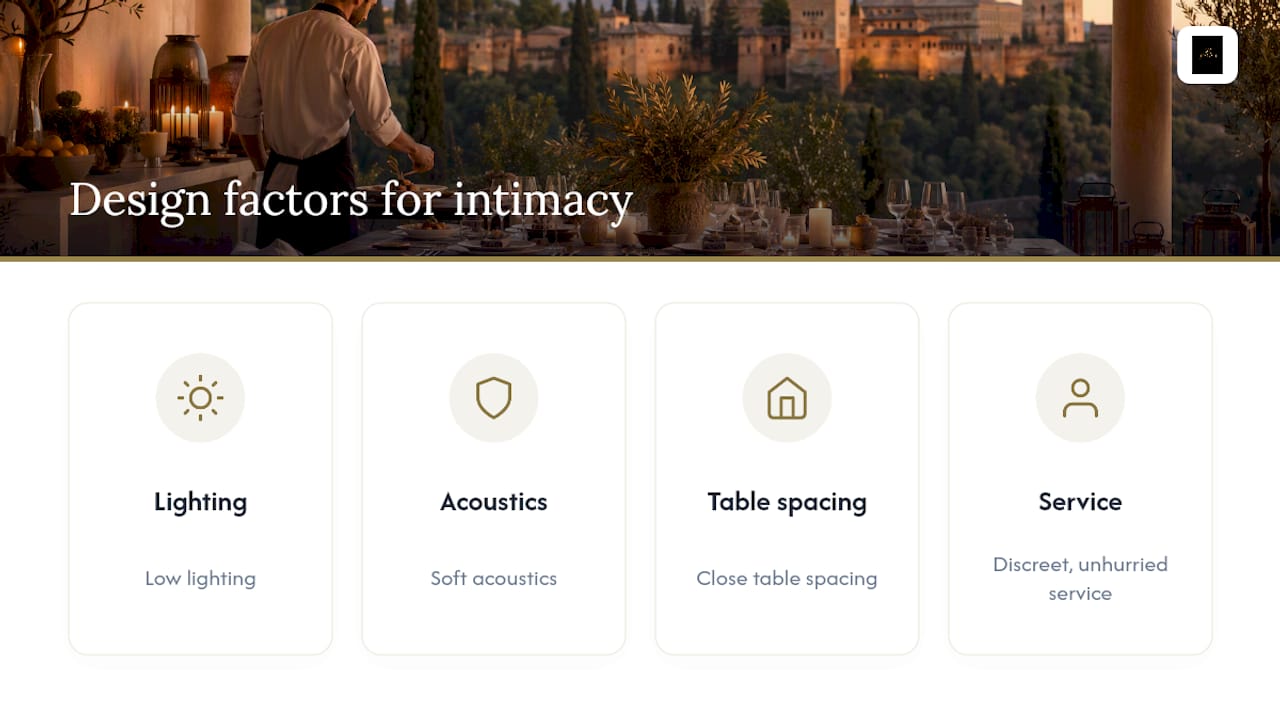
Low lighting, soft acoustics, close table spacing and discreet, unhurried service are the primary factors. Acoustic levels, table spacing and lighting are measurable design choices that materially affect conversation quality and perceived intimacy.
What should you wear to a private dining experience?
Smart-casual is appropriate for most private or villa dinners; semi-formal dress suits special celebrations or dedicated private dining rooms. Follow any dress guidance the host or venue provides.
How is intimate dining different from fine dining?
Fine dining refers to formally served, higher-priced restaurant meals with multiple courses and technical skill. Intimate dining prioritises privacy and personalisation for a small group and can range from relaxed shared plates to a full tasting menu, depending on the occasion.
How far in advance should you book a private chef?
Six to eight weeks is a comfortable lead time for most private dining bookings, allowing enough time to finalise the menu, share dietary requirements and arrange any logistics such as kitchen access or additional service staff.