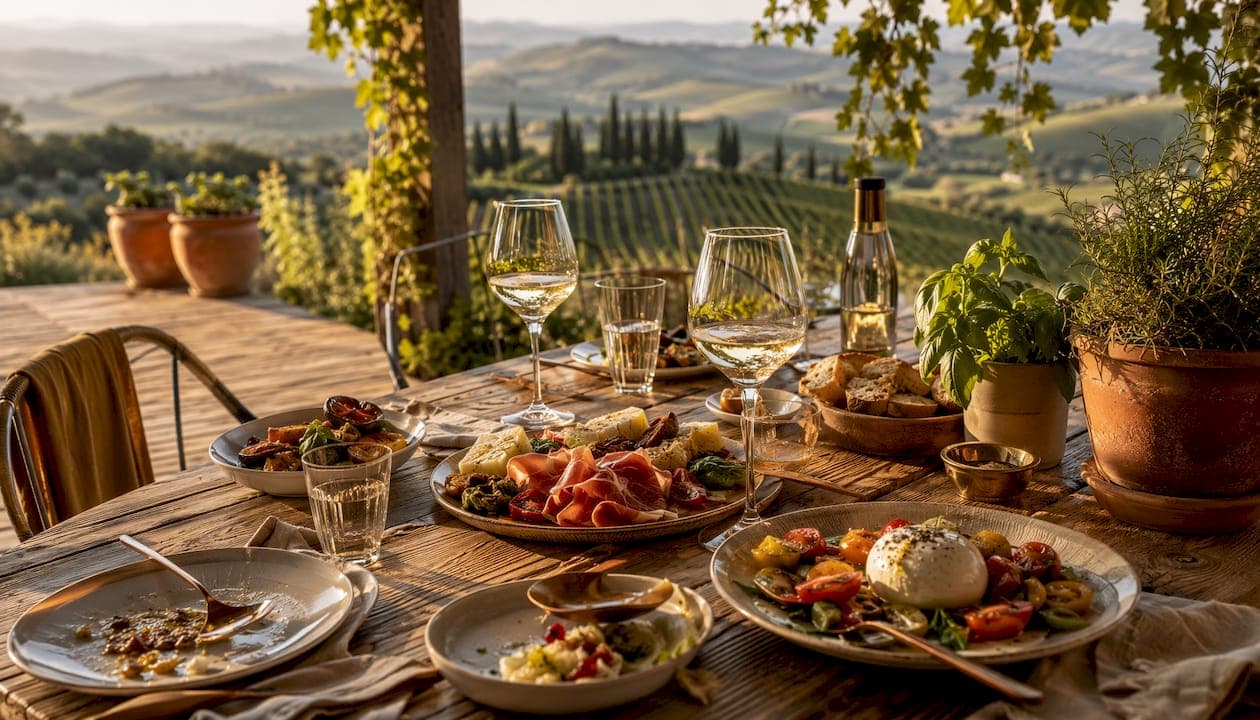
A classic Italian private-dining menu follows five courses: Antipasti, Primi, Secondi, Contorni and Dolci. That structure is familiar to most guests, scales gracefully from two people to twenty, and adapts to almost any dietary need without losing its identity. For a typical villa dinner, a workable sample brief reads: burrata with roasted peppers and cured meats to start; handmade tagliatelle with a slow ragù as the primo; branzino baked with capers and cherry tomatoes as the secondo; roasted courgettes and polenta as contorni; tiramisu to finish. Joseph Warner of Thesensorychef designs and delivers exactly this kind of bespoke Italian menu for villa events across Granada and Andalucía.
Table of Contents
- How a classic Italian private-dining menu is organised
- Four sample Italian menus for villa events
- Which service style suits your villa event?
- Ingredient sourcing and theatre-dish ideas for villa dining
- Portioning and budgeting for Italian private dining
- How to adapt Italian dishes for dietary requirements
- Key takeaways
- What actually makes Italian villa dining memorable
- Bespoke Italian private dining in Andalucía with Thesensorychef
- FAQ
How a classic Italian private-dining menu is organised
A private dining Italian menu built on the five-course Italian progression gives each dish a clear role and keeps the pacing natural. Here is what each course does and which dishes typically fill it:
Antipasti open the table and set the tone. Think cured meats, marinated olives, burrata with heritage tomatoes, bruschetta, or grilled vegetables with good olive oil. These are social dishes, designed to be shared while guests settle.
Primi is where the chef shows technique. Handmade pasta, risotto, or a refined soup carry the most flavour complexity of the meal. Tagliatelle al ragù, cacio e pepe, a saffron risotto, or pappardelle with wild mushrooms all work beautifully for Italian fine dining in a villa setting.
Secondi is the centrepiece protein. Classic choices include:
- Osso buco (braised veal shank, traditionally served with risotto alla Milanese)
- Bistecca Fiorentina finished over high heat
- Chicken cacciatore simmered with tomatoes, peppers and herbs
- Whole branzino baked or finished on a plancha
- Braciole, a rolled flank steak stuffed with prosciutto and Parmesan, ideal for larger groups
Contorni are side dishes served alongside or just after the main. Roasted seasonal vegetables, sautéed cavolo nero, creamy polenta, or a simple dressed salad keep the plate balanced without competing.
Dolci closes the meal. Tiramisu made a day ahead is the most practical choice for villa service; panna cotta sets overnight and plates cleanly. Both travel well and hold their texture.
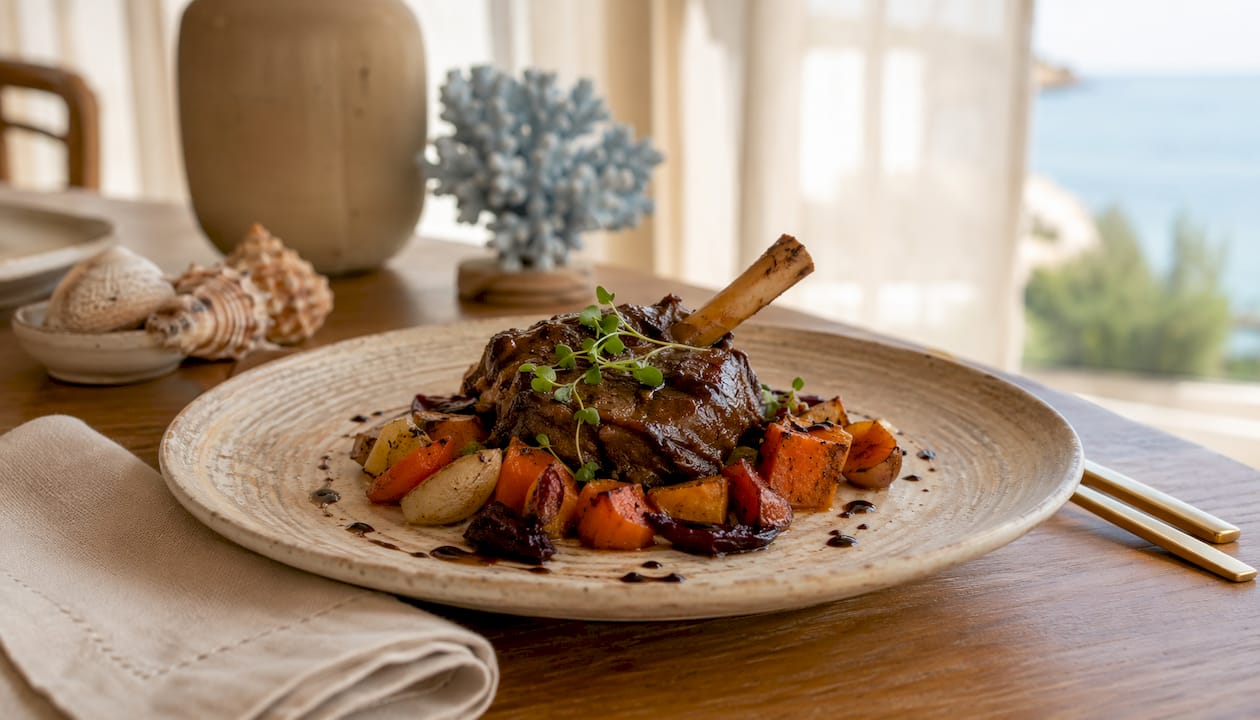
Finish with caffè and, if the occasion calls for it, a digestivo such as limoncello or grappa. For wine, Italian wine pairings follow a reliable logic: Barolo or a full Sangiovese with braised meats, a crisp southern white such as Vermentino or Greco di Tufo with seafood, and a light Barbera or Dolcetto alongside pasta.
Four sample Italian menus for villa events
Menu 1: Romantic tasting for two (plated)
- Burrata with heritage tomatoes, basil oil and sea salt
- Fresh tagliolini with brown butter, sage and Parmesan
- Branzino fillet with capers, lemon and roasted cherry tomatoes
- Roasted asparagus with pecorino
- Panna cotta with macerated strawberries
Plating note: each course arrives individually, finished à la minute. Portion sizes are smaller than a family dinner; the focus is on flavour progression and presentation. Dietary swaps: replace branzino with a roasted aubergine steak for vegetarian guests; use oat cream in the panna cotta for a dairy-free version.
Menu 2: Family-style sharing feast for 8–14 guests
- Antipasti board: cured meats, marinated vegetables, burrata, olives, grilled bread
- Two pastas served in large bowls: tagliatelle al ragù and a vegetarian cacio e pepe
- Chicken cacciatore in a Dutch oven, served family-style with crusty bread
- Roasted seasonal vegetables and polenta
- Tiramisu in a large dish, portioned at the table
Holding note: the cacciatore and polenta hold well in chafing pans with water. Tiramisu is made the day before. Gluten-free guests can substitute polenta for pasta; the cacciatore is naturally gluten-free.
Menu 3: Celebratory plated dinner for 10–20 guests
- Starter: caprese with buffalo mozzarella and aged balsamic
- Primo: saffron risotto with prawns, finished tableside
- Secondo: osso buco with gremolata, served with risotto alla Milanese
- Two contorni: roasted root vegetables and sautéed spinach with garlic
- Dessert: individual panna cotta with pistachio crumble
Staffing note: plated service for 15+ guests benefits from one additional server. The risotto is finished à la minute for theatre; the osso buco braises ahead and is reheated gently.
Menu 4: Buffet or convivial party for 20+ guests
- Antipasti station: cheeses (pecorino, Parmesan), cured meats, marinated vegetables, grissini
- Pasta tray: baked ziti with ricotta and mozzarella (assembled 24 hours ahead)
- Polenta tray with sausage and slow-cooked tomato sauce
- Hot main: chicken cacciatore in chafing pans
- Dessert and caffè station: tiramisu, biscotti, espresso
Buffet tip: workhorse cheeses such as pecorino and Parmesan hold at room temperature without losing texture or flavour, making them ideal for a long antipasti station. Refill trays in small batches to keep presentation fresh. Vegan guests are well served by the marinated vegetable station and a polenta portion without sausage.
Which service style suits your villa event?
Family-style sharing works well for up to 12 guests. It creates warmth, reduces the pressure on timing, and suits informal celebrations. For 12–20 guests, a hybrid approach works: shared antipasti and contorni, with individually plated primi and secondi. Buffet service makes sense for 20 or more, particularly when the event runs over several hours.
Day-of timeline (typical villa dinner for 10–12 guests):
- 3–4 hours before service: chef arrives, unloads, and begins mise en place
- 1 hour before: antipasti assembled; braise reheated; pasta dough rested
- Service start: antipasti to table; pasta cooked and plated; secondi finished à la minute
- Post-service: clear-down, kitchen left clean; typically 1–1.5 hours after the last course
Equipment checklist: portable induction burners (if the villa hob is limited), chafing dishes with water pans for buffet mains, a portable espresso kit for caffè service, and adequate cold storage for seafood and dairy.
Pro Tip: Ask your chef for a brief kitchen walkthrough before the event day. Villa kitchens vary enormously in hob power and work-surface space; knowing the layout in advance prevents last-minute adjustments during service.
Ingredient sourcing and theatre-dish ideas for villa dining
Joseph Warner sources seasonal produce locally wherever possible, drawing on Andalucía's excellent markets for tomatoes, aubergines, courgettes, citrus and fresh herbs. For Italian-specific ingredients, a chef will typically bring specialist items such as aged Parmesan, good-quality dried pasta, and specific salumi; fresh seafood is usually sourced locally the morning of the event.
Key sourcing principles:
- Favour seasonal vegetables over imported out-of-season produce; the flavour difference is significant
- Use Mediterranean local sourcing to complement Italian technique with Andalucían ingredients
- Hard cheeses travel and hold well; soft cheeses and fresh burrata should be sourced as close to service as possible
For theatre, polenta alla spianatora poured onto a wooden board at the table creates a genuinely communal moment. Finishing a risotto tableside, or presenting a whole branzino before filleting, adds the kind of sensory drama that guests remember. Simple plating works best in a villa setting: clean lines, a drizzle of good oil, a few fresh herbs.
Portioning and budgeting for Italian private dining
Cost drivers for a private Italian dinner include ingredient quality (fresh seafood and aged cuts cost more than braised meats), chef experience and travel, staffing for plated service, equipment hire, and whether wine pairing is included.
For portioning, buffet guidance suggests about 1–1.25 pounds of food per guest for a 90-minute event, with suggested portions of 5–6 ounces of pasta, 4–5 ounces hot main, and 3–4 ounces antipasti or salad per guest. Bread and dessert are typically 2–3 ounces per guest.
A plated tasting menu costs more per head than a family-style feast, primarily because of the labour involved in individual plating and the smaller, higher-quality portions. Where clients want to manage cost without losing quality, the most effective approach is to invest in one exceptional handmade pasta and one well-sourced protein, and keep the contorni simple and seasonal. As private chef experience consistently shows, impeccably made basics outperform expensive rare ingredients every time.
How to adapt Italian dishes for dietary requirements
Italian cuisine adapts well to most dietary needs without losing its character. The key is substituting at the structural level, not just removing an ingredient.
Vegetarian and vegan: replace meat secondi with a rich vegetable braise, such as slow-cooked aubergine with tomato and capers, or a whole roasted cauliflower with salsa verde. Risotto with roasted mushrooms works as a vegan main when made with vegetable stock and finished with olive oil rather than butter. Chickpea-based pasta is a credible gluten-free and higher-protein alternative to wheat pasta.
Gluten-free: polenta replaces pasta as a primo or contorno; osso buco and most braised secondi are naturally gluten-free. Panna cotta is a reliable gluten-free dessert; tiramisu requires a swap of the ladyfingers.
Allergy management: separate prep areas, clearly labelled dishes, and a confirmed ingredient list shared with the host before the event are standard practice. Thesensorychef routinely accommodates dietary needs and provides a final labelled menu before every event.
Key takeaways
A well-structured Italian private-dining menu follows Antipasti, Primi, Secondi, Contorni and Dolci, with service style matched to guest count: family-style for up to 12, hybrid for 12–20, and buffet for 20 or more.
| Point | Details |
|---|---|
| Canonical course order | Antipasti, Primi, Secondi, Contorni, Dolci — familiar, scalable, and easy to adapt. |
| Service style by guest count | Family-style suits up to 12; hybrid works for 12–20; buffet for 20 or more. |
| Buffet portioning | Allow 1–1.25 lb of food per guest; 5–6 oz pasta, 4–5 oz hot main, 3–4 oz antipasti. |
| Dietary adaptation | Polenta, vegetable braises and panna cotta cover most gluten-free and vegan needs. |
| Thesensorychef | Joseph Warner designs bespoke Italian menus for villa events across Andalucía, with full dietary accommodation. |
What actually makes Italian villa dining memorable
There is a tendency, when planning a private dinner, to reach for the most impressive-sounding dishes on the menu. Truffle pasta. Lobster. Elaborate plated desserts. In practice, the moments guests talk about afterwards are almost never those.
What lands is a bowl of handmade tagliatelle with a ragù that has been cooking since morning. A whole fish brought to the table before it is filleted. Polenta poured onto a board in the middle of the terrace. These are the dishes that create atmosphere, not just food. The craft of private dining lies in knowing which dishes carry that weight and which are just expensive.
The other thing worth saying: a villa kitchen is not a restaurant kitchen. The best private chefs plan around its constraints rather than fighting them. That means choosing dishes that can be staged intelligently, finishing proteins à la minute, and keeping the dessert something that was made the day before and simply needs plating. Simplicity, executed with precision, is what distinguishes a genuinely memorable evening from a complicated one.
Bespoke Italian private dining in Andalucía with Thesensorychef
Thesensorychef brings restaurant-quality Italian cooking directly to your villa, whether you are hosting a romantic dinner for two on the Costa Tropical, a family celebration in Granada, or a larger gathering in the hills above Málaga. Joseph Warner designs every menu from scratch, sources ingredients locally where possible, and handles service from arrival through to clear-down.
Every booking includes a bespoke menu consultation, full dietary accommodation, and a labelled menu shared before the event. For larger events, staffing and equipment options are available. Whether you want a refined tasting experience or a convivial sharing feast, the process starts with a conversation about your guests, your kitchen, and the kind of evening you have in mind. Visit the private dining page to check availability and begin planning your menu.
FAQ
What dishes are most popular for Italian private dining?
Handmade pasta, osso buco, bistecca Fiorentina, chicken cacciatore and tiramisu are among the most requested dishes for Italian private events. These classic Italian dishes scale well and retain authentic flavour when prepared on-site.
How much food should I plan per guest for an Italian buffet?
Plan for about 1–1.25 pounds of food per guest for a 90-minute buffet, which typically breaks down to 5–6 ounces of pasta, 4–5 ounces of hot main, and 3–4 ounces of antipasti or salad per guest.
Can Italian menus be adapted for vegan or gluten-free guests?
Yes. Polenta replaces pasta for gluten-free guests; vegetable braises and mushroom risotto work as vegan mains. Panna cotta made with coconut cream is a reliable dairy-free dessert option.
What service style works best for a villa dinner?
Family-style sharing suits up to 12 guests and creates a relaxed, convivial atmosphere. Plated service works well for more formal occasions of 10–20 guests; buffet format is most practical for 20 or more.
How do I brief a private chef for an Italian villa dinner?
Give your chef your guest count, any dietary requirements, the kitchen's constraints (hob type, work surface, power), and your preferred formality level. Thesensorychef provides a full menu consultation and a labelled final menu before every event.