
Local ingredients are the single most reliable way to raise the quality, authenticity, and sustainability of a restaurant menu. They shorten the distance between producer and plate, preserve nutritional value, and give diners a genuine sense of place. For UK restaurant owners and food professionals, building menus around local produce also signals a commitment to the community and the environment that increasingly drives guest loyalty. The sensory chef, founded by French-trained private chef Joseph Warner, has built its entire culinary philosophy on this principle, sourcing fresh, regional ingredients to craft bespoke dining experiences that are rooted in the character of their location.
The core benefits of integrating local ingredients into your menu include:
-
Freshness and flavour: produce picked and delivered within hours retains far more aroma, texture, and taste than goods transported over long distances.
-
Nutritional quality: shorter supply chains mean fewer preservatives and less time between harvest and consumption.
-
Environmental responsibility: reduced food miles lower your kitchen’s carbon footprint and support sustainable farming and fishing practices.
-
Economic contribution: spending with local producers keeps money circulating within the regional economy and supports rural livelihoods.
-
Customer appeal: diners increasingly seek provenance and transparency, and menus that tell a local story command both attention and premium pricing.
Table of Contents
-
How local ingredients improve the health and nutritional quality of your menu
-
Why local sourcing is one of the most credible sustainability commitments a restaurant can make
-
How buying local supports the food economy and your regional community
-
Practical steps for sourcing and integrating local ingredients into your menu
-
Expert insights on overcoming barriers and innovating with local ingredients
-
Food safety and regulatory standards for locally sourced ingredients
-
UK restaurants that have built their identity around local ingredients
-
Why local sourcing is where culinary craft and conscience meet
How local ingredients improve the health and nutritional quality of your menu
Fresh, locally sourced produce reaches the kitchen at peak nutritional value. Vitamins and antioxidants degrade during storage and transit, so a vegetable harvested that morning and delivered by afternoon retains considerably more of its nutritional content than one that has spent days in a refrigerated lorry.
Local sourcing also reduces the need for preservatives, waxes, and modified atmosphere packaging that extend shelf life on long-haul produce. For chefs designing menus for health-conscious diners, this is a genuine selling point, not a marketing claim. Guests notice the difference in flavour, and that difference is rooted in chemistry.
Consumer attitudes reinforce this. Seafood consumers believe it is important to their health and nutrition, and they want to know where it came from. That expectation extends well beyond seafood to meat, dairy, and produce. Restaurants that can answer the question “where does this come from?” with a specific farm or harbour name are meeting a real and growing demand.
Key nutritional advantages of local sourcing:
-
Shorter time from harvest to plate preserves vitamins, minerals, and natural flavour compounds.
-
Reduced reliance on chemical preservatives and ripening agents.
-
Seasonal produce is naturally at its most nutrient-dense when harvested at the right time.
-
Grass-fed and pasture-raised local meats typically carry a better omega-3 to omega-6 ratio than intensively reared alternatives.
-
Fresh local seafood, particularly oily fish, delivers high levels of omega-3 fatty acids that support cardiovascular and cognitive health.
Why local sourcing is one of the most credible sustainability commitments a restaurant can make
Reducing food miles is the most immediate environmental benefit of local sourcing, but it is far from the only one. Buying from nearby farms and fisheries supports land management practices that protect soil health, water quality, and biodiversity. A restaurant that sources from a mixed arable farm in Kent or a day-boat fishery in Cornwall is, in a small but direct way, funding the continuation of those ecosystems.

Sustainable hospitality is shifting from generic claims to deep traceability and guest education, particularly around seafood provenance. Diners are becoming more sophisticated. A vague “sustainably sourced” label on a menu no longer carries the weight it once did. Specific provenance, named suppliers, and seasonal availability are the new credibility markers.
Seasonal menus also reduce food waste. When a kitchen builds its offering around what is available rather than what is always available, it naturally avoids over-ordering and the spoilage that comes with it. Michelin-starred chefs in Catalonia adapt their menus frequently to seasonal catches, enhancing both sustainability and culinary identity in the process.
Sustainability advantages of local sourcing at a glance:
-
Lower carbon emissions from reduced transport and cold-chain logistics.
-
Support for farming and fishing practices that prioritise biodiversity over volume.
-
Seasonal menus reduce over-ordering and kitchen waste.
-
Buying from small-scale producers encourages crop diversity and traditional breeds.
-
Transparent supply chains make it easier to verify and communicate environmental credentials to guests.
How buying local supports the food economy and your regional community
Every pound spent with a local supplier stays closer to home. It supports the farmer’s wages, the fisherman’s boat maintenance, the market trader’s stall. Over time, that spending circulates through the regional economy in ways that a payment to a national distribution company simply does not.
Local seafood as an identity and tourism attraction is well documented in coastal destinations, where restaurants that champion regional catch become destinations in their own right. The same logic applies across the UK, from Cornish crab to Scottish langoustines to Welsh salt marsh lamb. When a restaurant becomes known for a specific local ingredient, it draws guests who are specifically seeking that experience.
There is also a pricing dimension. Provenance commands a premium. Diners who understand and value the story behind a dish are willing to pay more for it, which means that investing in quality local suppliers can improve both your menu’s perceived value and your margins on the right dishes.
Economic benefits of local sourcing for restaurants:
-
Keeps spending within the regional economy, supporting rural and coastal livelihoods.
-
Builds direct relationships with producers, often leading to priority access and better pricing over time.
-
Provenance-led dishes support premium menu pricing.
-
Strengthens the restaurant’s identity as a community-rooted business.
-
Contributes to regional food tourism, attracting guests who travel specifically for local culinary experiences.
Practical steps for sourcing and integrating local ingredients into your menu
The biggest barrier most restaurants face is not finding local suppliers. It is building the reliable, consistent relationships that make local sourcing operationally viable. The first step is identifying what is genuinely local to your area and in season right now, then working backwards to find who produces it.
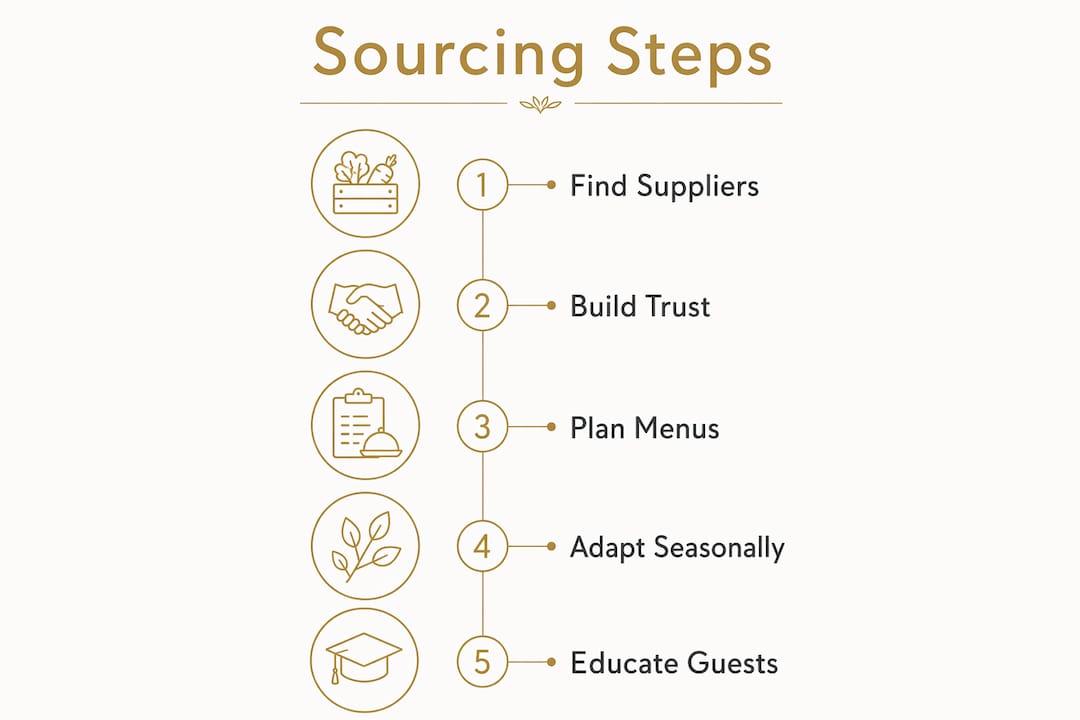
Farmers’ markets, regional food hubs, and direct approaches to farms and fisheries are all effective starting points. In the UK, organisations such as the Sustainable Restaurant Association and regional food networks can connect chefs with vetted local producers. For seafood specifically, day-boat fisheries and local fish markets often sell direct to trade at competitive prices, provided you can commit to taking what is available rather than a fixed weekly order.
Seasonality requires menu flexibility. A kitchen that can adapt its specials daily or weekly based on what has arrived that morning is far better placed to use local ingredients well than one locked into a rigid printed menu. Flexible menus tied to daily and seasonal local ingredient availability reduce waste, lower inventory costs, and reinforce authenticity in fine dining. This is not a compromise. It is a mark of culinary confidence.
Pro Tip: Start with one or two signature local ingredients rather than attempting a full menu overhaul. Master the supplier relationship, understand the seasonal rhythm, and build from there. Guests notice when a chef genuinely knows their produce, and that knowledge shows on the plate.
Practical sourcing guidance:
-
Visit local farmers’ markets and food fairs to meet producers face to face before committing to a supply arrangement.
-
Ask suppliers about their growing or fishing calendar so you can plan menus weeks in advance.
-
Build flexibility into your menu format, using a specials board or a daily-changing section for the most seasonal items.
-
Negotiate a standing weekly order with your most reliable suppliers to guarantee volume, while leaving room for opportunistic purchases.
-
Consider community-supported agriculture schemes, which provide a regular seasonal box of produce and often include direct contact with the grower.
How to use local provenance to attract and retain guests
The word “local” on a menu does more than describe geography. Eye-tracking research shows that “local” as a menu cue captures diners’ attention and influences their selection more powerfully than the word “fresh.” That is a meaningful finding for anyone writing menu copy. Specificity amplifies the effect: naming the farm, the harbour, or the producer transforms a description into a story.
Displaying producer information on menus significantly influences diners’ local food purchase intentions, particularly for regular guests who value verbal proof of provenance over visual cues alone. Research shows that involvement level shapes how diners respond to these stimuli, with more engaged diners responding strongly to named-producer information. That means your regulars, your most valuable guests, are precisely the audience most likely to reward this kind of transparency.
Staff education is equally important. Menu storytelling and specific provenance details, combined with staff briefing, significantly increase guest connection and orders of local dishes. A server who can say “the sea bass tonight is from a day-boat out of Brixham, landed this morning” is doing more for your local sourcing programme than any amount of menu copy.
Effective communication strategies for local provenance:
-
Name the producer, farm, or fishery directly on the menu rather than using generic regional labels.
-
Brief front-of-house staff on the story behind each local ingredient before every service.
-
Use social media to document supplier visits and seasonal arrivals, building a narrative that extends beyond the dining room.
-
Highlight seasonal availability to create a sense of occasion and urgency around specific dishes.
-
Consider a short “meet the producer” section on your menu or website, with photographs and a sentence about each supplier.
Expert insights on overcoming barriers and innovating with local ingredients
The challenges of local sourcing are real. Inconsistent quality, higher costs, limited availability, and the processing demands of whole or less-prepared ingredients all create friction, particularly for smaller kitchens. Barriers to purchasing local proteins include inconsistent quality, price, limited availability, and processing needs. Smaller, higher-end restaurants are generally better placed to absorb these challenges because their entrée pricing gives them the margin to work with premium local suppliers.
Native and heirloom ingredients in menus strengthen cultural identity, drive culinary innovation, and support regional tourism. Yet these ingredients are often underrepresented, precisely because they require more knowledge, more preparation, and more supplier effort than commodity produce. That gap is an opportunity for chefs willing to invest the time.
The concept of “glocalization” captures what the best local-sourcing restaurants actually do. They balance global culinary standards with local seasonal offerings, respecting local heritage and resources through menu design. Thesensorychef applies this approach directly, drawing on French culinary training and Mediterranean technique while grounding every menu in the ingredients that the local land and sea genuinely produce. The market-to-table experience offered by Thesensorychef is a direct expression of this philosophy, built around what is available at the market that day.
| Challenge | Practical response |
|---|---|
| Inconsistent supply | Build relationships with multiple producers for the same ingredient; keep a flexible specials format |
| Higher unit cost | Focus local sourcing on hero dishes where provenance justifies premium pricing |
| Limited processing capacity | Start with ingredients that arrive table-ready: whole fish, seasonal vegetables, aged local cheeses |
| Seasonal gaps | Plan menus around preservation techniques: pickling, fermenting, and curing extend seasonal produce |
| Staff knowledge gaps | Brief the team on each local ingredient’s origin, flavour profile, and best preparation method |
Food safety and regulatory standards for locally sourced ingredients
Local sourcing does not exempt a kitchen from the full weight of UK food safety law. The Food Standards Agency sets the framework, and all food businesses must comply with Regulation (EC) No 852/2004 on food hygiene, which remains retained in UK law post-Brexit. Local suppliers must be able to provide traceability documentation, and restaurants are responsible for verifying that any producer they buy from meets the relevant hygiene and safety standards.
For seafood specifically, the UK requires that all fish and shellfish sold commercially meet the standards set out in retained EU Regulation (EC) No 853/2004, covering temperature control, handling, and species labelling. Day-boat fisheries and small-scale producers are not exempt. Chefs sourcing direct from the harbour or a local farm should request copies of the producer’s food business registration and any relevant inspection records.
Traceability is both a legal requirement and a marketing asset. The law requires you to be able to identify where each ingredient came from. Good practice goes further, using that information as the basis for the provenance storytelling that guests now expect. Seafood traceability has moved from a minor administrative function to the centre of the sustainable seafood movement, and the same shift is underway across meat, dairy, and produce.
Cost implications and budgeting for local ingredients
Local ingredients often cost more per unit than commodity alternatives sourced through large national distributors. That is a fact of the supply chain, not a reason to avoid them. The question is where in the menu that cost is best absorbed, and how the kitchen’s overall buying strategy can offset it.
Concentrating local sourcing on a small number of high-visibility dishes is the most effective approach for most restaurants. A single hero ingredient, a named local cheese, a day-boat fish, a heritage breed pork, carries the provenance story and justifies a higher menu price. The rest of the menu can draw on conventional supply without undermining the restaurant’s local credentials.
Waste reduction is the other side of the cost equation. Seasonal, local produce used at peak freshness spoils less quickly than produce that has already spent days in transit. A kitchen that plans its menus around what is arriving fresh that week, rather than maintaining a fixed year-round ingredient list, will typically find that its waste costs fall as its local sourcing increases. The net cost impact is often smaller than it first appears.
UK restaurants that have built their identity around local ingredients
Several UK restaurants have demonstrated that a local-first sourcing philosophy can become the foundation of a nationally recognised culinary identity. L’Enclume in Cumbria, led by Simon Rogan, operates its own farm to supply the kitchen directly, with the menu changing to reflect what is ready to harvest. That farm-to-table commitment has been central to the restaurant’s two Michelin stars and its reputation as one of the most distinctive dining experiences in Britain.
In Cornwall, restaurants along the coast have built menus almost entirely around the day-boat catch from Newlyn and Looe, with chalkboard menus that change daily depending on what the boats bring in. The model mirrors what Michelin-starred chefs in Catalonia have long practised: cook the fish that is available according to the seasons, and let the sea dictate the menu rather than the other way around.
Scotland’s larder, from Orkney scallops to Hebridean lamb to Perthshire game, has become a defining feature of the country’s fine dining scene. Restaurants that name their suppliers and celebrate the provenance of Scottish produce have found that this transparency builds a loyal following among both domestic diners and international visitors seeking an authentic regional experience. The role of fresh seafood in menus as an identity marker is as true in the Scottish Highlands as it is on the Catalan coast.
Key takeaways
Local ingredients are the most direct route to a menu that is fresher, more sustainable, more economically responsible, and more compelling to guests who value provenance and authenticity.
| Point | Details |
|---|---|
| Freshness drives quality | Local produce reaches the kitchen at peak nutritional value, with better flavour and less need for preservatives. |
| “Local” outperforms “fresh” on menus | Eye-tracking research shows the word “local” influences dish selection more powerfully than “fresh.” |
| Flexibility reduces waste | Menus adapted to daily and seasonal availability lower inventory costs and food waste. |
| Provenance justifies premium pricing | Named-producer information increases purchase intention, particularly among regular, engaged diners. |
| Regulatory compliance is non-negotiable | All local suppliers must meet UK Food Standards Agency traceability and hygiene requirements. |
Why local sourcing is where culinary craft and conscience meet
There is a version of the local sourcing conversation that stays entirely at the level of marketing: put the farm name on the menu, charge more, repeat. That version misses the point entirely.
The real argument for local ingredients is about what cooking actually is. When a menu is built around what the land and sea are genuinely producing right now, the chef is forced to engage with the ingredient on its own terms. You cannot hide behind a consistent, year-round commodity product. You have to understand the seasonal rhythm, build relationships with the people who grow and catch your food, and adapt your technique to what arrives at the kitchen door. That discipline produces better cooking.
The provenance storytelling that guests respond to is not a communications exercise. It is the natural result of a chef who genuinely knows where the food comes from and why it matters. When Joseph Warner sources ingredients for a private dinner in Granada or along the Costa Tropical, the conversation with the market vendor or the local fisherman is part of the creative process, not an afterthought. That knowledge shapes the menu, the flavour combinations, and the way each dish is presented and explained at the table.
For restaurant owners considering a deeper commitment to local sourcing, the practical advice is simple: start with the ingredient you care most about, find the best local producer of it, and build from there. The operational complexity is real but manageable. The culinary reward is immediate.
Bring local ingredients to your table with Thesensorychef

Thesensorychef offers bespoke private dining experiences built around fresh, seasonal, and locally sourced ingredients, crafted by Joseph Warner with more than 13 years of professional culinary experience. Whether you are planning a villa dinner in Granada, a celebration on the Costa Tropical, or an intimate tasting menu for a special occasion, every menu is designed around what the local land and sea are producing at their best. Explore the signature dining experience or get in touch to discuss a menu tailored entirely to your occasion.
FAQ
Why is it important to use local ingredients in a restaurant menu?
Local ingredients deliver superior freshness, better nutritional quality, and a genuine sense of place that guests increasingly seek. They also support local producers, reduce environmental impact, and give chefs the provenance stories that drive guest engagement and premium pricing.
How does the word “local” affect what diners order?
Eye-tracking research shows that “local” as a menu descriptor captures diners’ attention and influences their selection more powerfully than “fresh,” making it one of the most effective single words in menu copywriting.
What food safety rules apply to locally sourced ingredients in the UK?
All local suppliers must comply with UK Food Standards Agency requirements, including retained Regulation (EC) No 852/2004 on food hygiene and, for seafood, retained Regulation (EC) No 853/2004. Restaurants are responsible for verifying supplier registration and maintaining full traceability records.
Does local sourcing always cost more?
Local ingredients often carry a higher unit cost than commodity alternatives, but concentrating local sourcing on a small number of hero dishes and reducing waste through seasonal menu planning typically narrows the net cost difference considerably.
What is the best way to communicate local provenance to guests?
Name the specific producer or fishery on the menu, brief front-of-house staff on each ingredient’s origin before service, and use social media to document supplier relationships. Research shows that named-producer information significantly increases purchase intention, particularly among regular, engaged diners.