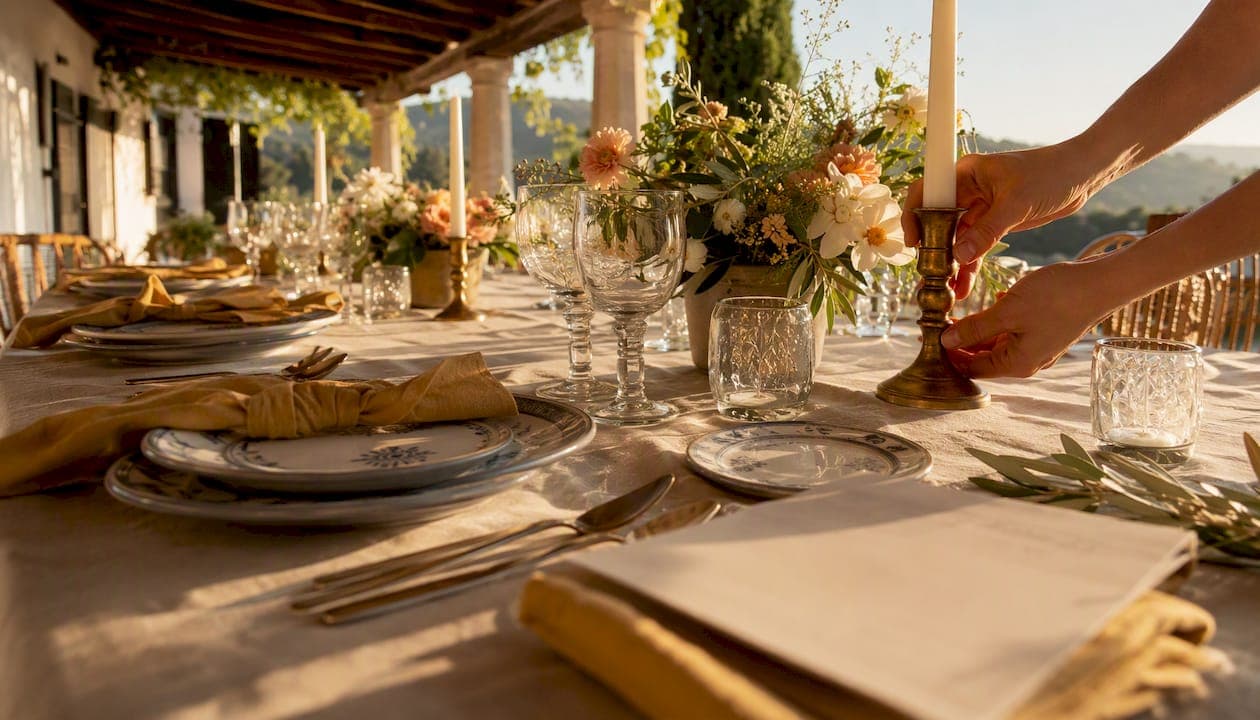
For most intimate at-home weddings, a shared family-style menu or a short tasting menu of 4–6 courses gives the best balance of warmth, logistics, and cost. Both formats suit the scale, keep service manageable, and let the food become part of the occasion rather than a background task. Intimate weddings typically host 10–40 guests, and that scale is precisely what makes a more considered, personalised menu feasible.
Two alternatives are worth knowing. A cocktail or grazing format suits very informal gatherings or couples who want guests mingling freely from the start. A formal plated multi-course dinner works beautifully when the occasion calls for ceremony; however, it demands more staffing and kitchen coordination. The right choice depends on four factors:
- Guest count: 10–20 guests suit a tasting menu or plated dinner; 20–40 lean naturally towards family-style or a generous grazing spread.
- Kitchen access: a single domestic oven limits simultaneous plating; family-style and sharing formats are more forgiving.
- Budget: self-catering a sharing menu costs less per head than a staffed tasting menu, though hiring a private chef often closes that gap when you factor in your own time and stress.
- Dietary needs: the more varied the requirements, the more a structured menu with labelled dishes helps everyone eat confidently.
A home wedding works well for roughly 20–40 guests and benefits from around two to three months of planning. Start the menu conversation early, and the rest of the day tends to fall into place around it.
Key takeaways
A shared family-style or short tasting menu of 4–6 courses suits most intimate at-home weddings, giving the best balance of atmosphere, kitchen logistics, and cost for 10–40 guests.
| Point | Details |
|---|---|
| Choose the right format | Family-style suits 20–40 guests; a tasting menu works best for 10–20 with a private chef. |
| Plan portions carefully | Allow 180 g raw protein per guest for mains and 5–7 canapé pieces per person for a cocktail hour. |
| Manage dietary needs early | Collect requirements at RSVP, confirm two weeks before, and label every dish with allergen information. |
| Drinks maths | For 20 guests, plan roughly 5 bottles of sparkling, 7 white, and 6 red, plus 10 litres of non-alcoholic options. |
| The Sensory Chef | Joseph Warner provides fully bespoke private chef services for home weddings across Andalusia, including menu design, sourcing, and dietary accommodation. |
Table of Contents
- What menu format suits your intimate home wedding?
- Practical sample menus for a home wedding
- Portions, quantities, and rough UK cost guidance
- What drinks should you serve at a home wedding?
- Service, staffing, and equipment for a home wedding
- How to manage dietary requirements for every guest
- Presentation and atmosphere: small touches that matter
- How The Sensory Chef designs a bespoke wedding menu
- Hour-by-hour timeline for the wedding day
- Why intimate home weddings deserve more credit
- The Sensory Chef: bespoke private chef services for your home wedding
- Sources
- FAQ
What menu format suits your intimate home wedding?
Choosing a serving format is the single most consequential decision in planning a home wedding menu. Get it right and everything else, from shopping lists to staffing, becomes straightforward.
The five formats at a glance
Seated tasting menu (4–8 courses): Each guest receives individual plates in sequence. Intimate and theatrical, it suits 10–20 guests and a kitchen with at least one experienced cook or a hired chef. For groups under 50, a tasting menu of 7–10 small plates with wine pairing turns the food into a focal experience rather than a backdrop.
Family-style sharing: Large platters are placed at the table for guests to serve themselves. Conversation flows naturally, individual plating pressure disappears, and the format scales from 10 to 40 guests without drama. It is the most forgiving option for a home kitchen.
Buffet: Guests serve themselves from a central station. Works for 30–60 guests and reduces waiting staff requirements, but can feel less personal at a small wedding and requires careful temperature management.
Cocktail or grazing: Canapés, charcuterie boards, and bite-sized dishes circulate or sit on styled stations. Ideal for very informal celebrations or a pre-dinner drinks hour. Not suited as the sole food offering for a seated wedding of more than two hours.
Plated three-course dinner: A classic starter, main, and dessert served to each guest. Familiar, elegant, and manageable for 10–25 guests with one or two servers.
How to decide: five quick questions
- Does your kitchen have two or more working oven shelves and a large hob? If not, rule out the tasting menu unless you are hiring a chef.
- Do you want guests seated throughout, or mingling freely? Seated formats need a dining area; cocktail formats need open floor space.
- Is the atmosphere formal or relaxed? Tasting menus and plated dinners signal ceremony; sharing and grazing signal celebration.
- How many dietary variations are on your guest list? More than three distinct requirements favour a structured menu with labelled dishes over a free-form buffet.
- What is your staffing plan? A tasting menu without a private chef is genuinely difficult to execute well.
Pro Tip: If you are torn between family-style and a tasting menu, combine them: serve two or three sharing starters, then a plated main course, then a shared dessert. You get the theatre of plating where it matters most without needing a full brigade in the kitchen.
Practical sample menus for a home wedding
These four templates are starting points. Adjust dishes to the season, your kitchen, and your guests' preferences.
Menu 1: Short tasting menu (6 courses, 10–20 guests)
- Amuse-bouche: chilled gazpacho shot with basil oil
- Starter: seared scallop, cauliflower purée, crispy capers
- Fish course: pan-roasted sea bass, fennel, saffron beurre blanc
- Sorbet: lemon and thyme
- Main: slow-braised lamb shoulder, roasted root vegetables, rosemary jus
- Dessert: dark chocolate fondant, salted caramel ice cream
Seasonal notes: In spring, swap lamb for spring chicken with morel cream. In summer, replace the fondant with a strawberry and elderflower pavlova.
Substitutions: Scallop starter becomes a roasted beetroot and goat's cheese tart for vegetarians. Sea bass course becomes a grilled courgette and lemon ricotta cannelloni for vegans. Gluten-free guests skip the cannelloni and receive a grilled aubergine stack instead.
Advance prep: Gazpacho, cauliflower purée, and the jus can all be made the day before. The fondants can be portioned and refrigerated, ready to bake to order.
For inspiration on French seasonal menus that translate beautifully to a home setting, The Sensory Chef's seasonal dining approach is worth exploring.
Menu 2: Family-style sharing menu (20–40 guests)
Starters (shared platters):
- Burrata with heritage tomatoes, basil, and aged balsamic
- Charcuterie and Manchego board with honey and walnuts
- Roasted red pepper and almond romesco with sourdough
Mains (large dishes at the table):
- Slow-roasted pork belly with apple and fennel
- Roasted Mediterranean vegetables with harissa yoghurt (vegan)
- Saffron rice and herb salad
Dessert:
- Lemon tart, sliced and plated
- Fresh fruit platter
Substitutions: Replace pork with a whole roasted cauliflower with chermoula for a vegetarian centrepiece. Gluten-free guests skip the sourdough; all other dishes are naturally GF.
Advance prep: Romesco, charcuterie boards, and the lemon tart can be prepared the morning of the wedding. The pork belly benefits from an overnight brine.
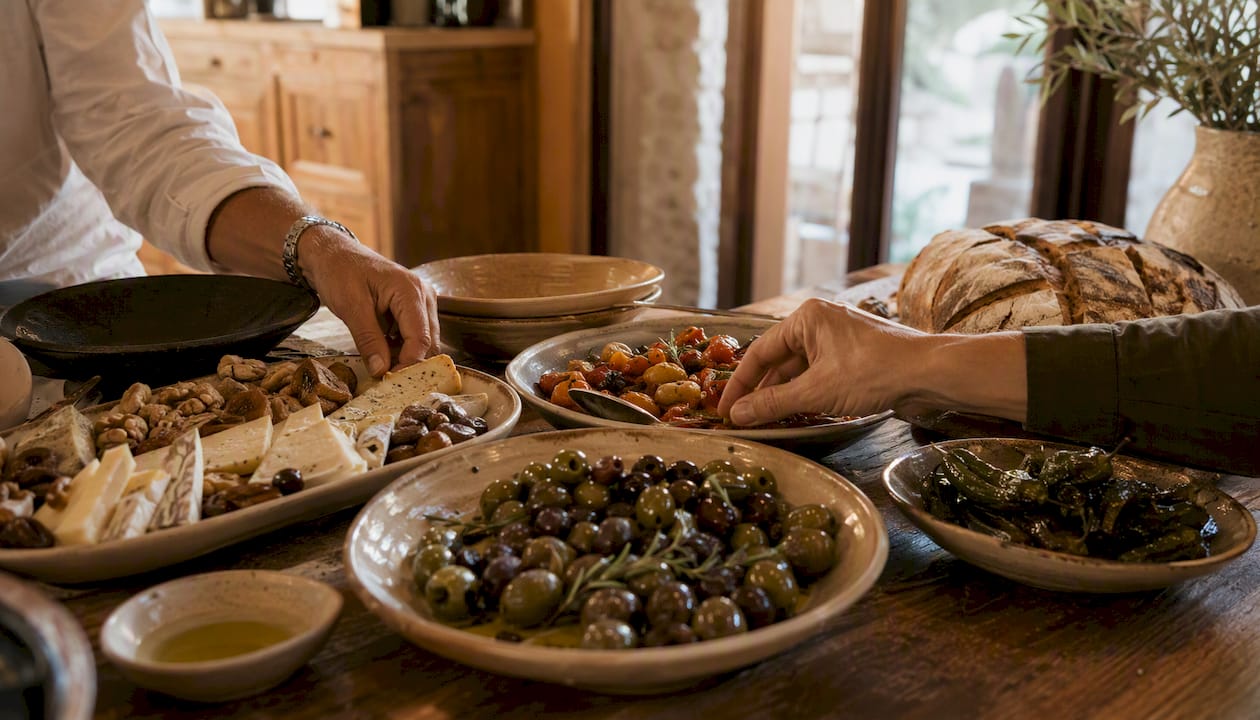
Family-style sharing menus foster conversation and reduce individual plating pressure, making them ideal when you want a relaxed, convivial atmosphere.
Menu 3: Cocktail and grazing (20–50 guests, pre-dinner or standalone)
Canapés (6–8 varieties, 4–6 pieces per guest):
- Smoked salmon blini with crème fraîche and dill
- Manchego and quince crostini
- Gazpacho shooter (vegan, GF)
- Mini crab tart
- Caprese skewer (vegan, GF)
- Mushroom and truffle arancini
Grazing station:
- Seasonal cheeses, cured meats, olives, pickles, and flatbreads
- Crudités with hummus and tzatziki
When offering grazing or canapé formats, choose bite-sized, easy-to-eat items and provide clear allergen labelling for every dish on the station.
Advance prep: Arancini can be formed and refrigerated a day ahead. Blinis can be made the morning of the event and reheated gently.
Menu 4: Plated three-course dinner (10–25 guests)
- Starter: Roasted tomato and red pepper soup, basil cream
- Main: Pan-roasted duck breast, cherry and port sauce, dauphinoise potatoes, wilted spinach
- Dessert: Vanilla panna cotta, raspberry coulis
Substitutions: Soup is naturally vegan. Swap duck for a wild mushroom and chestnut Wellington for vegetarians. Panna cotta becomes a coconut milk version for dairy-free guests.
For international dishes that work equally well in a home kitchen, The Sensory Chef's private dining repertoire spans Mediterranean, French, Spanish, and Italian formats.
Pro Tip: For any plated menu, pre-plate the starter before guests sit down. It removes the most stressful moment of service and lets you focus on the main course.
Portions, quantities, and rough UK cost guidance
Getting quantities right prevents both waste and the quiet panic of running short. The figures below are practical starting points, not guarantees, as appetite varies with the time of day, alcohol service, and the number of courses.
Portion guide per guest
| Item | Per guest (approx.) | Notes |
|---|---|---|
| Canapés (cocktail hour) | 5–7 pieces | Increase to 8–10 if no sit-down meal follows |
| Starter (plated) | 80 g | Soup: 200 ml |
| Main protein | 180 g (raw weight) | Reduce to 100 g for sharing platters |
| Starchy side | 150 g (cooked) | Rice, potatoes, or pasta |
| Vegetable side | 100 g (cooked) | Two varieties recommended |
| Dessert (plated) | 100 g | Increase for sharing formats |
| Bread / rolls | 1–2 rolls | Or 30–40 g sliced sourdough |
| Cheese board (sharing) | 50 g | Per person at the table |
Rough UK per-person cost bands
These are indicative ranges based on typical UK market conditions. Actual costs vary by supplier, season, and region.
- Self-catering (you shop and cook): £25–£55 per head for a three-course dinner with quality ingredients; £15–£30 for a sharing or grazing format.
- Private chef (chef cooks, you provide kitchen and ingredients): £60–£120 per head depending on menu complexity and guest count.
- Full private chef service (chef sources, cooks, and serves): £90–£180 per head, inclusive of ingredients and basic service. This range reflects the UK market; costs in Andalusia differ and are quoted separately by The Sensory Chef.
Leftovers store well; running short does not. Cool and refrigerate surplus food within two hours of service, and consume within two days or freeze promptly.*
What drinks should you serve at a home wedding?
Drinks planning is where many home weddings overspend or underplan. A few clear rules keep it manageable.
Simple pairing principles
- Sparkling wine or Cava for the welcome drinks and toasts.
- Light whites (Albariño, Vermentino, unoaked Chardonnay) with fish courses, scallops, and lighter starters.
- Fuller whites or light reds (Pinot Noir, Grenache) with poultry and pork.
- Medium reds (Tempranillo, Côtes du Rhône) with lamb, duck, and beef.
- Sweet wine or Cava with dessert, or simply return to sparkling.
For a more considered approach to wine pairing for your event, The Sensory Chef's pairing guide covers practical rules for matching bottles to a multi-course menu.
Bottle maths for 10, 20, and 40 guests
A standard 750 ml bottle of wine yields approximately five glasses. Plan on two to three glasses of wine per guest over a two-to-three-hour dinner, plus one glass of sparkling for the toast.
Non-alcoholic options should include still and sparkling water, a soft drink, and at least one non-alcoholic cocktail or mocktail. Guests who do not drink alcohol often feel overlooked when the only alternative is tap water.
Bar format options
- Self-serve drinks table: lowest cost, no staffing needed, suits informal formats. Risk: guests over-pour and bottles empty faster than planned.
- Limited bar (2–3 cocktails plus wine): a single person can manage this for up to 30 guests. Prepare cocktail bases in advance.
- Staffed bar: one bartender per 40–50 guests. Adds polish and controls consumption. Worth the cost for a tasting menu or formal dinner.
Service, staffing, and equipment for a home wedding
The gap between a home wedding that feels effortless and one that feels chaotic usually comes down to staffing and equipment, not the food itself.
Staffing options and when to choose each
- DIY with family: suitable for a grazing or sharing format with up to 20 guests. Assign specific roles (drinks, clearing, plating) in advance so no one person is overwhelmed.
- One or two waiting staff: the right choice for a plated three-course dinner with 15–30 guests. A single experienced server can manage 10–12 guests for a simple menu.
- Private chef plus one server: the most practical model for a tasting menu or any format where the host wants to be a guest at their own wedding. The chef handles all kitchen logistics; the server manages the dining room.
- Full waiting team: for 30–50 guests with a formal menu, plan on one server per 10–12 guests. A head waiter or maître d' to coordinate service is worth adding for larger counts.
Hiring a private chef for an at-home wedding reduces host workload and improves coordination of dietary needs, plating, and service timing compared with a fully DIY approach.
Recommended staff-to-guest ratios
- Tasting menu (plated): 1 server per 8–10 guests
- Family-style sharing: 1 server per 15–20 guests
- Buffet or grazing: 1 server per 25–30 guests (primarily for replenishment and clearing)
For a practical overview of how to set up a luxury dining experience at home, The Sensory Chef's guide covers staging, equipment, and service flow in detail.
Equipment and rental checklist
- Dinner plates, side plates, and soup bowls (one set per guest, plus 10% spare)
- Wine glasses, water glasses, and champagne flutes
- Serving platters and tongs for sharing formats
- Chafing dishes or warming trays for buffet items
- A portable induction hob if the home kitchen has fewer than four burners
- Portable bar station or trestle table for drinks
- Linen tablecloths and napkins (hire rather than buy for a single event)
- Adequate refrigeration: hire a catering fridge or cool box if your domestic fridge cannot hold all pre-prepped dishes
Safety note: Keep raw proteins separate from ready-to-eat foods at all times. If you are using a temporary outdoor kitchen or gazebo, ensure you have a power source rated for catering equipment and that all surfaces are food-safe. Check with your local council if you plan to serve food to guests beyond your immediate household, as Environmental Health guidance may apply.
How to manage dietary requirements for every guest
A guest list of 10–40 people almost always includes at least one allergy, intolerance, or dietary preference. A clear system prevents last-minute substitutions and keeps service calm.
Step-by-step collection and management
- Include a dietary field on your RSVP. Ask guests to list allergies (with severity), intolerances, and preferences (vegetarian, vegan, pescatarian, halal, kosher). Keep the question open rather than tick-box to catch unusual combinations.
- Confirm two weeks before the wedding. Follow up with any guest who did not respond or whose answer was vague. Confirm the exact number of each dietary variant with your chef or catering team.
- Create a one-page kitchen reference sheet. List each guest's name, seat number, and dietary needs. Give a copy to the chef and each server.
- Label every dish at the table. For sharing and buffet formats, use small cards listing the dish name and the 14 UK-regulated allergens present. For plated formats, a discreet card at each place setting works well.
- Plate dietary variants first. When plating, prepare all special-requirement plates before the standard plates. This prevents cross-contamination and ensures no one waits longer than other guests.
- Brief your servers. Every person carrying food should know which plates go to which guests and be able to answer basic allergen questions.
Pro Tip: The 14 allergens regulated under UK food law (including gluten, crustaceans, eggs, fish, peanuts, soya, milk, nuts, celery, mustard, sesame, sulphites, lupin, and molluscs) should be identified for every dish you serve. The Sensory Chef's approach to accommodating dietary needs in private dining offers a practical model for home events.
Clear allergen labelling is particularly important for grazing and buffet formats, where guests serve themselves and cannot easily ask a server about ingredients.
Presentation and atmosphere: small touches that matter
The difference between a home dinner and a wedding dinner is rarely the food itself. It is the considered detail around it.
Table setting checklist
- Pressed linen tablecloths and cloth napkins (hire if you do not own enough)
- Charger plates or placemats under dinner plates
- Candles: taper candles in holders for a formal look; tea lights in glass votives for warmth
- Simple centrepieces: a single stem in a bud vase, a small arrangement of seasonal flowers, or a cluster of candles at varying heights
- Handwritten or printed menu cards at each place setting
- Small cards noting the provenance of a key ingredient ("Tomatoes from a local Andalusian farm" or "Lamb sourced from a nearby estate")
Plating cues for a home kitchen
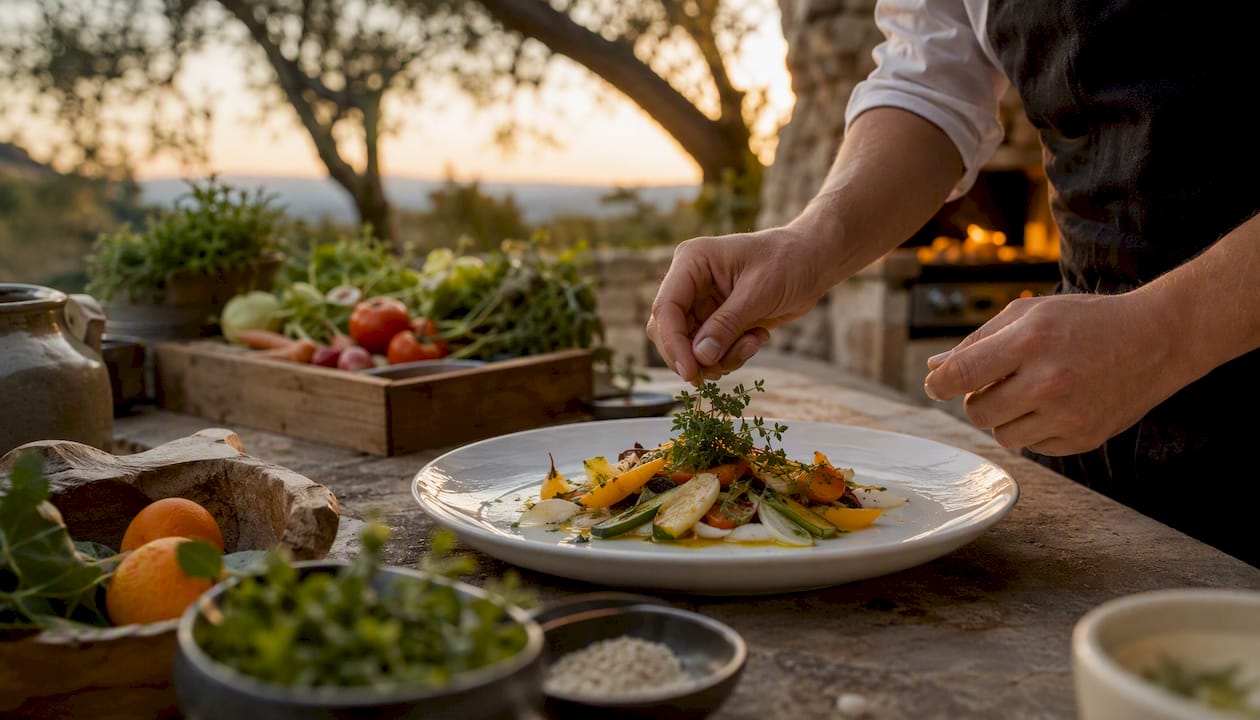
For plated formats, keep the plate clean and the portion centred. A smear of sauce, a sprig of fresh herb, and a drizzle of good olive oil transform a home-cooked dish into something that reads as considered. For family-style, use the largest, most beautiful serving vessels you own. Rustic wooden boards, wide ceramic platters, and cast-iron dishes all add texture and warmth to the table.
Wedding planners consistently recommend seasonal, locally sourced menus and simple, personal decoration for intimate ceremonies, and the two work together: a dish built around a single exceptional local ingredient needs very little else on the plate.
For specific guidance on food presentation in a private dining context, The Sensory Chef's presentation guide covers plating techniques suited to home kitchens.
How The Sensory Chef designs a bespoke wedding menu
Joseph Warner is a French-trained private chef with more than 13 years of professional culinary experience, trained in classical French gastronomy and experienced across Spanish, Mediterranean, Italian, and international cuisine. He founded The Sensory Chef to bring bespoke private dining to villas, private homes, and exclusive events across Granada, Málaga, and Andalusia.
What distinguishes his approach is the sensory framework he developed as a deaf chef. Without relying on sound as a cooking cue, Joseph works with heightened attention to flavour balance, texture contrast, aroma layering, and visual composition. Every dish in a wedding menu is considered across all four dimensions, not just taste.
A sample bespoke menu outline from The Sensory Chef
- Welcome canapés: chilled gazpacho shot, Manchego croqueta, smoked salmon on blini
- First course: seared scallop, pea purée, pancetta crisp, lemon foam
- Fish course: roasted sea bass, saffron and mussel broth, fennel
- Sorbet: cucumber and mint
- Main: slow-cooked Iberian pork cheek, truffle potato terrine, glazed baby carrots
- Pre-dessert: citrus granita
- Dessert: dark chocolate sphere, salted caramel, hazelnut praline
Vegetarian and vegan variants are built into the menu from the outset, not added as afterthoughts. Gluten-free, dairy-free, and nut-free adaptations are confirmed during the pre-event consultation.
Booking and practicalities
The process begins with a brief consultation to understand the couple's tastes, the home's kitchen setup, and the guest list's dietary profile. Joseph then proposes a bespoke menu with two or three options per course. Once confirmed, he handles sourcing, preparation, and service, leaving the couple free to be present at their own celebration.
The Sensory Chef operates across Granada, Almuñécar, the Costa Tropical, Málaga, and Andalusia. For villa guests and residents planning a home wedding in the region, the private dining experience page outlines the full service and how to request a quote.
Pro Tip: Book your private chef at least six to eight weeks before the wedding date. Popular dates in spring and autumn in Andalusia fill quickly, and the pre-event consultation and menu development take time to do well.
Hour-by-hour timeline for the wedding day
A clear timeline prevents the two most common home wedding catering failures: food arriving late and the host spending the entire reception in the kitchen.
Adaptable timeline (evening ceremony, dinner at 7:30 PM)
- 10:00 AM: Chef arrives. Kitchen walkthrough, equipment check, refrigeration confirmed.
- 11:00 AM: Prep begins. Stocks, sauces, purées, and cold starters prepared and stored.
- 1:00 PM: Break. Kitchen cleaned and reset for afternoon prep.
- 2:00 PM: Afternoon prep: desserts portioned, proteins marinated or brined, garnishes prepared.
- 4:30 PM: Table set. Linen, glassware, menu cards, and centrepieces in place.
- 5:30 PM: Welcome drinks and canapés staged. Canapé trays prepped and ready to go.
- 6:00 PM: Guests arrive. Canapés served. Chef begins final mise en place for dinner service.
- 7:30 PM: Guests seated. First course plated and served within 10 minutes of seating.
- 8:00 PM: Second course served.
- 8:45 PM: Main course served.
- 9:30 PM: Dessert served. Wedding cake cut if applicable.
- 10:00 PM: Clearing begins. Leftovers cooled and stored within two hours of service.
- 11:00 PM: Kitchen cleaned and handed back.
Kitchen checklist for the day
- All equipment tested and working before guests arrive
- Warming oven or chafing dishes set to correct temperature
- Plating station clear and organised by course
- Allergen plates labelled and separated from standard plates
- Serving team briefed on course order, timing, and dietary variants
Contingency notes
- Power outage: keep a portable induction hob charged and a battery-powered LED lighting option for the dining area.
- Rain for outdoor service: have a gazebo or marquee confirmed in advance; never rely on a forecast alone.
- Extra refrigeration: hire a catering fridge if the domestic fridge cannot hold all pre-prepped dishes at safe temperatures (below 5°C).
Pro Tip: Cool all leftover food to below 5°C within two hours of service. Divide large quantities into shallow containers to speed cooling. Label with the date and consume within two days, or freeze immediately. Never leave cooked proteins at room temperature for more than two hours.
Why intimate home weddings deserve more credit
There is a tendency in wedding planning to treat a home celebration as a compromise, a smaller version of the real thing. That framing misses what makes these events genuinely special.
When the guest list is 15 or 20 people, the food can do something it rarely achieves at a large reception: it can be the event. A tasting menu with wine pairing at a table of 20 creates a shared rhythm, a collective experience of anticipation and pleasure, that a buffet for 200 simply cannot replicate. The conversation is richer because the table is smaller. The couple are present in a way that is impossible when they are working a room of a hundred people.
The practical argument for a home wedding is also stronger than it looks. Venue hire, corkage fees, and mandatory catering packages at licensed venues add up quickly. A well-planned home wedding with a private chef can deliver a genuinely superior culinary experience at a comparable or lower total cost, with none of the venue's constraints on timing, décor, or suppliers.
What I find most rewarding about cooking for these events is the specificity of it. Every dish can reflect something real about the couple: a region they love, an ingredient from their first trip together, a flavour that means something. That kind of personalisation is not a luxury add-on. At a small table, it is simply what good cooking looks like.
The Sensory Chef: bespoke private chef services for your home wedding
Planning a home wedding menu is one of the most personal decisions in the whole process, and it deserves the same care as every other detail of the day.
The Sensory Chef offers a fully bespoke private chef service for intimate home weddings across Granada, Málaga, Almuñécar, the Costa Tropical, and Andalusia. Joseph Warner designs each menu around your tastes, your kitchen, and your guests, handling everything from sourcing and preparation to plating and service. Dietary requirements, seasonal ingredients, and wine pairing are all built into the process from the first conversation.
To request a sample menu or discuss your wedding date, visit the private dining experience page and get in touch directly. Dates in spring and autumn book early, so the sooner you reach out, the more time there is to craft something genuinely memorable.
Sources
The following UK and sector resources are worth consulting for food safety, licensing, and catering guidance:
- Cómo organizar una boda en casa | Mireia Casamada
- Cómo organizar una boda íntima de menos de 50 invitados
- 6 consejos para elegir la comida de una boda - ESAH
- Boda íntima: ideas y consejos para tener éxito - Celinni
If you are serving food to guests beyond your immediate household at a private home event, it is worth a brief call to your local council's Environmental Health department to confirm whether any notification or registration is needed. Requirements vary by local authority and the nature of the event.
FAQ
How many guests count as an intimate wedding?
Most planning resources place intimate weddings at 10–40 guests, with some rural or private-property celebrations extending to 50. Below 20 guests is typically considered micro or elopement scale.
What food works best for a small home wedding dinner?
A family-style sharing menu or a short tasting menu of 4–6 courses suits most home weddings. Both formats are manageable in a domestic kitchen and create a warm, personal atmosphere.
How do you handle dietary requirements at a home wedding?
Collect dietary needs at RSVP, confirm two weeks before the event, and label every dish with allergen information. Plate dietary variants first to avoid cross-contamination, and brief all servers on which plates go to which guests.
How many bottles of wine do you need for 20 wedding guests?
For a two-to-three-hour dinner with 20 guests, plan on roughly 7 bottles of white wine, 6 bottles of red, and 5 bottles of sparkling for the toast, plus 10 litres of non-alcoholic options.
When should you hire a private chef for a home wedding?
A private chef is particularly valuable for a tasting menu, a guest list with complex dietary requirements, or any occasion where the host wants to be fully present rather than managing the kitchen. Booking six to eight weeks in advance is advisable for popular dates.