A professional private chef manages dietary intolerances by documenting every restriction before arrival, redesigning the menu around safe substitutions, and enforcing strict kitchen protocols on the day. When you share your guests’ needs early, the result is a table where everyone eats the same quality of food, with no compromises on flavour or presentation.
The five pillars of professional dietary management are:
-
Assessment — a written pre-event questionnaire capturing severity, reaction type, and confirmed diagnosis
-
Bespoke menu design — dishes rebuilt from the base up, not simply stripped of one ingredient
-
Kitchen protocols — dedicated prep areas, colour-coded utensils, and allergen-free plating order
-
Careful service — labelled plates, server briefings, and discreet table communication
-
Documentation and insurance — written allergen matrix, food hygiene certificates, and public liability cover
When evaluating a chef, look for: verifiable credentials, a written questionnaire sent before arrival, confirmation of insurance, and a signed menu agreement.
Table of Contents
-
How does a chef gather and verify intolerances before arrival?
-
What kitchen protocols prevent cross-contamination in a villa?
-
How are modified dishes plated and served without singling anyone out?
-
What documentation and emergency readiness should you expect from a chef?
-
A ready-to-use questionnaire for collecting guest dietary information
-
Why an experienced private chef makes intolerance-safe dining genuinely enjoyable
-
Thesensorychef: bespoke private dining with full dietary care
How does a chef gather and verify intolerances before arrival?
A rigorous pre-arrival assessment prevents most problems at the table. The process begins at booking, not on the day.
A thorough intake covers:
-
Full name and emergency contact for each affected guest
-
Exact reaction type (anaphylaxis, intolerance, coeliac disease, preference)
-
Whether the condition is medically diagnosed or self-reported
-
Sensitivity to cross-contact (traces in shared oils, shared pans)
-
Preferred substitutes and any foods the guest actively dislikes
-
Number of affected guests and their seats at the table
For severe allergies, a responsible chef will ask to see a medical note or dietitian’s guidance, and will verify ingredient provenance with suppliers before confirming the menu. Thesensorychef uses a written questionnaire as standard, with dietary preferences confirmed directly with the chef before the menu is finalized.
Pro Tip: Share restrictions at least 14 days before the event. Remote properties in Andalusia often require specialist ingredients to be sourced from Granada, Málaga, or ordered from specialist suppliers, and lead times matter.
What kitchen protocols prevent cross-contamination in a villa?
Separation and labelling are the simplest, most effective controls. In a rented villa kitchen, where surfaces and equipment have unknown histories, a professional chef brings their own safeguards.
Step-by-step checklist for allergen-safe prep:
-
Designate a separate prep area for allergen-free components before any other cooking begins
-
Use colour-coded chopping boards and utensils (kept in a sealed bag until needed)
-
Store allergen-free ingredients in sealed, labelled containers away from standard ingredients
-
Use separate oils, fats, and condiments — never pour from a shared bottle into an allergen-free pan
-
Cook allergen-free components first, before any cross-contact risk exists in the kitchen
-
Label every prepared component clearly (ingredient list, allergen status) as it moves from prep to service
Cleaning between stages matters as much as separation. Surfaces are wiped down with food-safe sanitiser, not just rinsed, before allergen-free prep begins.
Pro Tip: When booking a private chef for a villa event, confirm in advance that the kitchen has a dishwasher or sufficient hot water for thorough equipment cleaning. If not, ask the chef what they will bring. Thesensorychef arrives with dedicated utensils, trays, and labelled containers as standard.
How are modified dishes plated and served without singling anyone out?
Plating order and clear server phrasing prevent mistakes at service. Allergen-free plates are always plated last, on a clean surface, using dedicated serving utensils. Each plate is labelled or marked so the server knows exactly which guest receives it.
Practical service routines:
-
Allergen-free plates are plated after standard plates, never before, to avoid cross-contact from splashes or shared garnish spoons
-
Each modified plate carries a small label or coloured marker visible to the server, removed discreetly before the plate reaches the guest
-
Servers are briefed before service with the guest’s name, seat position, and the specific modification
When delivering a modified dish, a brief, calm phrase is all that is needed: “This is your dish, prepared without gluten and dairy as requested.” No announcement to the table, no drawing of attention. The guest feels considered, not conspicuous.
Pro Tip: Brief every person involved in service, not just the lead server. A single uninformed team member handing the wrong plate is the most common point of failure at private events.
What documentation and emergency readiness should you expect from a chef?
A responsible chef documents their processes and carries appropriate cover. Before the event, you should be able to request:
- Written allergen matrix — a table mapping every dish to the 14 major allergens regulated under UK food law
For emergency readiness, a professional chef’s role is clear: if a guest shows signs of a severe allergic reaction, call emergency services immediately and follow the guest’s own emergency plan (EpiPen use, for example, is the guest’s or their carer’s responsibility). The chef’s job is to keep the scene calm, provide accurate ingredient information to paramedics, and ensure no further exposure. This is general guidance, not medical advice; always confirm emergency procedures with a qualified professional before your event.
How much notice do you need, and where do costs increase?
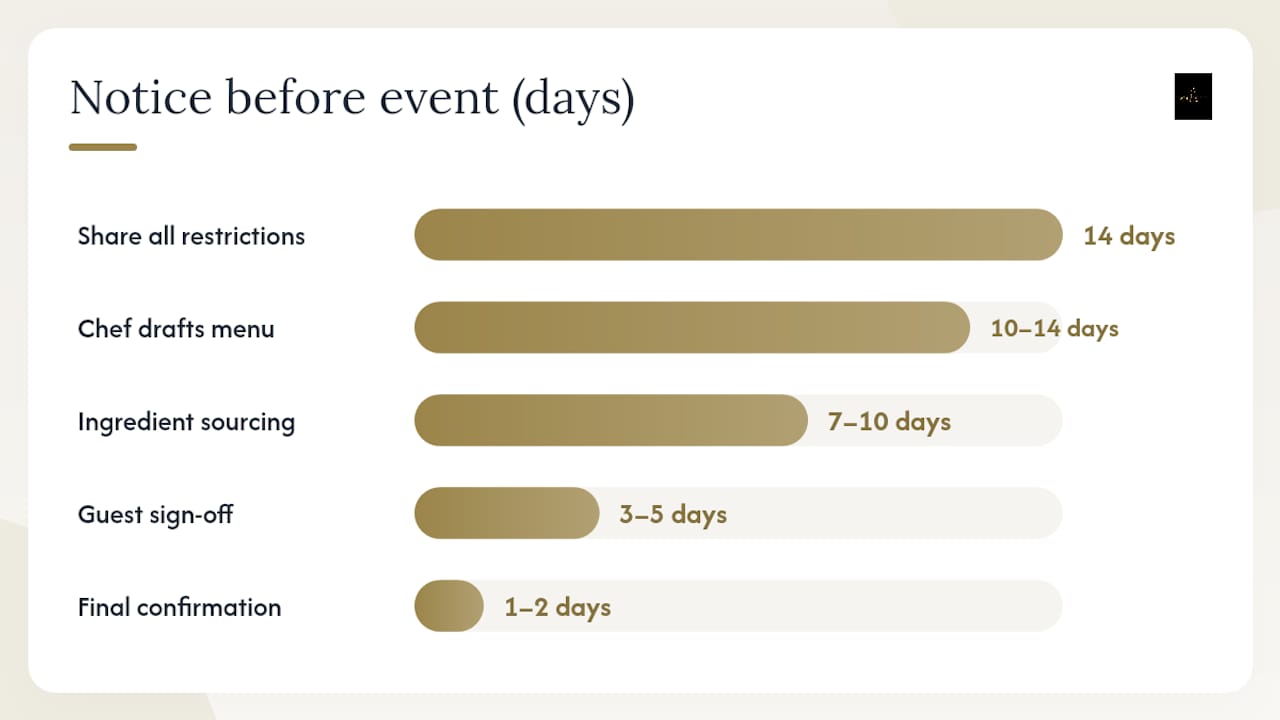
More notice reduces surprise charges. For a straightforward intolerance with widely available substitutes, 14 days is a workable minimum. For complex multi-allergen requirements or remote properties in Andalusia, up to 21 days is more realistic.
| Milestone | Suggested days before event |
|---|---|
| Share all dietary restrictions | 14 days |
| Chef drafts adapted menu | 10–14 days |
| Ingredient sourcing confirmed | 7–10 days |
| Guest sign-off on final menu | 3–5 days |
| Final confirmation and labelling plan | 1–2 days |
Typical cost drivers for intolerance-safe private dining:
-
Speciality flours, certified gluten-free stocks, or allergen-free dairy alternatives cost more than standard equivalents
-
Extra prep time for separate components and additional cleaning adds to the chef’s hours
-
Couriered or specialist-ordered ingredients for remote villas carry a delivery premium
-
A separate tasting session, when requested, is usually charged as an additional service
For events in rural Andalusia, supply runs to Granada or Málaga add both time and cost. Sharing restrictions early, as outlined in the event planning checklist, gives the chef the best chance of sourcing everything locally and keeping costs predictable.
A ready-to-use questionnaire for collecting guest dietary information
A short, structured questionnaire reduces ambiguity and speeds planning. Send this to each guest at least 14 days before the event.
Guest dietary questionnaire:
-
Full name
-
Emergency contact name and number (for severe allergies)
-
Do you have a medically diagnosed condition (coeliac disease, nut allergy, lactose intolerance, etc.)? If yes, please specify.
-
Is this a preference or a medical requirement?
-
Severity: discomfort, intolerance, or anaphylaxis risk?
-
Are you sensitive to cross-contact (traces in shared equipment or oils)?
-
Preferred substitutes or foods you enjoy
-
Any foods you dislike or wish to avoid (non-allergy)
-
Any medical instructions the chef should know (e.g. carry an EpiPen)?
-
Permission to share these details with the chef and any service staff: Yes / No
Sample message to guests:
A brief data-privacy note is worth including: dietary and medical information is personal data under UK GDPR. Store responses securely, share only with the chef and relevant staff, and delete after the event.
Forward completed responses to the chef as a single document, not as individual messages, so nothing is missed. Thesensorychef provides communication templates and timing guidance to make this step straightforward.
Pro Tip: Ask each guest to confirm their response, not just submit it. A read-receipt or a brief reply (“confirmed, thank you”) closes the loop and gives you a record.
Why an experienced private chef makes intolerance-safe dining genuinely enjoyable
A skilled private chef makes intolerance-safe dining simpler and more pleasurable than relying on a restaurant, where kitchen separation is rarely guaranteed and menu flexibility is limited.
Joseph Warner is a French-trained private chef with more than 13 years of professional experience, working across Granada, the Costa Tropical, Málaga, and Andalusia. His sensory approach to cooking, developed as a deaf chef, centres on texture, aroma, and layered seasoning, qualities that matter especially when substituting ingredients, because the replacement must deliver the same perceived richness as the original.
Thesensorychef offers:
-
Bespoke menus designed around your guests’ specific intolerances and preferences
-
In-villa preparation with dedicated allergen-safe equipment
-
A pre-arrival written questionnaire and signed menu agreement
-
Verified supplier sourcing for speciality and allergen-free ingredients
-
Public liability insurance and food hygiene certification
-
A private dining experience tailored to your occasion, from intimate dinners to larger celebrations
To enquire, send your guest list, event date, and any known dietary requirements through the booking page. The earlier you share the details, the more considered the menu.
Pro Tip: Send your dietary questionnaire responses to the chef at the same time as your booking confirmation. It saves a separate exchange and gets the menu planning started immediately.
Key takeaways
A professional private chef handles dietary intolerances safely by combining a written pre-event assessment, bespoke menu design, strict kitchen protocols, and documented insurance before a single dish is plated.
| Point | Details |
|---|---|
| Share restrictions early | Provide dietary details at least 14 days before the event to allow sourcing and menu planning. |
| Expect written confirmation | Ask for a signed allergen matrix and menu agreement before the event date. |
| Verify credentials and insurance | Request food hygiene certificates and public liability insurance as standard. |
| Ask about emergency procedures | Confirm the chef’s emergency plan and ensure guests carry any personal medication. |
| Thesensorychef covers all of this | Joseph Warner provides bespoke allergen-safe menus, written agreements, and verified sourcing across Andalusia. |
A note on the sensory approach to dietary care
There is a tendency in private dining to treat dietary restrictions as a logistical problem to be minimised. The more considered view is that they are a design brief. When a guest cannot eat gluten, the question is not “what do I remove?” but “what texture, depth, and satisfaction am I trying to recreate, and which ingredients get me there?”
Joseph Warner’s sensory approach, built around aroma, texture, and layered flavour rather than visual cues alone, is particularly well suited to this kind of work. Substituting dairy from a sauce, for example, is not simply a swap: it changes the fat content, the mouthfeel, and the way the sauce coats the palate. Getting it right requires tasting at every stage, adjusting seasoning, and sometimes rebuilding the dish’s structure entirely.
The result, when done properly, is a table where no guest feels like an afterthought. That is the standard every event deserves.
Thesensorychef: bespoke private dining with full dietary care
Thesensorychef offers something most restaurants cannot: a fully personalised menu designed around your guests from the start, prepared in your villa with allergen-safe protocols, and backed by written documentation. For villa guests and event organisers across Granada, Almuñécar, the Costa Tropical, and Málaga, that means no last-minute substitutions, no vague assurances, and no guest left eating a plain plate while everyone else enjoys a tasting menu.
Joseph Warner brings more than 13 years of French-trained culinary experience to every booking, along with a pre-arrival questionnaire, a signed menu agreement, and verified sourcing for speciality ingredients. Whether you are planning a birthday dinner, an anniversary, or a multi-course celebration, the process begins with your guests’ needs and builds outward from there.
Send your event date, guest count, and dietary details through the private dining booking page to receive a tailored menu proposal.
FAQ
How far in advance should I share dietary restrictions with a private chef?
Share all dietary details at least 14 days before the event. For remote properties or complex multi-allergen requirements in Andalusia, up to 21 days gives the chef time to source speciality ingredients and draft a tested menu.
What documents should I ask a private chef to provide?
Ask for public liability insurance, a food hygiene certificate, a written allergen matrix for the confirmed menu, and a signed menu agreement noting all dietary modifications.
Can a private chef handle multiple different intolerances at the same table?
Yes. When several guests have different restrictions, a professional chef designs naturally inclusive dishes where possible and uses dedicated prep areas and labelled plates to manage separate modifications safely.
How does Thesensorychef handle dietary intolerances for villa events?
Thesensorychef uses a written pre-arrival questionnaire, bespoke menu design with tested substitutions, allergen-safe kitchen protocols, and verified supplier sourcing. Joseph Warner provides a signed menu agreement and carries public liability insurance for every event across Andalusia.
Is there an extra charge for accommodating dietary intolerances?
Speciality ingredients, additional prep time, and separate plating can add to the cost. Sharing restrictions early reduces surprises; your chef will outline any additional charges when presenting the adapted menu proposal.