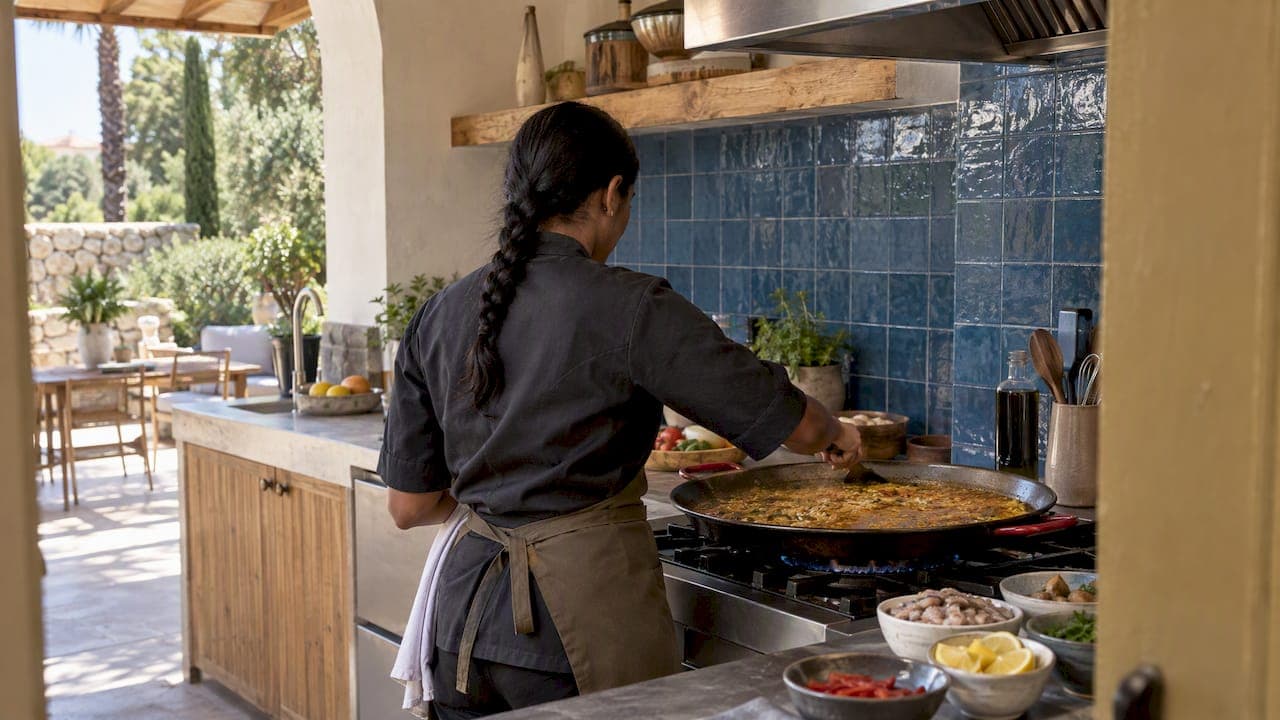
A paella class in Marbella can be a seat at a shared table in a cooking school, a group session at a country finca, or a private lesson in the kitchen and terrace of your own villa. The best choice depends on who is coming, how much time you have and how much you want to cook rather than watch. We run the private version: Chef Joseph Warner arrives with the ingredients, the pan and the method, and your group cooks a paella from the first chop to the last spoonful.
This guide explains what a class usually involves, what you will learn, the questions worth asking before you pay, and how our own paella experiences are priced.
TL;DR
- A good paella class is hands-on: you prepare the sofrito, build the rice and learn to read the pan, rather than only watching a demonstration.
- Private villa classes suit celebrations, families and mixed-age groups, because the menu, pace and dietary needs are set around you.
- Ask about group size, what is included, dietary and allergy handling, and cancellation terms before you book anything.
- Our paella classes start at €75 per person (Andalusian Paella Experience) or €85 for the Paella Cooking Experience, with Chef Joseph Warner, French-trained and with more than 13 years in professional kitchens.
- Book early for summer weekends and event dates; contact us through The Sensory Chef to shape the menu.
Table of Contents
- What a paella class in Marbella usually involves
- Where paella comes from, and why it matters in class
- What you will learn at the stove
- How to choose a paella class: six questions to ask
- Private villa class or group class?
- Our paella experiences and prices
- Pairing the class with tapas
- Planning your class: practical advice
- Our perspective
- Book a paella class with The Sensory Chef
- FAQ
- Sources
What a paella class in Marbella usually involves
Most classes follow the same arc, whatever the venue. You meet the chef, usually with a welcome drink and a few nibbles. You are shown the ingredients, then you cook, and at the end you sit down and eat what you have made. The cooking itself takes perhaps an hour; the rest is preparation, conversation and the meal.
Where classes differ is in the setting and the format:
- Group classes in a cooking school or on a finca. You share the session with other travellers. They are sociable and usually the most economical option, but the pace is set for the group and the menu is fixed.
- Private classes at a venue. Only your party attends, but you travel to the chef.
- Private classes in your villa. The chef comes to you. Your own kitchen, terrace and outdoor table become the classroom, which is especially welcome when children, grandparents or a large celebration group are involved.
If you are staying in a villa around Marbella, Nueva Andalucía, Benahavís or further along the coast, the last format removes the transfers and the timetable. Nobody needs to be the designated driver after the wine.
Where paella comes from, and why it matters in class
Paella is a dish of Valencian origin, a star of Alicante and Valencian gastronomy, and in many Spanish families it is the Sunday meal, cooked slowly and shared. Spanish press coverage of two leading chefs cooking together in Marbella shows how seriously the dish is taken even on the Costa del Sol: the discussion covered seafood, vegetable and mixed versions, each with its own logic.
That tradition shapes a good class. A chef who respects the dish will tell you that a paella is not a pile of rice with everything on top. It is a sequence: a base built with patience, rice added at the right moment, a broth that is tasted and corrected, and a rest at the end. In Andalucía the dish is made with local produce, so you will often find fish and shellfish from the coast, vegetables from nearby farms and good olive oil from the region.

What you will learn at the stove
A proper hands-on class should leave you able to repeat the dish at home. These are the skills we focus on.
The sofrito and the stock
The flavour of a paella is decided before the rice goes in. You will learn how to cut and cook the base slowly, how to build a stock with depth, and how to season it so that the rice absorbs something worth absorbing.
Choosing the rice
Spanish short-grain rice is the usual choice because it absorbs liquid without collapsing. We talk through why it matters, how much to use per person and why you should resist the urge to stir.
Heat, timing and the pan
This is the part that surprises most guests. The pan is wide and shallow so the rice cooks in a thin layer. You learn to manage the flame, to move the pan around the heat and to judge the moment when the liquid is nearly gone. We also explain how to aim for the lightly toasted crust at the base that Spanish tables prize.
Finishing and resting
A short rest off the heat lets the grains settle and the flavours knit together. Then comes the presentation: the pan goes to the table, and everyone helps themselves.
Choosing a version
Seafood, chicken and vegetable paellas, or a mixed one, each have different timings. We tailor the choice to your group and to any dietary requirements, so a vegetarian guest or someone with a shellfish allergy still gets a paella that is properly made rather than an afterthought.
How to choose a paella class: six questions to ask
With so many options in Marbella, a short checklist saves disappointment.
- Is it hands-on or a demonstration? Both are enjoyable, but they are different. If you want to cook, confirm that every guest handles the ingredients.
- How large is the group? Smaller groups mean more time with the chef. A private class gives you the chef's full attention.
- Where does it take place, and how long does it last? Ask about travel time to the venue and whether the stated duration includes the meal.
- What is included? Ingredients, aprons, drinks, wine, recipe notes and the meal itself should all be spelled out.
- How are allergies and dietary needs handled? Ask how cross-contamination is managed and whether the menu can be changed in advance. We cover this in more detail in our guide to accommodating dietary needs in private dining.
- What are the booking and cancellation terms? Check the deposit, the notice period and what happens if the weather or a flight changes your plans.
Price is a sensible question too, but compare like with like. A per-person group price and a per-service private price are different things, so work out the cost for your whole party before deciding.
Private villa class or group class?
| Group class | Private villa class | |
|---|---|---|
| Setting | Shared school or finca | Your own villa kitchen and terrace |
| Menu | Fixed | Tailored to your group |
| Pace | Set for strangers | Set for you |
| Dietary needs | Limited flexibility | Planned in advance |
| Best for | Solo travellers, couples, small budgets | Families, celebrations, hen and stag groups, anniversaries |
| Travel | Required | None |
A group class is a fine afternoon out. A private class turns the afternoon into the event itself: a birthday where everyone cooks together, an anniversary built around one shared pan, or a family week where the grandchildren learn to stir a sofrito.
Our paella experiences and prices
We offer several ways to cook paella, from a relaxed class to a full celebration feast. Prices below are as published on our site.
| Experience | Price |
|---|---|
| Andalusian Paella Experience | from €75 per person |
| Paella Cooking Experience | €85 |
| Paella Feast | €130 |
| Tapas Masterclass | €75 |
| Tapas Of Andalusia | from €65 per person |
| Villa Chef Experience | from €350 per service |
The Paella Cooking Experience is the one most guests start with. If you would like to understand the method in more depth, our page on learning Spanish paella with Chef Joseph explains the approach. For larger parties, the Marbella class costs and workshops page sets out how pricing changes between a group and a full villa booking, and the private tapas and paella class in a Marbella villa shows a longer half-day format that combines both.
If you want the paella to be one part of a larger meal, the Andalusian Paella Experience and our other menus can be built into a tapas starter, a main and a dessert.
Pairing the class with tapas
Many guests ask to begin with a few tapas while the rice cooks. It is a natural fit: small plates of local ingredients keep everyone occupied during the slow parts of the method, and the cooking becomes a social event rather than a lesson. Tapas also give us room to include different dietary needs without fuss. Our tapas class in Marbella covers this in detail.
Planning your class: practical advice
- Choose the time of day. Paella is traditionally a lunchtime dish. In summer, a late-morning start with the meal on the terrace avoids the hottest hours.
- Think about outdoor space. The pan is often cooked outdoors or near an open window. Tell us what your villa has, and we will plan around it.
- Tell us about the guests. Ages, allergies, vegetarians, and anyone who would rather watch than cook all change the plan.
- Book early for busy periods. Summer weekends, wedding weeks and holidays fill quickly along the coast.
- Decide what the day is for. A birthday, a hen weekend, a family reunion or a quiet couple's lunch each suggest a different menu and pace.
If you are also weighing up a full chef for part of your stay, our page on how a private chef service works on holiday explains how the booking process and menu planning work.
Our perspective

We believe a paella class should feel like being invited into someone's kitchen rather than attending a lesson. Our approach comes from French training, years of professional kitchen experience and a way of cooking that is built on taste, texture, aroma and presentation. As a deaf chef, I rely on sight, touch, smell and intuition in the kitchen, and I teach the same way: we look at the colour of the sofrito, feel how the rice behaves, and trust the aroma to tell us when the pan is ready. That makes the class visual and practical, and easy to follow whatever your cooking experience.
We also think the dish deserves respect. Paella is Spanish, and Valencian in origin. We cook it with fresh, local ingredients and with care for the technique, and we adapt it honestly for guests with allergies or dietary requirements rather than compromising the result.
— Joseph Warner
Book a paella class with The Sensory Chef
If you are staying in or around Marbella and want a class that is private, hands-on and shaped around your group, we would be glad to hear from you. Tell us the date, the number of guests, any allergies and the occasion, and we will suggest a menu and confirm the details. Start with our paella and private dining menus or reach us through The Sensory Chef to book.
FAQ
How long does a paella class take?
Most classes last a few hours, including preparation, cooking and the meal. The cooking is usually about an hour, with the rest given to the ingredients, the tasting and the table. Ask your chef whether the stated time includes eating, and allow extra if you want a long, relaxed lunch.
Can a paella class be arranged in my own villa?
Yes. Our classes can take place in your villa kitchen or on your terrace, so there is no travel and the group can set the pace. Tell us about your space and your guests when you book, and we will bring what is needed.
Can you cater for allergies and vegetarians?
Yes. We plan the menu around dietary requirements and allergies before the day, and we can make seafood, chicken, mixed or vegetable paellas. Tell us about every requirement when you book, so we can plan ingredients and preparation carefully.
What does a paella class cost with The Sensory Chef?
The Andalusian Paella Experience starts from €75 per person, and the Paella Cooking Experience is €85. A Paella Feast is €130, and a full Villa Chef Experience starts from €350 per service. See our pricing pages for the current details of each.
Which part of Spain is paella from?
Paella comes from the Valencia region and is closely tied to Valencian and Alicante gastronomy. It is also a Sunday family tradition across Spain, as Spanish media coverage of chefs cooking it in Marbella reflects.