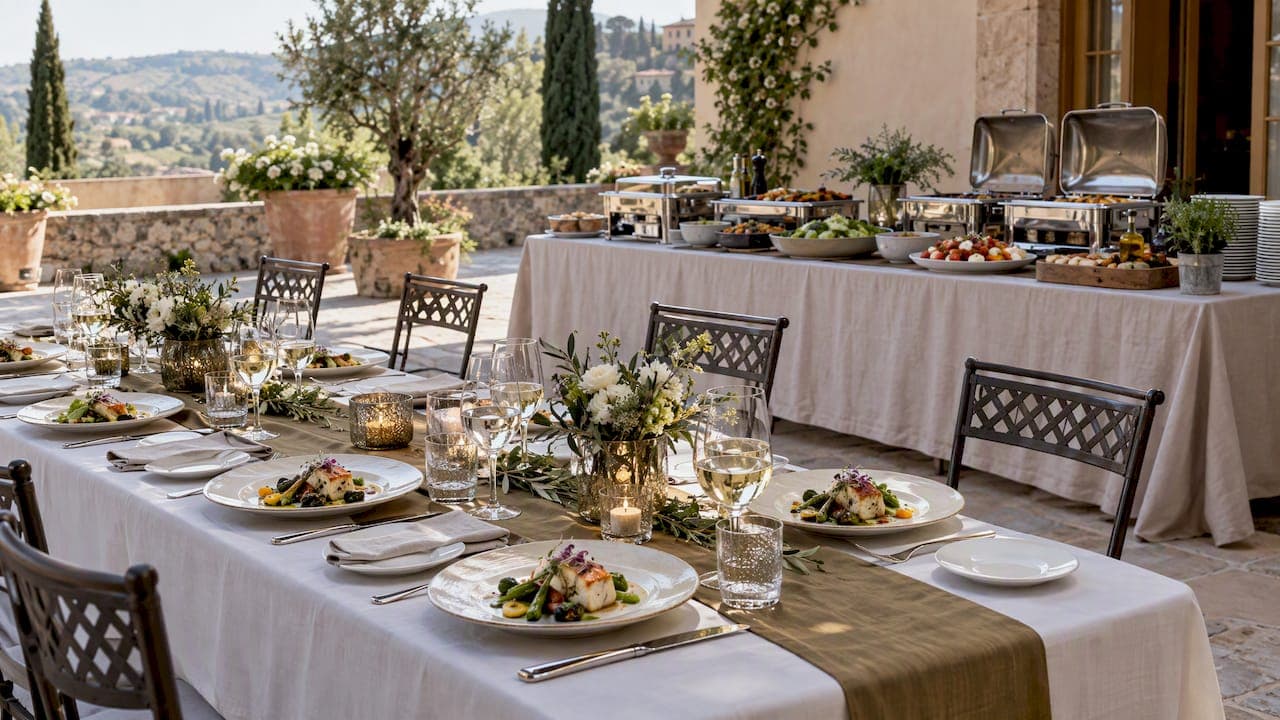
Choose a plated dinner when you want a polished, perfectly timed meal with speeches and toasts woven in. Choose a buffet when you want guests to mingle, pick their own dishes and eat at their own pace. Cost, guest count, venue and dietary needs decide the rest, and this guide takes each in turn, with figures for Spain and a few suggestions for villa celebrations in Granada, the Costa Tropical and the Costa del Sol.
TL;DR
- Plated gives you control of timing, presentation and portions, and suits formal weddings, anniversaries and tasting menus. It needs more serving staff, so it usually costs more.
- Buffet gives guests choice and a relaxed, sociable mood. Labour costs per guest are lower, but food waste and portion control can narrow the saving.
- In Spain, one guide puts the average wedding menu at about €105 per person, with plated service typically between €70 and €150.
- For smaller villa celebrations, a chef-led menu served in courses, or dishes brought to the table to share, often gives you the best of both styles.
- Dietary requirements and allergies are simpler to manage when the kitchen knows every guest's plate in advance.
Table of Contents
- What actually separates a buffet from a plated dinner
- Cost: is plated really more expensive?
- Timing and service flow
- Guest experience: choice versus ceremony
- Food quality, presentation and menu variety
- Dietary requirements and allergies
- The cheapest way to feed 100 guests
- A quick way to decide
- Our view as a chef
- Choosing for an Andalusian celebration
- Book a chef-led dinner for your villa
- FAQ
- Sources
What actually separates a buffet from a plated dinner
In a plated dinner, every guest is seated and each course is brought to the table, already portioned and presented by the kitchen. The chef decides how the dish looks and how much of it you eat. Guests choose their main course in advance, or eat a set menu.
In a buffet, dishes are laid out on one or more tables or stations and guests serve themselves. They compose their own plate, return for more and move around the room as they do so. Many buffets also include a chef carving or finishing a dish at a station.
A third option sits between the two. Family-style or sharing service brings large platters to each table. Guests stay seated, but pass the food around. In Andalucía this feels natural, because tapas, raciones and paella are shared dishes by tradition.
The choice shapes more than the meal. It decides how many staff you need, how the room is laid out, when the speeches happen and how long guests spend queuing or waiting.
Cost: is plated really more expensive?
Usually, yes. The main reason is labour. Plated service needs enough waiting staff to bring every course to every table at about the same moment. One Spain-focused catering guide says that plated service needs a higher staff-to-guest ratio so that the kitchen and floor stay synchronised, and that this drives the cost.
Sources do not agree on exact ratios, which is a good reason to ask any caterer for their own. One Spanish guide to table service suggests one server per 16 to 20 guests for plated banquets, one per 10 to 12 for service à l'anglaise and one per 30 to 40 for buffets. Another puts plated service at one server per eight to ten guests and buffets at about one per 25. The gap between the two sources is large, and it shows that the ratio depends heavily on the venue, the number of courses and the standard you expect.

One Spanish wedding-cost guide says a buffet can reduce costs by 15 to 25 per cent, depending on region, season and how customised the menu is. Treat that as a rough guide rather than a promise.
Where a buffet saving can shrink
Buffets are not automatically cheap. The same Spanish table-service guide notes that although labour costs per guest are lower at a buffet, food costs often rise. Dishes must stay full and look generous until the last guest has eaten, and portions are harder to control. A plated menu is cooked and portioned for the exact number of guests.
So compare like with like. Ask for a quote on the same dishes, the same ingredients and the same number of guests in both formats, then look at the whole price, including staff, equipment and any extra tables or stations.
What does it cost with us?
For villa dinners and private events, our menus are priced per person, and the price covers a chef-led experience rather than a generic catering line. As published on our site, our menus start at:
| Menu | Price |
|---|---|
| Tapas of Andalusia | from €65 per person |
| Andalusian Paella Experience | from €75 per person |
| The Sensory Journey | from €85 per person |
| French Heritage Menu | from €95 per person |
| Celebration Experience | from €110 per person |
You can see every menu on our private chef menus page. For a wider view of how catering is priced locally, our guide to catering prices on the Costa del Sol explains what moves the total.
Timing and service flow
This is where plated service earns its reputation. Because every guest is served together, you control the evening. One event-planning guide notes that plated service gives superior control over timing, with structured pauses for speeches or presentations. A buffet runs on a more fluid, guest-led timeline.
In practice:
- Plated: the first course arrives, plates are cleared, toasts happen between courses, and the cake or dessert appears at a moment you choose. Guests are rarely left waiting for long if the kitchen is well organised.
- Buffet: tables are released one at a time or in waves. With 100 guests, the first table may be eating while the last is still in the queue. Staff replenish dishes, clear plates and monitor food temperatures throughout.
If you have a first dance, a surprise or a long programme of speeches, plated service gives you a reliable framework. If your celebration is a long, loose afternoon by the pool, a buffet or sharing style will not feel rushed.
Heat is a practical matter in Andalucía. A buffet in July on a terrace needs a plan for keeping cold dishes cold and hot dishes hot, with shade, chilled serving and food replenished in smaller batches. A plated service moves food from the kitchen to the guest quickly, which helps with temperature control. Ask any caterer how they handle the summer sun before you commit.
Guest experience: choice versus ceremony
A plated dinner feels like a restaurant at its best. Guests are looked after, stay seated and do not have to think. One Spain-focused guide describes it as the gold standard for formal weddings, creating a structured atmosphere with uninterrupted moments for speeches and toasts.
A buffet feels looser. The same guide notes that buffet service encourages mingling, freedom of choice and a casual atmosphere, and lets guests control their own portions.
Think about your guests rather than the format in the abstract:
- Older relatives may find queuing and carrying a full plate tiring, so plated or table-served dishes are kinder.
- Young children often do better with a buffet, where they can take small amounts of what they like.
- Mixed international groups, common at villa weddings in Spain, appreciate a spread of dishes that lets everyone find something familiar.
- A guest list that barely knows each other benefits from the movement of a buffet, or from sharing platters that start conversations at the table.
Food quality, presentation and menu variety
Plated dining lets a chef cook each dish to a precise moment and present it exactly as intended: sauce placed, garnish added, temperature right. The trade-off is a narrower menu. Most couples offer two or three choices at each course, chosen beforehand.
A buffet offers more variety on one table, which suits large, diverse guest lists. The kitchen must hold dishes, so recipes that travel well, such as slow-cooked meats, rice dishes, roasted vegetables and cold salads, work best. Delicate fish, soufflés and anything that must be eaten the second it is ready belong on a plate.
The Mediterranean kitchen has natural answers to both. A paella is cooked for the table and served at its best the moment it comes off the heat. A tapas selection suits a standing reception or sharing tables. A French-inspired menu with a seasonal starter, a main and a dessert is made for plated service. We explore the last of these in our South of France dinner menu for villas.

Dietary requirements and allergies
This is often the deciding factor, and it deserves proper planning rather than a note on a form.
In a plated dinner, the kitchen knows who is eating what. Each guest's plate can be prepared separately, labelled and delivered to the right seat. A coeliac guest or a guest with a nut allergy gets a dish prepared away from the risk, and you know exactly what was served.
In a buffet, guests choose for themselves, so the host must make sure that every dish is clearly labelled and that serving spoons are not shared between dishes. Cross-contact is a real risk with shared utensils and neighbouring dishes. A guest with a severe allergy should speak to the chef or caterer directly before eating.
Whichever format you choose:
- Collect dietary requirements and allergies with your invitations, and ask guests to be specific. "No shellfish" is a different request from "allergic to shellfish".
- Pass the full list to your chef or caterer weeks before the event, not days.
- Ask how dishes will be labelled and how the kitchen avoids cross-contact.
- Brief the serving team so that every member can answer a guest's question about ingredients.
We design menus around allergies and dietary needs from the start, and we explain how in our page on accommodating dietary needs at private dinners. If you have a coeliac guest in the party, our gluten-free cooking workshops in Granada show how we approach it.
The cheapest way to feed 100 guests
There is no single cheapest option, but these choices tend to lower the bill without making the meal feel mean:
- Simplify the number of courses. A generous starter to share and a plated main can feel complete without a third course.
- Choose seasonal, local ingredients. What is in season in Andalucía is usually better and kinder to the budget than imported luxury produce.
- Use a sharing or buffet format for the main course only, with a plated dessert and a toast.
- Hold the wedding outside peak season or on a weekday. One Spanish guide says prices are influenced by region, season and level of customisation.
- Cut the choice, not the quality. A single, well-cooked set menu is cheaper than three options at each course, and it reduces waste.
Be wary of a very low per-head price. Check what it includes: staff, tableware, glassware, service time, clearing up and drinks are often charged separately.
A quick way to decide
| If your celebration is... | Consider |
|---|---|
| A formal wedding with speeches and a fixed timetable | Plated |
| A relaxed afternoon party by the pool | Buffet or sharing platters |
| An anniversary or romantic dinner for two to ten | Plated tasting menu |
| A large, mixed group with many tastes and ages | Buffet or a plated main with sharing starters |
| A guest list with several allergies | Plated, with individually prepared dishes |
| A tight budget and a long guest list | A simplified menu in either format, quoted like for like |
Our view as a chef
We cook for small and mid-sized gatherings in villas across Granada, the Costa Tropical and the Costa del Sol, and we have a clear view of what works in those settings.
For most villa celebrations, the best dinner is one where the chef stays close to the plate. Cooking in your villa kitchen, with fresh, local ingredients, we can time each course to your evening, adjust a dish for a guest with an allergy and present the food with care. That is the heart of how we cook: flavour, texture, aroma and presentation, guided by intuition. As a deaf chef, I have built a sensory approach to cooking that relies on exactly these things.
We would also say that formal does not have to mean stiff. A paella brought to the table, or a tapas selection passed around, can sit very happily beside a plated French-style main course. Tell us the mood you want and we will shape the menu and the service around it.
Whatever format you choose, ask your chef how many guests they can cook for with the quality you expect, and speak to them early about allergies. Good planning matters more than the label on the service style.
Joseph Warner
Choosing for an Andalusian celebration
A few local points can tip the decision.
Villa kitchens are often domestic. A plated dinner for 40 requires a kitchen that can plate quickly. Ask your chef to see the space, or send photos, before the day. Some villas have a large outdoor kitchen, which suits sharing dishes and live cooking.
Summer heat matters. Evening dinners on a terrace are wonderful, but food safety and comfort need planning. A plated service, or a buffet with small, frequent replenishment, makes this easier to manage.
Local food culture favours sharing. Tapas, jamón, fresh seafood and paella are natural sharing foods, so a sharing or semi-buffet format can feel more authentic than a copy of a formal banquet from elsewhere. Our Andalusian villa dining menus show how this works in practice.
Smaller gatherings gain most from a chef. Hen parties, birthdays, family reunions and anniversaries are often well suited to a private chef cooking course by course. See our guide to a hen party private chef in Andalucía for an example of how a villa dinner can run.
Book a chef-led dinner for your villa
If you are planning a wedding celebration, rehearsal dinner, anniversary or family gathering in Granada, Almuñécar, Nerja, Marbella or elsewhere in Andalucía, we can design a menu around your guests, your villa and your timetable. Our private chef experiences start at €250 for a private dining experience, and the Villa Chef Experience starts from €350 per service. Tell us your date, your guest numbers, your venue and any dietary requirements, and we will propose a menu and a service style that suit your evening.
Browse the full range of menus on our services page, or read about our approach to private chefs for special occasions before you get in touch.
FAQ
Is plated more expensive than buffet?
Usually, because plated service needs more serving staff to bring each course to every table together. Guides to Spanish weddings suggest a buffet can reduce costs by 15 to 25 per cent, but food costs can rise at a buffet because of waste and harder portion control. Always compare quotes for the same menu and the same number of guests.
Which is better for a wedding with speeches and toasts?
Plated service is usually the better fit. Because everyone is served at the same time, there are natural pauses between courses for speeches. At a buffet, guests eat at different moments, so you need to plan when everyone is seated and ready to listen.
How do I manage allergies at a buffet?
Label every dish clearly, use separate serving utensils for each and ask guests with severe allergies to speak to the chef before they eat. Collect allergy details with your invitations and give the list to your caterer well in advance. A plated menu makes this easier because each plate is prepared and delivered individually.
Can I combine buffet and plated service?
Yes, and it is common. Many hosts serve a sharing starter or tapas at a reception, a plated main course at the table and a dessert buffet or plated dessert to finish. The hybrid keeps the formality where it counts and the relaxed mood elsewhere.
How many staff will I need for 100 guests?
It depends on the style, the venue and the number of courses. Published guides vary, from one server per eight to ten guests for plated service to one per 16 to 20 in another, with buffets needing fewer. Ask your caterer for their own ratio and what it includes.
Sources
- Precio del menú por cubierto en bodas 2025
- Your Guide to Catering for Wedding Feasts in Spain
- Tipos de servicio de mesa y su coste
- Choosing the Right Food Service Style for Your Event