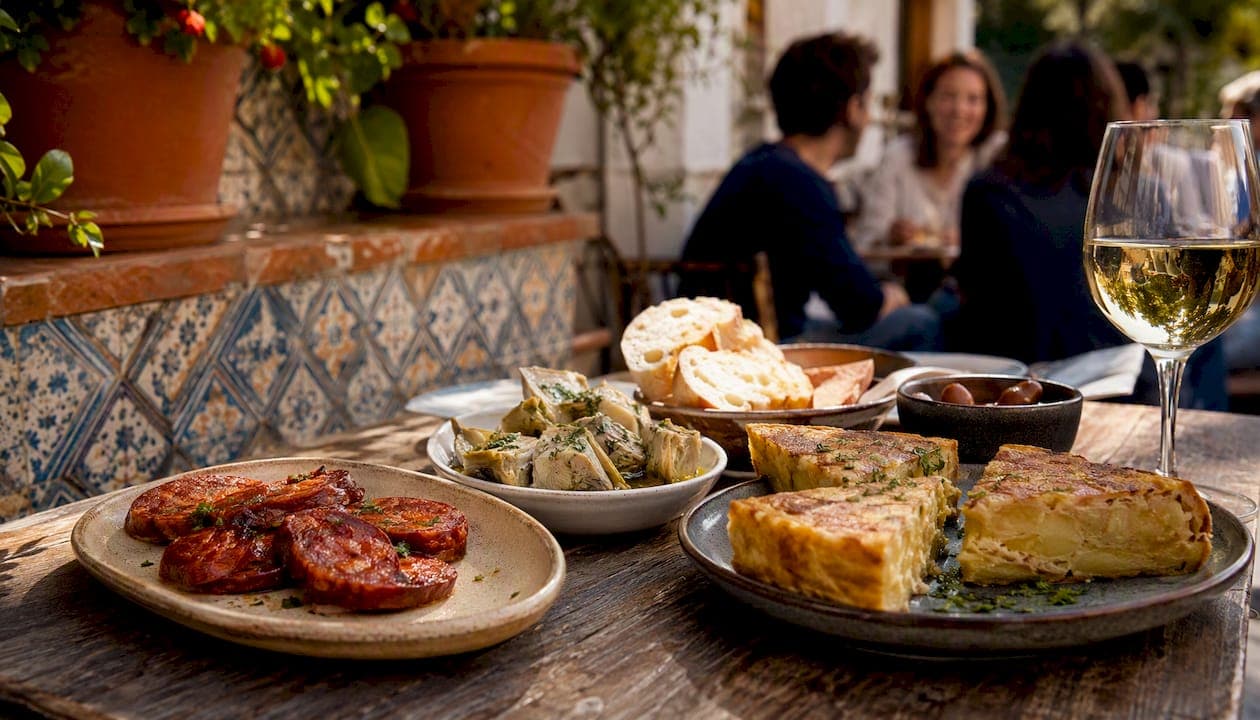
Granada's food culture is unique for two reasons that reinforce each other: a layered culinary inheritance stretching back to the Nasrid era, and a free-tapa, communal bar economy that keeps everyday eating exceptional rather than exclusive. Nowhere else in Spain do Moorish, Sephardic, Romani and Maghrebi flavours sit so visibly on a bar counter, served free with a simple beer or vermouth.
The evidence is on every tapeo street. Most Granada bars still bring a small plate with every drink, a habit that has largely disappeared elsewhere in Andalucía. Jamón de Trevélez, a PGI-protected ham cured high in the Alpujarras, ages for months in mountain air barely 40 kilometres from prawns landed that morning on the Costa Tropical. That kind of proximity between mountain and sea produce is rare, and it shows up on the plate constantly.
If you're planning where to start, keep it simple:
- Taste first: pionono de Santa Fe, jamón de Trevélez, remojón granadino
- Go to: Calle Navas, the Albaicín, and Realejo
- Time it right: spring for remojón, summer for salmorejo, autumn or winter for the best mountain ham
Key takeaways
Granada's food culture is unique because layered Nasrid-to-modern history and a competitive free-tapa bar economy combine with a pantry spanning mountain, plain and coast.
| Point | Details |
|---|---|
| Two core causes | Historical layering (Nasrid, Sephardic, Romani) and the free-tapa communal bar economy drive Granada's distinctiveness. |
| Try these dishes first | Pionono de Santa Fe, jamón de Trevélez, remojón granadino and salmorejo cover the city's flavour range in four plates. |
| Go to the right streets | Calle Navas, the Albaicín and Realejo still practise genuine free tapas away from tourist-heavy strips. |
| Time your visit | Remojón suits spring, salmorejo suits summer, and cured mountain ham suits autumn and winter. |
| Sample it in one sitting | The Sensory Chef's private tasting menus combine mountain, plain and coastal ingredients from across the region in a single villa dinner. |
Table of Contents
- Why is Granada food culture unique: the historical layers behind it
- How geography built Granada's unusually diverse pantry
- What is the free-tapa culture in Granada, and how does it work?
- The signature dishes that define Granada's food identity
- Where to taste it: neighbourhoods, markets and long-standing addresses
- The economics behind Granada's free-tapa system
- Bring Granada's contrasts to your own table
- Sources
- FAQ
Why is Granada food culture unique: the historical layers behind it
Granada's flavours are archaeology you can eat. Every wave of settlement left something on the table, and unlike in many cities where old influences fade into vague "Mediterranean" cooking, Granada kept the ingredients distinct enough to trace.
The Nasrid dynasty ruled Granada until 1492, and its kitchens left the deepest mark. Almonds, citrus, saffron, cumin and coriander entered Andalusian cooking under Moorish rule, along with pickling techniques and a fondness for pairing sweet with savoury. A scholarly review of medieval Andalusian recipe books traces sustained Arab culinary influence through ingredient introductions that never left the regional repertoire. You can taste that inheritance directly in berenjenas con miel, fried aubergine drizzled with cane syrup, a dish that would look at home in a North African market.
Sephardic Jewish cooking added its own thread, particularly around preserved fish, legumes and slow-cooked stews built to survive both economy and religious dietary rules. Romani (gitano) communities in the Sacromonte caves contributed the offal-and-egg dish that still carries the neighbourhood's name. Later, 19th and 20th century arrivals, including Italian pastry techniques and Galician seafood habits, folded into the mix without displacing what came before.
The clearest proof of that continuity sits in a pastry box. Pionono de Santa Fe, a small rolled sponge cake soaked in syrup and topped with toasted cream, was created in the town of Santa Fe in 1897 by Casa Ysla, reportedly to honor Pope Pius IX. It has barely changed in over a century, and it is still made by the same family business today.
A short timeline makes the pattern easier to follow:
- Nasrid era (until 1492): almonds, citrus, saffron, sweet-savoury pairings enter the local kitchen
- 1492 onward: Sephardic and Morisco cooking blends into what remains, even as populations were expelled or forced to convert
- 1897: Casa Ysla creates the pionono in Santa Fe, a rare case of a single named invention becoming a regional icon
- Late 1920s to early 1940s: the free-tapa habit takes its modern, systematic shape in Granada's bars, as historical accounts of the city's food trace
Few Spanish cities can point to convent kitchens, Nasrid palace cooking and a single 19th-century pastry shop all still shaping what's on the menu tonight.
How geography built Granada's unusually diverse pantry
Granada sits within an hour's drive of snow-capped peaks, a fertile plain and a warm coastline, and that geography does more work than most food guides admit. The Sierra Nevada and the Alpujarras behind it, the Vega plain around the city itself, and the Costa Tropical each supply ingredients you would not expect to find sharing a menu.
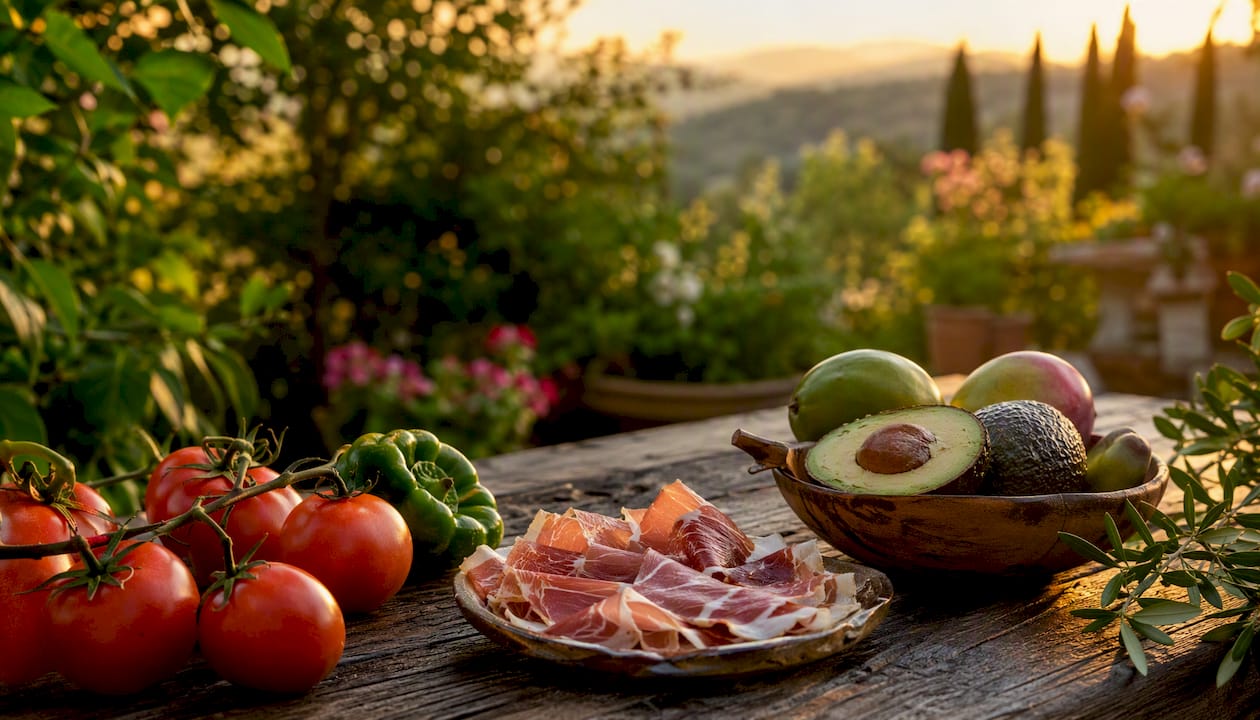
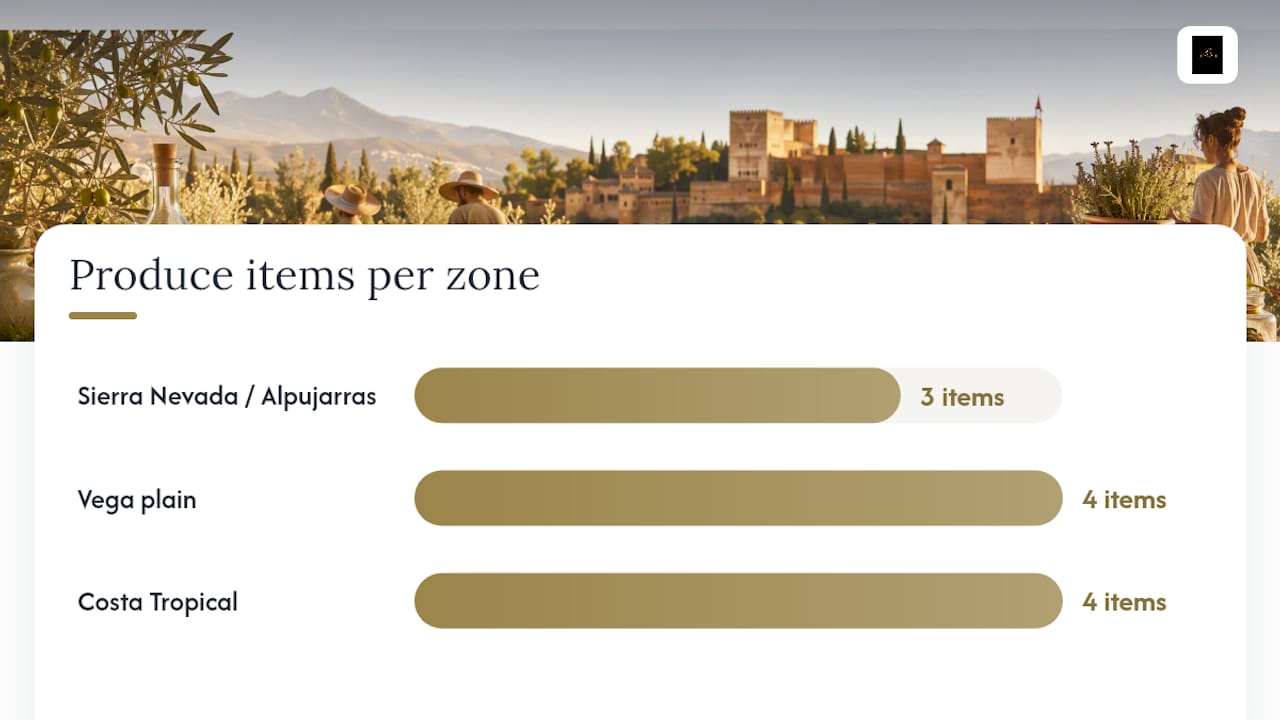
The Sierra Nevada and Alpujarras produce mountain lamb, wild mushrooms and, most famously, PGI-certified jamón de Trevélez, cured at altitude where the dry, cold air slows spoilage without needing excessive salt. The Vega plain, the fertile lowland around Granada city, grows the tomatoes, peppers and pulses that anchor dishes like espinacas con garbanzos. The Costa Tropical, barely 70 kilometres south, lands Motril prawns and grows mango and avocado in a microclimate warm enough for genuinely tropical fruit on Spanish soil. Granada's dramatic topographical range means high-altitude cured meats and subtropical produce coexist within a short drive of each other, something few other Spanish provinces can claim.
| Zone | Typical produce | Why it matters to Granada dishes |
|---|---|---|
| Sierra Nevada / Alpujarras | Cured ham, mountain lamb, wild mushrooms | Supplies the cured mountain protein found in plato alpujarreño and salmorejo toppings |
| Vega plain | Tomatoes, peppers, pulses, market vegetables | Forms the base of espinacas con garbanzos and summer gazpacho-style dishes |
| Costa Tropical | Motril prawns, mango, avocado, cod for remojón | Brings coastal freshness and unusual fruit pairings into inland cooking |
That short distance between zones explains combinations that would look odd on paper: cured mountain ham scattered over a cold summer soup, or a Moorish-influenced sweet served a few tables away from a plate of fresh coastal prawns. Seasonality follows the same logic. Remojón, the citrus and salted cod salad, tastes best in spring when oranges are still sharp. Salmorejo needs the height of summer, when Vega tomatoes concentrate their sugars under full sun. Cured ham and heavier mountain stews suit autumn and winter, when the Alpujarras turn cold enough to justify the richness.
What is the free-tapa culture in Granada, and how does it work?
Order a beer or a glass of wine at a genuine neighbourhood bar in Granada, and a small plate arrives with it. You don't choose the tapa. The bar does, and it usually rotates through a short menu as the evening goes on: cold, cured plates at lunchtime, fried fish or croquetas in the early evening, and heartier stews or mountain dishes later at night. The time of day strongly determines the tapa style, so a second round an hour later can bring something completely different from the first.
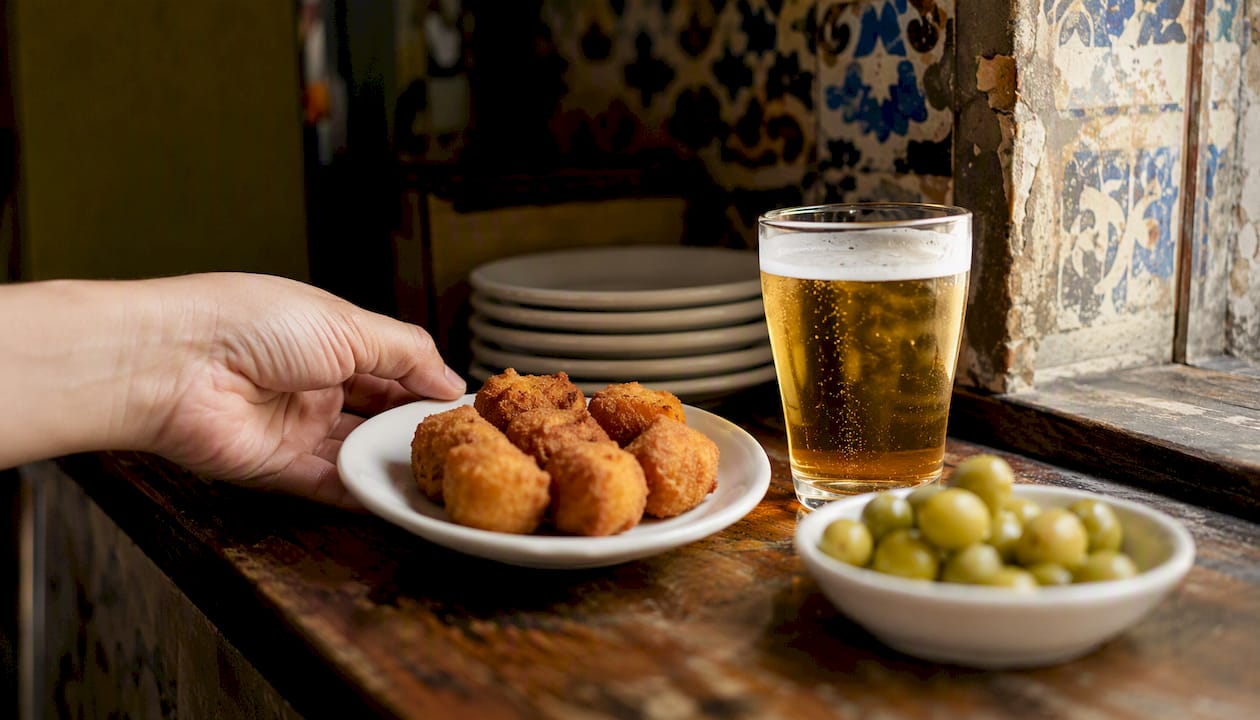
The custom survives here largely because of who drinks in Granada. A large, price-conscious student population from the University of Granada, combined with an unusually high density of bars packed into small neighbourhoods, means customers can walk to the next bar in under a minute if the tapa or the pour disappoints. That mobility turns generosity into a competitive necessity rather than simple hospitality.
A few practical rules help you get the most from it:
- Don't order the tapa. It comes automatically with your drink.
- Order a second drink if you want another tapa. Tapas generally don't repeat within the same bar visit.
- Expect lighter, colder plates at lunch and heavier ones after 9pm.
- Look for bars where locals outnumber tourists. That's usually where the tradition holds up best.
Calle Navas remains the most reliable street for a genuine tapeo crawl, packed with bars competing hard for the same regulars. The lower Albaicín, Realejo and the area around Plaza de la Trinidad all still practise the custom properly, and Bodegas Castañeda, a long-running bodega near the cathedral, is a solid example of a bar that has kept quality high despite decades of foot traffic.
Pro Tip: If a bar's tapa menu is printed in three languages and pinned outside the door, that's usually your signal to walk two streets further before ordering.
Fancy trying the technique behind these small plates yourself before booking a private chef? A hands-on tapas class covers the same dishes bars serve free, minus the guesswork of finding the right bar.
The signature dishes that define Granada's food identity
Nine dishes turn up again and again in serious food guides to Granada, and each one tells you something different about the layered history and geography behind them.
Pionono de Santa Fe is a small rolled sponge soaked in syrup, invented in 1897 and still made by the original Casa Ysla business in Santa Fe. It's arguably the only dish on this list that is genuinely, exclusively Granada's own invention rather than a regional variation.
Jamón de Trevélez (PGI) comes from the Alpujarras village of the same name, aged under standard PGI rules, with premium cuts aged longer. Fanciers of ham argue about the difference between this and other Spanish curing regions for hours.
Remojón granadino mixes orange segments, salted cod, olives and onion, a direct echo of the sweet-citrus, preserved-fish pairing Moorish cooking left behind. It tastes sharpest in spring.
Espinacas con garbanzos pairs spinach and chickpeas with cumin, a spice combination traced straight back to Andalusian Arab cooking, and it remains one of the most common tapas across the city year-round.
Tortilla del Sacromonte is the offal-and-vegetable omelette named after the Roma cave neighbourhood, a dish that rarely travels far outside Granada province.
Salmorejo (Granada style) is the thick, chilled tomato and bread soup, best from June to September when Vega tomatoes peak, often finished here with a scattering of Trevélez ham rather than the egg garnish more common in Córdoba.
Plato alpujarreño stacks cured meats, fried egg, potatoes and black pudding, a hearty mountain plate built for cold Alpujarras winters.
Migas, fried breadcrumbs with garlic, peppers and often chorizo, has rural origins as a way to use stale bread and remains a firm autumn and winter favourite.
Berenjenas con miel, fried aubergine with cane syrup, is the clearest surviving example of the Moorish sweet-savoury habit, and it's found on nearly every traditional tapas menu in the city.
| Dish | Defining ingredient | Best time to try |
|---|---|---|
| Pionono de Santa Fe | Syrup-soaked sponge, toasted cream | Year-round |
| Jamón de Trevélez (PGI) | High-altitude cured ham | Autumn to winter |
| Remojón granadino | Orange, salted cod, olives | Spring |
| Salmorejo (Granada style) | Chilled tomato, Trevélez ham | Summer |
| Berenjenas con miel | Fried aubergine, cane syrup | Year-round |
A tasting menu that combines even three or four of these dishes in one sitting is far quicker than working through a week of separate bar visits, and it's exactly the kind of contrast a private dining menu built around Mediterranean produce is designed to showcase.
Where to taste it: neighbourhoods, markets and long-standing addresses
Some streets in Granada exist almost entirely for tapeo, and knowing which ones still hold to tradition saves an evening from disappointment.
Calle Navas is the obvious starting point, dense with bars and reliably competitive on tapa quality. Plaza Nueva and the streets climbing into the Albaicín offer a mix of tourist-facing and genuinely local spots, so it pays to walk a block off the main square. Campo del Príncipe, tucked below the Alhambra in Realejo, has a quieter, more residential feel and some of the most consistent tapas in the city.
For addresses worth seeking out by name:
- Casa Ysla, in Santa Fe, the original pionono bakery since 1897
- Pastelería López-Mezquita, in the city centre, a long-established pastry shop known for its own version of pionono and other Granada sweets
- Bodegas Castañeda, a classic bodega-style bar near the cathedral, known for cured meats and cheese boards alongside its free tapas
- Casa Juanillo, a Sacromonte spot known for its own take on the tortilla del Sacromonte and cave-neighbourhood atmosphere
Granada's food markets matter here too, because they show the pantry in motion rather than on a plate. Fish stalls carrying Motril prawns sit close to cured-meat counters stacking Trevélez ham, and Vega vegetables fill the stands between them. Mornings are the best time to visit, well before lunchtime crowds, and many stallholders are happy to explain where a particular cut or catch came from if you ask.
The economics behind Granada's free-tapa system
The free-tapa custom isn't sentimental generosity. It survives because the economics reward it. Local analysts describe the free-tapa system as a competitive quality floor: with bars clustered tightly together, a customer unhappy with a thin or stale tapa simply walks to the next door along.
Bars clustered this closely can't afford a bad tapa. Customers vote with their feet within thirty seconds, and a large student population makes them even quicker to move on.
That combination, a dense concentration of bars and a price-conscious student crowd tied to the University of Granada, functions as an enforcement mechanism few cities replicate. Local food researchers frame Granada's distinctiveness as resting on the quality of everyday, communal food rather than an exclusive fine-dining scene, and that everyday consistency is precisely what visitors notice first. The effect isn't universal, though. In the busiest tourist-dominated strips near the cathedral and Plaza Nueva, tapa quality can slip, since footfall no longer depends on repeat local custom the way it does on Calle Navas or in Realejo. Modern chefs across the province are increasingly reworking these same everyday dishes with more attention to sourcing, proof that the pantry, not novelty, remains the anchor of Granada's food identity.
A chef's note on Granada's ingredients
Joseph Warner trained in traditional French gastronomy and has spent more than 13 years working across professional kitchens, including as a head chef, before founding The Sensory Chef to bring bespoke dining into villas across Granada and Andalusia. What strikes him most about Granada's pantry is the contrast: bright citrus and cured mountain ham on one plate, coastal freshness from Motril prawns on the next, all within a single evening's drive.
A tasting menu built around that contrast, mountain ham against a citrus salad, a coastal prawn course beside a Moorish-inspired sweet finish, gives villa guests something a single bar or restaurant rarely manages: the full geographic range of the region on one table. Joseph applies the same sensory-led approach he developed working across French technique and Mediterranean cooking, focusing on how flavour, texture, aroma and presentation combine rather than following a single national tradition too rigidly.
Bring Granada's contrasts to your own table
Working through Calle Navas, the Albaicín and a handful of markets takes days to cover properly, and even then you'll miss the mountain-to-coast pairing that makes Granada's food genuinely distinctive. A private tasting menu solves that in one evening, bringing Trevélez ham, Motril prawns, remojón-style citrus and a Moorish-inspired dessert to your own villa table without a single bar crawl.

The Sensory Chef designs villa tasting menus around exactly this contrast, drawing on more than 13 years of French-trained culinary experience to combine mountain, plain and coastal ingredients into a single sitting. Birthdays, romantic dinners and family gatherings across Granada, Almuñécar, the Costa Tropical and wider Andalucía can all be built around a menu featuring these local specialities, alongside seasonal paella or French-influenced courses if your group prefers. Browse sample menus on the Private Chef Granada Menus page, or go straight to the Private Dining Experience page to check availability and request a bespoke tasting for your dates.
Sources
- Granada Food Guide: What to Eat and Where to Find It | ExploreGranada
- Gastronomy | Trek Sierra Nevada
- Arabic culinary legacy in al-Andalus (academic article) | Revista ARA
- Granada: From the Albaicín to the sea — Guide Michelin
- Food history of Granada | TableJourney
FAQ
What is Granada known for food-wise?
Granada is best known for its free-tapa custom, where most neighbourhood bars serve a small dish with every drink, alongside signature dishes like pionono de Santa Fe, jamón de Trevélez and remojón granadino.
What makes Granada, Spain, so special?
Granada combines a rare geographic mix of Sierra Nevada mountains, the Vega plain and the Costa Tropical coast within a short drive, plus a layered Nasrid, Sephardic and Romani culinary history that still shapes its dishes today.
What's an interesting fact about Granada's food?
Pionono de Santa Fe, one of Granada's best-known sweets, was invented by Casa Ysla in the town of Santa Fe in 1897 and is still made by the same family business over a century later.
What is Granada famously known for?
Beyond the Alhambra, Granada is famous for being one of the few Spanish cities where the free-tapa tradition survives at scale, driven by a large student population and densely packed neighbourhood bars.
Can a private chef recreate Granada's local flavours for a villa dinner?
Yes. The Sensory Chef builds tasting menus around Granada's regional produce, from Trevélez ham to Motril prawns, letting villa guests experience the province's mountain-to-coast contrasts in one sitting rather than across several days of bar visits.