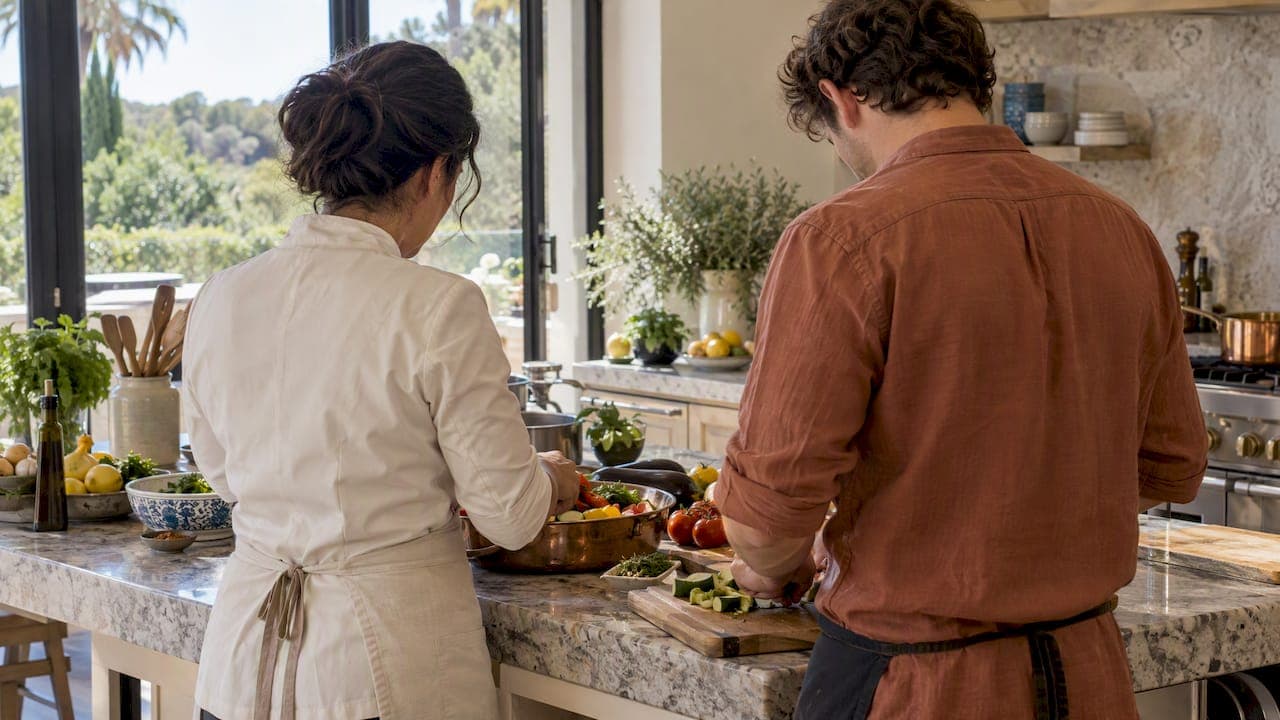
A Mediterranean cooking workshop in Marbella is a hands-on session led by a professional chef, usually built around a few dishes you cook together and then sit down to eat. You can join a shared class, or have the chef come to your villa and teach just your own party. We offer the second kind: a private workshop, led by French-trained chef Joseph Warner, in the kitchen you are already staying in.
This guide explains what a workshop involves, what you might cook, how a private session compares with a group class, what to check before you book, and how dietary needs and allergies are handled.
TL;DR
- A good workshop is hands-on, ends with a shared meal and is built around a short menu, such as tapas, paella or a Mediterranean three-course lunch.
- A private villa session suits couples, families, birthdays, anniversaries and small groups who want their own table and pace, with no travelling.
- Our published Mediterranean Cooking Class is €85, our Paella Cooking Experience is €85 and our Tapas Masterclass is €75. Our Marbella pricing guide covers group and villa formats.
- Tell the chef about allergies and dietary needs at the time of booking, not on the day.
- Check group size, kitchen space, timing and the menu before you confirm.
Table of Contents
- What a Mediterranean cooking workshop involves
- What you might cook
- Private villa workshop or group class?
- What it costs
- Planning a workshop for a private event
- Dietary requirements and allergies
- Our perspective
- Book a private workshop with The Sensory Chef
- Frequently asked questions
- Sources
What a Mediterranean cooking workshop involves
The word "workshop" (taller, in Spanish) covers a lot of ground in Marbella. Some are demonstrations where you watch and taste. Others put a knife and an apron in your hands from the first minute. The best ones sit between the two: the chef shows a technique, you do it yourself, and the dish arrives at the table as your own work.
A typical flow looks like this:
- A welcome and a short briefing. The chef explains the menu, the ingredients and what each dish teaches.
- Preparation. Vegetables are cut, sauces started, seafood or meat prepared. This is where technique is learned: how to hold a knife, how to season in layers, how to judge heat.
- Cooking. Sofrito, paella rice, a slow braise, a quick sear. Timing matters more than speed.
- Plating. Presentation is part of the lesson, and it is one we care about.
- The meal. You sit down and eat what you made, usually with local wine or a soft drink.
Mediterranean cooking rewards this format because it is built on a small number of good ingredients treated with care: olive oil, ripe tomatoes, garlic, fresh fish, citrus, herbs. There is little that can be hidden, so the lesson is about judgement rather than gadgets.
What you might cook
In Marbella, the menu is shaped by the coast and the market. Fish, shellfish, seasonal vegetables and good rice are the backbone. Common choices for a workshop include:
- Paella. The dish most visitors ask for. A workshop lets you learn the rice-to-stock ratio, how to build the sofrito and how to leave the rice alone as it cooks. Chef Dani García, who cooks in Marbella, has described paella as a typical Sunday dish around which many families gather, which is exactly the spirit of a family workshop.
- Tapas. Croquettes, tortilla, marinated anchovies, prawns with garlic, small plates built for sharing. Tapas are ideal for mixed-ability groups because each person can take one dish.
- Chilled soups. Salmorejo and gazpacho teach texture: how emulsifying olive oil changes a soup.
- Mediterranean main courses. Fish baked with herbs and lemon, slow-cooked meats, or vegetable-led dishes with pulses and grains.
- A dessert. Often a light, fruit-led finish, or a French-style pastry if the group wants one.
Because Joseph trained in traditional French gastronomy before working across Spanish, Mediterranean and Italian kitchens, a workshop can lean towards the rustic coastal table or towards something more refined. A French sauce or pastry technique sits comfortably beside Andalusian ingredients, and many guests enjoy that blend.
Private villa workshop or group class?
Both have a place. The honest question is what your group needs from the day.
| Shared group class | Private workshop in your villa | |
|---|---|---|
| Who is there | Other visitors you may not know | Only your own party |
| Menu | Fixed by the school | Agreed with you in advance |
| Pace | Set for a mixed group | Set around your group |
| Location | A teaching kitchen | The kitchen where you are staying |
| Dietary needs | Possible if declared early | Planned into the menu from the start |
| Travel | You go to the class | The chef comes to you |
| Best for | Solo travellers, budget-conscious couples | Families, celebrations, anniversaries, friends sharing a villa |
A group class is a good, sociable choice if you are travelling alone or want a low-cost activity. A private workshop earns its place when the occasion matters: a birthday, a family reunion, an anniversary, a hen or stag weekend, or simply a group who would rather not leave the villa after a long day by the pool.
It also removes the practical friction. There is no taxi to organise, no one is rushed, and children can join in with age-appropriate tasks. You can read more about how a private tapas class works in a Marbella villa, including timing and what the chef brings.
What it costs
Prices depend on the format, the number of guests and whether you want a cooking lesson or a full dinner served to you. Our published prices at the time of writing are:
| Experience | Price |
|---|---|
| Tapas Masterclass | €75 |
| Paella Cooking Experience | €85 |
| Mediterranean Cooking Class | €85 |
| French Pastry Workshop | €85 |
| Market to Table Experience | €150 |
| Tapas Of Andalusia (menu, per person) | from €65 |
| Andalusian Paella Experience (menu, per person) | from €75 |
| Villa Chef Experiance (per service) | from €350 |
The full details of each are on our services page and menus page. If you want a breakdown of how the numbers change between a group format and a villa visit, our Marbella class costs guide walks through it, and the blog version in Spanish and English terms covers the same ground.
When you compare quotes from any provider, compare like with like: the number of hours, the number of dishes, whether drinks and ingredients are included, and whether the price is per person or per session.

Planning a workshop for a private event
If you are organising a workshop for a party, a family gathering or a corporate group, a short checklist saves a lot of stress.
Group size and the kitchen
Be honest about numbers. A villa kitchen with one island and one hob works well for a small party, whereas a larger group needs more workstations or a split into teams. Tell the chef how many will cook and how many will simply watch and eat. If you are looking at team activities, our ideas for chef-led cooking team-building in Spain show how groups can be organised.
Timing
Decide whether you want a late-morning session ending in lunch, or an afternoon one that flows into dinner. In summer, an evening class on a terrace is cooler and more atmospheric. Allow time at the start for shopping or setup and at the end for eating without hurrying; the meal is part of the workshop, not an afterthought.
The menu
Agree the dishes beforehand. Think about what the group will actually enjoy eating, and who will need something different. If you want a mix of cooking and being served, a hybrid works well: guests cook a starter and the chef finishes the main course.
Equipment and shopping
Ask what the chef brings and what the villa must provide. Basic items such as pans, a sharp knife, a chopping board and enough hob space are worth checking at the outset. Ask also whether ingredients are sourced by the chef from local markets or delivered, and who handles the shopping. Our Market to Table Experience is designed for those who want to start at the market.
Children and mixed ages
Children often love rolling, stirring and assembling. Mention ages when you book so tasks and timings can be planned around them.
Drinks and extras
Clarify who provides wine, soft drinks and coffee. If it is a celebration, say so: a cake, a special dessert or a toast can be built into the day.
Confirming the details
Get the menu, the price, the start time, the number of guests and the dietary information in writing. A confirmed plan avoids last-minute surprises.
Dietary requirements and allergies
A workshop should be safe and enjoyable for everyone around the table. That begins with information. Tell the chef at the time of booking about every allergy, intolerance and preference: coeliac disease, nuts, shellfish, dairy, vegetarian or vegan diets, pregnancy, and alcohol-free requirements.
Allergies are more than a swap of ingredients. Spanish health-authority guidance on allergens makes clear that allergen information must be available for unpackaged food and food served to groups, and that it must be accurate and clearly communicated. In practice, that means the person cooking needs to know exactly what goes into every dish, and needs to keep preparation separate to avoid cross-contamination.
What that looks like in our kitchen:
- We ask about restrictions before we plan the menu, not after.
- We design the menu around the restriction, so that nobody is eating a lesser version of the meal.
- We discuss sauces, stocks, garnishes and shared utensils, which are where hidden allergens often sit.
Seafood-heavy Mediterranean menus can be adapted. Paella can be made with vegetables, chicken or fish, and many tapas are naturally gluten-free. If a guest is coeliac, see our examples of gluten-free menus for private events. If the allergy is severe, say so plainly, and ask your doctor or allergist for guidance on whether a shared kitchen is appropriate for that person.
Our perspective
We have cooked for more than 13 years, in professional kitchens and now in private villas, and we have come to believe that the best workshop is not the one with the longest list of dishes. It is the one where everyone leaves feeling they can cook one thing properly.
I am a deaf chef, and that has shaped how I teach. I rely on sight, touch, smell and taste, and I teach guests to do the same: to watch how onions change colour, to feel when dough is ready, to smell the moment garlic turns from raw to golden, to taste and adjust before the plate leaves the pass. Cooking is a sensory conversation, and a workshop is the easiest place to start it. There is no need to talk over a noisy hob; we work with demonstration, gesture and attention, which many guests find unexpectedly calming.

Our French training shows in the way we handle technique. Seasoning, heat control and timing are the same whether we are making a sauce in Lyon or a paella in Marbella. The Mediterranean table supplies the ingredients and the generosity. Put the two together and you get food that is simple to look at and satisfying to eat.
We would rather cook a small menu well, tailored to your group, than overwhelm you with a long one.
— Joseph Warner
Book a private workshop with The Sensory Chef
If you would like a Mediterranean workshop in your Marbella villa, our Mediterranean Cooking Class is €85. You can also choose the Paella Cooking Experience at €85 or the Tapas Masterclass at €75 from our services page. Tell us your dates, the number of guests, the occasion and any dietary needs, and we will shape the menu around you. If you would rather be cooked for after the lesson, we can also arrange a private dining experience for the evening.
Frequently asked questions
How long does a Mediterranean cooking workshop in Marbella last?
Most workshops run for a few hours, including the meal at the end. The exact length depends on the menu and the group. A tapas session is usually shorter than a paella or a three-course menu. We agree the timing with you when you book, so it fits around your day.
Can I book a private workshop for just my family or friends?
Yes. A private workshop in your villa means the session is for your party alone, with a menu agreed in advance. This suits families, birthdays, anniversaries and groups sharing a villa. Tell us the number of guests and ages so we can plan the tasks.
Do I need cooking experience?
No. The workshop is designed for beginners as much as confident home cooks. We show each step, then let you do it, and we adjust the level to the group. Keen cooks can ask to focus on a particular technique.
Can you cater for allergies and special diets?
Yes, provided we know in advance. Vegetarian, gluten-free, dairy-free and other needs can be built into the menu, and we discuss ingredients and preparation with you beforehand. For severe allergies, tell us at the first enquiry so we can plan carefully.
Do you only work in Marbella?
No. We work across Granada, the Costa Tropical, Málaga and the Costa del Sol. If you are staying in Nerja, Almuñécar or elsewhere in Andalusia, get in touch and we will confirm availability. You can also see our Mediterranean cooking classes in Granada.
Sources
- Chefs Nobu Matsuhisa and Dani García cook together in Marbella (COPE, 2024)
- Allergen information in labelling and for collective catering (Castilla-La Mancha health authority)