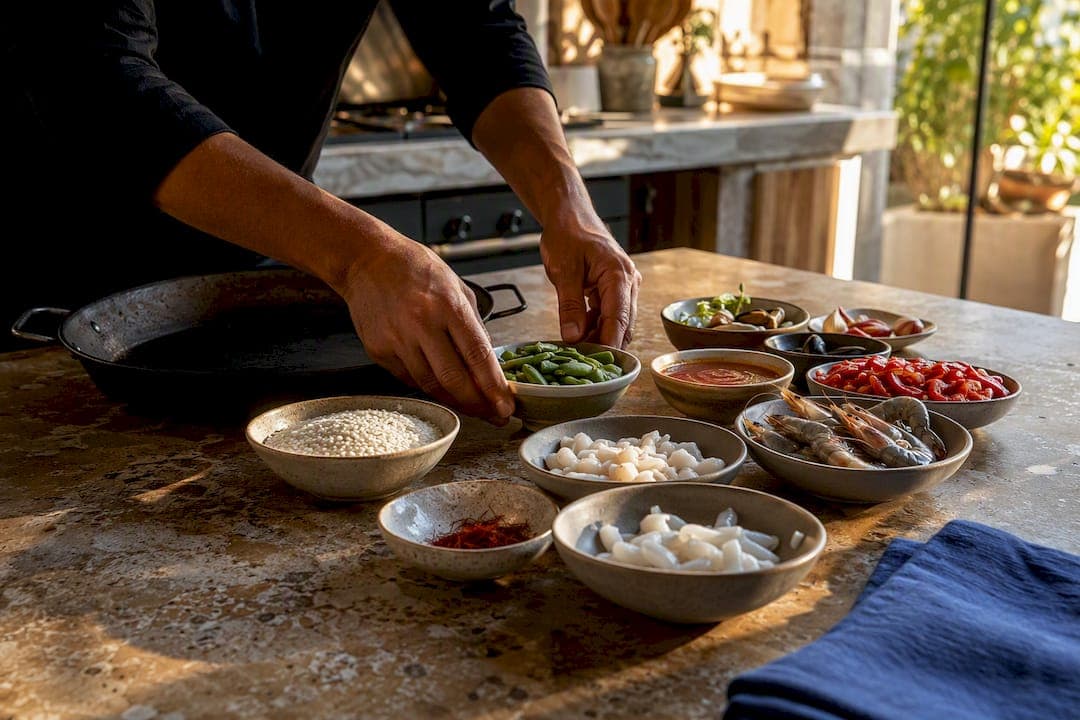
A clase de cocina española en casa is a hands-on cooking session, live online or in your own kitchen, where a chef guides you through an authentic Spanish recipe from start to finish. For most home cooks, the best route is a live cook-along or a private chef visit, not a pre-recorded course. Book with a chef like The Sensory Chef and you leave with a finished dish, a technique you can repeat, and a shopping list for next time.
TL;DR:
- Live online cook-alongs and in-home classes provide real-time feedback vital for mastering techniques like socarrat and sofrito.
- Sourcing authentic ingredients such as bomba rice, saffron, and pimentón de la Vera at least a week in advance is crucial for successful dish execution.
- Private in-home classes offer personalized attention and menu adjustments that group or pre-recorded formats cannot match.
- The most effective way to learn Spanish cuisine involves early preparation and live correction, not just choosing a specific dish.
- A typical online class requires a stable internet connection, a basic camera setup, and pre-arranged kitchen space for optimal participation.
Table of Contents
- What is a Spanish cooking class at home, and which format suits you?
- What Spanish dishes and techniques will you actually learn?
- How do you prepare your kitchen a week before class?
- How does booking, pricing and class inclusions usually work?
- Why Joseph Warner's approach makes the difference in a home class
- What do you need for a smooth online cooking class?
- Personal attention versus a social evening: which class format wins?
- What actually happens during the class?
- Where to compare formats and inclusions before booking
- What the conventional advice gets wrong about home Spanish classes
- Book a hands-on Spanish class with The Sensory Chef
- Sources
- FAQ
What is a Spanish cooking class at home, and which format suits you?
Three formats dominate the market, and each solves a different problem. A live online cook-along puts you and a chef on video together, usually in a small group, cooking the same dish in real time. Sessions typically run 60 to 120 minutes, with the chef talking through each step and answering questions as they come up.
A private in-home class is the more personal option. The chef arrives at your villa or apartment, brings professional guidance suited to your kitchen and your group, and adjusts pace depending on whether you want a full hands-on lesson or more of a guided demonstration with tasting. This format works particularly well for family gatherings, birthdays, or a small group wanting one-on-one attention without competing for the chef's focus.
Pre-recorded courses sit at the convenient end of the spectrum. You watch at your own pace, pause when needed, and rewatch a tricky step, but there's no live feedback if your sofrito looks wrong or your rice absorbs liquid too fast. That trade-off matters more with a dish like paella, where timing is everything.
Match the format to what you're actually trying to achieve:
- Learning a specific technique (rice absorption, socarrat, sofrito): live online or in-home, where a chef can correct you mid-step.
- Hosting a celebration or gift experience: private in-home class, which doubles as entertainment for guests.
- Casual, flexible learning with no fixed schedule: pre-recorded course, accepting the lack of real-time correction.
- Learning with people in different locations (family scattered abroad, for example): live online, since everyone joins from their own kitchen.
Interactive classes consistently highlight real-time Q&A and personalised feedback as the main educational advantage over recorded formats, according to Traveling Spoon's Spanish cooking class listings. If genuine skill transfer is the goal rather than passive entertainment, that live correction is what makes the difference.
What Spanish dishes and techniques will you actually learn?
Paella sits at the centre of almost every Spanish cooking class, and for good reason: it teaches more technique per dish than nearly anything else in the repertoire. A typical paella-focused workshop allocates around one hour of active cooking time within a 90 to 120 minute session, leaving room for explanation, tasting, and questions.
Beyond the seafood or Valencian paella itself, classes commonly cover:
- Sofrito building: the slow-cooked onion, garlic, tomato and pepper base that underpins most Spanish rice and stew dishes.
- Rice absorption ratios: how much stock a given rice variety needs, and why bomba rice behaves differently from standard long-grain.
- Socarrat technique: achieving the caramelised, slightly crisp rice layer at the base of the pan without burning it.
- Tapas fundamentals: patatas bravas, gambas al ajillo, and tortilla española, each teaching knife work, timing, and plating.
- Gazpacho preparation: blending ratios and seasoning balance for a cold soup that has almost no room to hide a mistake.
Tortilla española is deceptively simple and often the dish that trips people up most, purely because the potato-to-egg ratio and pan temperature take practice to judge by feel rather than by the clock. A well-run class will let you fail at this once, safely, with someone watching.
Dietary requirements rarely derail a class. Most chefs substitute proteins, adjust for gluten-free rice dishes (naturally straightforward, since paella is rice-based), or rework a tapas menu around allergies without losing the character of the dish. If you're planning a class around a specific dietary need, mention it at booking rather than on the day.
For a deeper look at the paella-specific curriculum, The Sensory Chef's paella cooking experience breaks down what a session typically covers.
How do you prepare your kitchen a week before class?
Preparation starts earlier than most people expect, particularly for paella. Speciality Spanish ingredients aren't always sitting on a supermarket shelf, and sourcing them under time pressure is the single most common reason a class starts on the back foot.
- One week ahead: check your grocery list against what's actually available locally. Insiders in the field recommend verifying your list at least a week in advance, since bomba rice, pimentón de la Vera and good saffron often require a specialist shop or an online order rather than a regular supermarket run.
- Five to six days ahead: order anything you can't find locally. Online Spanish grocers ship internationally, but delivery windows vary, so build in slack.
- Two to three days ahead: confirm your equipment. A paellera or wide, flat pan (roughly 22 to 30cm depending on group size) is the one piece of kit worth getting right, alongside a decent chef's knife, a solid chopping board, and a hand blender for gazpacho or sauces.
- The day before: do your mise en place. Chop, measure, and portion what you reasonably can, so the live session is about technique, not scrambling to find the garlic.
- On the day, for online classes: set up your camera at a stove top-height angle so the chef can actually see your pan, not just the top of your head. Clear counter space either side of the hob for your prepped ingredients.
- On the day, for in-home classes: clear a workspace big enough for two people to move comfortably, and let the chef know in advance if your kitchen has any quirks (induction hob, limited counter space) worth planning around.
Pro Tip: If bomba rice or pimentón de la Vera genuinely aren't available in time, don't panic and swap blindly. A short-grain risotto rice absorbs liquid differently, and sweet paprika lacks the smoky depth of pimentón de la Vera, so ask your chef for a substitution that preserves the dish's texture and flavour rather than guessing.
How does booking, pricing and class inclusions usually work?
Booking a class typically follows a simple pattern: choose a date and format, pay a deposit or the full fee, then receive a confirmation with the details you need to prepare. For an online class, that confirmation usually includes the menu, a recipe PDF, a shopping list, and a link to join the session. For an in-home visit, it's the arrival time and any final questions about your kitchen setup.
Pricing tends to follow one of two shapes: a flat fee per household for online sessions, or a per-person rate that scales with group size, with private in-home visits carrying a premium over group online formats to reflect the chef's travel and one-to-one attention. Rather than quoting a single figure across a fragmented market, it's more useful to know what that fee typically buys.
Standard inclusions across most reputable classes:
- Live instruction from a chef, not a pre-recorded voiceover.
- A recipe PDF to keep and cook from again.
- Flexibility for dietary requirements, agreed at booking.
- A shopping list sent ahead of the session.
Optional extras worth asking about include ingredient kits, useful if sourcing speciality items feels daunting, though chef-led shopping lists paired with local sourcing advice generally give you more room to adapt for allergies than a fixed kit does, according to Fresh Cooking Spain's class listings. A filmed recording of your session is another common add-on for those who want to rewatch later.
Cancellation and rescheduling policies vary by provider, so check the terms before paying a deposit, particularly around how much notice is needed to move a date.
Why Joseph Warner's approach makes the difference in a home class
Joseph Warner founded The Sensory Chef after more than 13 years in professional kitchens, trained in traditional French gastronomy and experienced across Spanish, Mediterranean and international cuisine. That French technical grounding shows up in how a Spanish class gets taught: precision with sofrito reduction, correct pan heat management for socarrat, and plating that treats a tapas board as seriously as a tasting menu course.
Warner's teaching method is built around a sensory approach, developed as a deaf chef, focusing on flavour, texture, aroma and presentation rather than relying purely on verbal instruction. For a hands-on class, that translates into clear visual demonstration of exactly what a properly reduced sofrito should look like, or what socarrat sounds like as it forms in the pan.

Dietary requirements and allergies are handled as standard practice, not as an inconvenience, with menus adjusted ahead of the session so nobody at the table is served an afterthought. Classes run as private online sessions or as in-home visits across Granada, Almuñécar, the Costa Tropical, Málaga and wider Andalucía, giving you the choice between learning from your own kitchen anywhere or hosting Warner directly in your villa.
To book a class or ask about a specific menu, The Sensory Chef's booking page lists current availability for both online and in-home sessions.
What do you need for a smooth online cooking class?
The technical bar for a good online class is lower than most people assume. A stable internet connection with reasonable upload speed matters more than raw download speed, since you're the one broadcasting video for most of the session. A basic laptop or tablet camera is usually sufficient, though positioning it to actually show your hob and chopping board, rather than your face, makes far more difference than camera quality.
Most classes run through mainstream video platforms rather than bespoke software, so there's rarely anything to install beyond what you likely already use for work calls. Check the confirmation email for the specific link and platform ahead of time rather than on the day.
A few practical habits smooth things out considerably. Test your camera angle and audio a few minutes before the session starts, not during it. Keep your phone or a second device nearby in case your main screen freezes, so you can rejoin quickly without missing a critical step like adding stock to rice. If your kitchen has patchy Wi-Fi near the hob, a mobile hotspot as backup avoids losing the connection at the worst possible moment, typically just as the socarrat starts forming.
Good chefs build some slack into the session for exactly this kind of hiccup, but arriving prepared means more of your class time goes towards actual cooking rather than troubleshooting.
Personal attention versus a social evening: which class format wins?
The honest answer is that it depends on what you're optimising for, and the two formats pull in genuinely different directions. A private in-home class gives you undivided attention. The chef adapts pace to your skill level in real time, corrects your knife grip before it becomes a habit, and tailors the menu around what your household actually likes to eat. That level of personalisation is difficult to replicate in a group setting, however well run.
A live online cook-along, particularly in a small group, trades some of that individual attention for a more social, energetic atmosphere. Cooking the same dish alongside strangers or friends in separate kitchens, with a chef narrating for everyone at once, creates a shared experience that a one-to-one session simply doesn't offer. It also tends to be the more affordable entry point, since the chef's time is split across a group rather than dedicated to one household.
If you're buying the experience as a gift, a group online class often works better for a mixed group of skill levels, since the pace stays moderate and nobody feels singled out. If you're hosting a milestone celebration, an anniversary, a birthday, a small family gathering, a private in-home class turns the cooking itself into part of the event, with the added benefit of a finished meal served at the end rather than a stack of washing up. Chef-led private sessions in particular allow for more personalised sensory guidance than a group format can offer, alongside meal service once the cooking wraps up, a natural extension a group class doesn't include.
What actually happens during the class?
Expect a working pace, not a lecture. A well-structured class opens with the chef talking through the full recipe and the technique goals for the session, typically two to three minutes, before moving straight into prep. From there, the rhythm mirrors a real kitchen: chop, build the base, add liquid, wait, taste, adjust.

Participation level is higher than most first-timers expect. This isn't a cooking show where you watch someone else do the work. You're holding the knife, standing at the hob, and making the calls on seasoning, with the chef there to correct course before a mistake becomes permanent. Questions are welcomed throughout rather than saved for the end, and a good chef will pause the group, or you, if there's a private session, at natural break points rather than rushing to a fixed script.
Guidance tends to be specific rather than general. Instead of "cook until done", expect direction like "you're looking for the rice to stop moving when you shake the pan gently" or "the sofrito should smell sweet, not sharp, before you add the rice." That specificity is what separates a class worth paying for from a recipe you could have followed off a page.
By the end, you should have a finished dish in front of you, a recipe PDF to repeat it, and a clear sense of the two or three things that made the biggest difference to the result.
Where to compare formats and inclusions before booking
A few listings are worth a look if you want to compare formats before committing. Viaexperiencias' paella course shows a typical live paella structure and recipe PDF inclusion. Byfood's Valencian paella class illustrates advance ingredient sourcing. Wild Foodz's guide to sensory culinary experiences explains why chef-led, multisensory formats tend to teach technique more effectively than passive ones.
What the conventional advice gets wrong about home Spanish classes
Most guides to booking a Spanish cooking class focus almost entirely on the recipe: which paella, which tapas, which menu. That's the wrong starting point. The research on what actually makes these sessions work points somewhere else entirely: preparation timing and live correction matter more than the dish you pick.
A class built around bomba rice and saffron falls apart if you're sourcing those ingredients the morning of the session rather than a week out. That's not a minor logistical footnote, it's the difference between a chef teaching technique and a chef watching you improvise with the wrong rice. The one-week checklist deserves far more attention than it typically gets in how these classes are marketed.
The other overlooked point is that live feedback is doing more work than people credit. A pre-recorded course is fine for entertainment, but if you actually want to reproduce socarrat or judge sofrito by smell, you need someone watching your pan in real time, not a video you can pause. If you're choosing between formats purely on price, that's the trade-off worth weighing first.
Prioritise the ingredient timeline and live guidance over the specific dish on the menu. Everything else follows from getting those two things right.
— Joseph Warner
Book a hands-on Spanish class with The Sensory Chef
The Sensory Chef is the alternative to a generic cook-along for anyone who wants a class actually built around their kitchen, their group, and their dietary needs rather than a fixed script for a crowd of strangers. Menus come from a French-trained chef with more than 13 years of experience, and every session, online or in-home, is shaped around flavour, texture, aroma and presentation rather than simply following a recipe card.
Whether you want a live online paella session from your own kitchen or a private in-home class ahead of a family gathering, birthday or anniversary in Granada, Almuñécar, the Costa Tropical, Málaga or across Andalucía, the services overview lists current class options including the Paella Feast and Tapas Selection. Dietary requirements and allergies are accommodated as standard, not as an add-on request. To check dates and reserve a session, visit The Sensory Chef's booking page and get your class on the calendar.
Sources
- Online | Cocina Paella - Viaexperiencias
- Clase de cocina virtual de paella valenciana – Byfood
- Fresh Cooking Spain — Cooking Classes Online
FAQ
How much does a Spanish cooking class typically cost?
Pricing varies by format and provider, generally running as a flat household fee for online sessions or a per-person rate for group classes, with in-home private visits priced higher to reflect travel and dedicated attention. For The Sensory Chef's current class pricing, including the Paella Feast and Tapas Selection, check the services page directly.
What are considered the best Spanish dishes to learn first?
Paella, tortilla española, gazpacho, patatas bravas and gambas al ajillo cover the widest range of foundational techniques, from rice absorption to sofrito building, making them the most commonly taught dishes in home classes.
What basic skills should you learn before your first class?
Basic knife handling, understanding how to build a sofrito, and knowing how to judge doneness by look and smell rather than a timer will help you get far more out of a live class than arriving with no kitchen experience at all.
What makes Spanish cuisine distinct from other Mediterranean cooking?
Spanish cooking relies heavily on rice dishes like paella, cured meats, olive oil as a base fat, and small-plate tapas culture, with regional variation (Valencian rice dishes versus Andalusian fried fish, for example) playing a much larger role than in more standardised national cuisines.
Can a Spanish cooking class accommodate dietary requirements?
Yes, most chefs, including The Sensory Chef, adjust menus for allergies, gluten-free needs and other dietary requirements when informed at the time of booking rather than on the day.